
Invest in ETFs for electromobility and autonomous driving


ETFs are the ideal instrument for investing in individual sectors with high potential. The areas of electromobility, autonomous driving and the automotive industry in general are particularly interesting for this!
Fortunately, there are already numerous ETFs for electromobility and the like, but do they deliver what they promise? Which product offers the best return? And what do the future prospects of the sector actually look like? Here are the answers!
In brief
- The automotive industry is currently undergoing a dramatic shift towards sustainable energy sources and intelligent vehicles
- High development potential and importance for our society make these areas extremely attractive as an investment
- Investing in electromobility through ETFs is a popular and simple way to profit from these megatrends
An industry in upheaval
Hardly any other industry is currently experiencing such dramatic upheavals as the automotive sector! Fossil fuels can no longer be considered as a source of energy in the long term due to their harmful effects on the environment. However, the alternatives are barely out of their infancy.
This is accompanied by a high potential for innovation and exciting competition between the various manufacturers. At the same time, human drivers are increasingly being supported by assistance systems. Here, too, it is clear that a partially or fully autonomous vehicle will not be long in coming.
However, mobility is not just limited to private cars! A lot is also happening in terms of public transport and alternative means of transport: electrically powered buses, e-bikes, car sharing, e-planes, vehicles in tubes, e-scooters … Getting around is an exciting environment with numerous innovations.
It can be difficult for investors to find the right shares in the most promising companies. As various trends and technologies are developed in parallel, celebrate successes or disappear into oblivion again, sector ETFs for electromobility or locomotion are a very good option. Here, the manual search is replaced by a rule-based selection.
The automotive industry has always been of interest to investors due to its enormous size: well-known brands have been active for decades and can be found in many portfolios. At the same time, comparatively young companies such as Tesla have proven that the sector is by no means outdated! This makes ETFs for electromobility or automotive ETFs in general particularly interesting.
ETFs for electromobility offer numerous advantages
Exchange-traded funds (ETFs) have enjoyed a veritable triumph on the financial markets in recent years. They contain dozens or even thousands of shares or other investment assets. Unlike regular funds, however, the selection is not made by highly paid managers!
Instead, ETFs replicate an existing index, such as the DAX or the S&P 500. Additional specifications (e.g. sustainability, minimum size, minimum age, etc.) allow for further specialisation. They therefore follow strict rules that determine which companies are part of the ‘basket of goods’.
A market as young as the one represented in the ETFs for electromobility is particularly difficult for investors to manoeuvre. Young companies such as Tesla show that established structures can be broken up in a short space of time. Today’s top dogs could be ready for the museum tomorrow. However, the rule-based approach simplifies our investment.
If we buy shares in an electromobility ETF, for example, we acquire shares in all the companies it contains – albeit usually only in fractions. As an investment is spread across so many securities, our risk is reduced: if the price of an individual security collapses, only a very small proportion of our capital is affected.
In addition to this very good diversification, exchange-traded funds also offer other advantages! For example, they stand out due to their large number and often high degree of specialisation. This enables investors to pursue a broad spectrum of strategies and personal goals! ETFs for electromobility are just as available as ETFs for renewable energy, ETFs for artificial intelligence, ETFs for commodities or even ETFs that track cryptocurrencies!
However, one of the most important arguments is probably the low price. As there is no active management, ETFs have very low costs – usually well below one per cent per year. This makes this form of investment particularly interesting for long-term investments, as our return is hardly affected by the costs!

Outlook: How the automotive industry is developing
ETFs for electromobility represent what is probably the biggest trend in transport: the switch to electric drives. After all, alongside energy generation and industry, CO₂ production by combustion engines is one of the biggest emitters of greenhouse gases.
The effects of global warming can be felt everywhere and the international community agrees that CO₂ emissions must be reduced.
The political direction is therefore clear: the switch to electric vehicles is already being accelerated in many countries by bans on combustion engines and other measures that will soon come into force.
This change is fuelling the automotive industry in several ways! Technical innovation is enabling companies to challenge the status quo. At the same time, demand for modern vehicles is increasing as more and more people attach importance to sustainability. The companies that are typically included in an electromobility ETF benefit from this increased sales.
The widespread availability and continuous further development are also accompanied by falling prices for electric vehicles. In future, middle and lower-middle class households will no longer turn to combustion engines, which will also benefit investors in electric mobility ETFs.
ETFs for electromobility also often reflect a second megatrend: autonomous driving. The assistance systems already in use today are merely a foretaste of the possibilities offered by autopilots and autonomous vehicles.
However, the current hype is premature in several respects. It will be several years before our private cars actually drive completely autonomously from our front door to our desired destination.
However, motorway driving without human intervention, automatic parking and other areas of mobility are already possible or will become reality in the next few years.
Step by step, further areas will be automated until we can expect to see the first fully autonomous vehicles between 2030 and 2040. Anyone who invests in this development via an electromobility ETF can therefore look forward to several years of good returns.

Risks with ETFs for electromobility
Anyone who decides in favour of an ETF in electromobility is investing in a comparatively safe investment. Nevertheless, the success of the industry and individual companies in particular is by no means guaranteed!
This means that the current boom in the field of electric mobility may well come to a premature end. Important questions remain unanswered, first and foremost: Where do the materials for the batteries come from?
The required cobalt and lithium are found in large quantities in hard-to-reach areas in South America or politically unstable areas of Africa. Such mineral resources have already caused conflicts in the past, for example when the USA attacked Afghanistan, one of the richest countries in the world (more than one trillion euros in important metals and minerals are believed to be involved). Not an ideal environment for sustainable business and a growing industry!
The area of autonomous driving, which is strongly represented in numerous ETFs for electromobility, also offers no guaranteed return. Alternative approaches such as interdependent driving could make the concept obsolete. This is because vehicles do not move independently in road traffic, but as part of the general flow of traffic.
The networking of vehicles, as is already practised by lorries on motorways today, is considered by many experts to be a potentially better solution. In this scenario, road users act as a network and accelerate, brake and react to each other immediately by continuously exchanging data.
However, such technologies would hardly allow any competing products and would mean a strong concentration, possibly even with state control. Here too, the profits of companies included in ETFs for electromobility could suffer significantly.
There are also repeated setbacks due to practical tests, some of which lead to serious accidents and even fatalities. Regular scandals, such as the Tesla autopilot, which switches off at the last moment before an accident so as not to be responsible for the damage, reduce acceptance. This unnecessarily slows down the development of autonomous driving.
Electric mobility ETFs: the most popular products
ETFs for electromobility are currently among the most popular investments among investors! Their prospect of high returns and comparatively low risk are particularly attractive. A large number of different products are available.
While some ETFs only offer electric mobility, others are more focused on autonomous driving and other innovation. Even ETFs for automobiles in general are available, offering an even broader range.
1. Lyxor MSCI Future Mobility ESG
| Lyxor MSCI Future Mobility ESG |
| ISIN LU2023679090 |
| Size: 354 million euros |
| Total costs (TER): 0.45% p.a. |
| Start: 10 March 2020 |
| Distribution: Accumulating |
If you want to invest in electromobility via an ETF without compromising on sustainability and social responsibility, the Lyxor MSCI Future Mobility ESG could be the right choice.
This predominantly includes companies from industrialised nations such as the USA (36%), China and Japan (12% each). However, emerging markets are also included to a lesser extent.
The aim of the fund is to reflect the future of the automotive industry. However, classic car brands only make up a small proportion of the total of 59 shares! Instead, the focus is on manufacturers of microchips, semiconductors and rechargeable batteries.
The comparatively small size of this ETF for electromobility is explained by the ESG criteria that are followed here: Companies must fulfil sustainability, social and corporate governance requirements in order to be included.
With annual costs of 0.45%, the ETF is within the usual range. However, its size of just 330 million euros can pose a risk, as funds that are too small are regularly closed by the operators. The very high volatility could also deter some investors.

2. Xtrackers Future Mobility UCITS ETF
| Xtrackers Future Mobility UCITS ETF |
| ISIN IE00BGV5VR99 |
| Size: 113 million euros |
| Total costs (TER): 0.35% p.a. |
| Start: 29 January 2019 |
| Distribution: Accumulating |
The Future Mobility ETF from Xtrackers also invests in the means of transport of the future and follows the ESG criteria for environmental, social and corporate governance. Above all, however, it shows a completely different regional focus than comparable products: more than 40 % of the companies included come from Japan!
Traditional automotive companies such as Honda and Kia can also be found here in comparatively large numbers. Nevertheless, there are enough technology companies and the like to ensure that this ETF for electromobility lives up to its name.
The strong focus on Japan may be of particular interest to investors who are already invested in the automotive sector and want to expand their portfolio towards East Asia in particular.
However, high volatility and the very small size of just over 100 million euros of this electromobility ETF can represent a considerable risk! However, at 0.35% costs, investors can hardly complain about the fees.
3. iShares Electric Vehicles and Driving Technology UCITS ETF
| iShares Electric Vehicles and Driving Technology UCITS ETF |
| ISIN IE00BGL86Z12 |
| Size: 691 million euros |
| Total costs (TER): 0.4 % p.a. |
| Start: 20 February 2019 |
| Distribution: Accumulating |
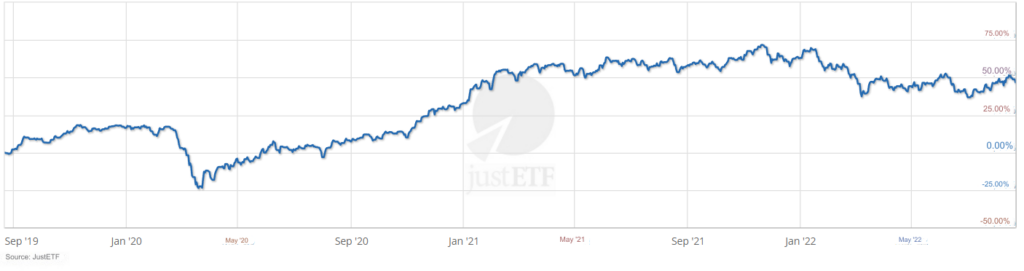
The iShares Electric Vehicles and Driving Technology is an ETF for electromobility and autonomous driving. It offers traditional companies from the automotive sector as well as chip manufacturers and producers of rechargeable batteries and other related industries.
With over 30% of its 87 shares, this ETF is also heavily concentrated in the USA. Japan is the second largest position with 14%. Tesla accounts for most of the shares here, closely followed by NVIDIA.
A volume of over 700 million euros ensures sufficient size. The costs of 0.4 % per year are also kept within limits. However, investors should be aware that volatility is also quite high here!
4. Global X Autonomous & Electric Vehicles UCITS ETF USD Accumulating
| Global X Autonomous & Electric Vehicles UCITS ETF USD Accumulating |
| ISIN IE00BMH5YR69 |
| Size: 2 million euros |
| Total costs (TER): 0.5 % p.a. |
| Start: 16. November 2021 |
| Distribution: Accumulating |
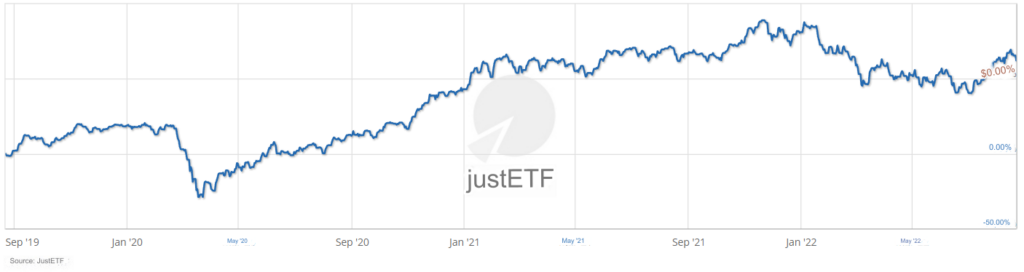
The Global X Autonomous & Electric Vehicles ETF comes in several variants, which can often cause confusion. However, they all have one thing in common: the enormous focus on the USA as a location! With over 50 % of the shares included, this product is strongly focussed on North America.
The aim here is also to create an ETF for electromobility and autonomous driving. The original fund is listed in the USA and can be found under ISIN number US37954Y6243. However, European investors may wish to switch to the offshoot with the number IE00BMH5YR69, as the costs and availability of savings plans are likely to be more attractive.
Attention!
While the US version has a volume of more than one billion euros, the European version has a measly 2 million euros! There is a considerable risk of closure here!
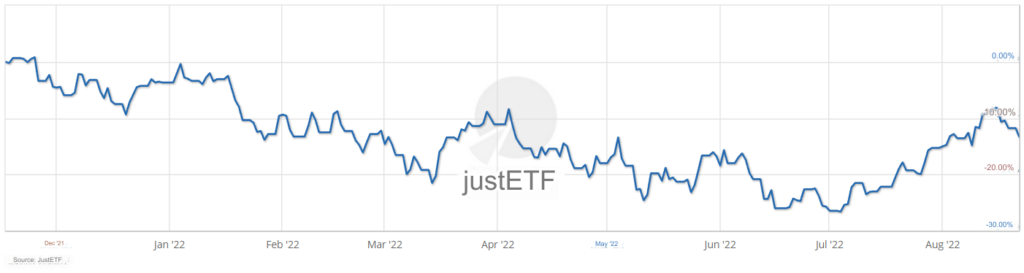
This electromobility ETF recorded considerable gains in 2020 in particular, but has recently lost significant ground. With annual costs of 0.68%, it is also one of the more expensive offerings.
5. Global X China Electric Vehicle and Battery UCITS ETF
| Global X China Electric Vehicle and Battery UCITS ETF |
| ISIN IE00094FRAA6 |
| Size: 3 million euros |
| Total costs (TER): 0.68% p.a. |
| Start: 18 January 2022 |
| Distribution: Accumulating |
Young ETFs only have a small volume and an uncertain future. They can grow into very lucrative investments or be closed after just a few months. The China Electric Vehicle and Battery UCITS from Global X is one such ETF.
It exclusively comprises shares in Chinese companies that are active in the field of electromobility and rechargeable batteries. As the world’s largest economy has long played a pioneering role within the industry, an investment could certainly make sense.
So far, this ETF for electromobility only has €2.5 million under management – but it was only launched in January 2022! Since then, it has already achieved an attractive return. However, the comparatively high costs of 0.68 per cent per year must also be taken into account.

6. HANetf Electric Vehicle Charging Infrastructure UCITS ETF Acc
| HANetf Electric Vehicle Charging Infrastructure UCITS ETF Acc |
| ISIN IE000HMSHYJ6 |
| Size: 2 million euros |
| Total expense ratio (TER): 0.65 % p.a. |
| Start: 25. April 2022 |
| Distribution: Accumulating |
An ETF for electromobility does not have to focus exclusively on the vehicles themselves! The Electric Vehicle Charging Infrastructure ETF from HANetf is aimed at companies that are involved in building and expanding the necessary charging infrastructure.
This is also a very young ETF, with a low volume of just under 3 million euros to date. However, as this is an interesting field, considerable growth is possible.
The infrastructure for charging electric vehicles is a typical bottleneck in the mobility transition. This is because the lack of availability often prevents drivers from purchasing a suitable vehicle. It is therefore quite clear that there is considerable potential here.
Courageous investors can find out whether the Electric Vehicle Charging Infrastructure UCITS is the right ETF to benefit from this potential. The performance so far is not yet impressive, but can change at any time.

Conclusion: ETF electric mobility as a yield guarantee?
Numerous ETFs for electromobility are already available to interested investors and the selection is growing steadily. Demand has risen sharply in recent months, as the shift towards non-fossil fuels has clearly gathered pace.
It is therefore safe to say that it is currently one of the most popular sectors: There is hardly a portfolio that does not yet include an ETF for electromobility! Related sectors, such as the battery industry or the provision of charging stations, can also be a worthwhile investment.
Autonomous driving is another area that is often covered by manufacturers of microchips within an electromobility ETF. However, anyone who believes this technology has greater potential should consider a separate entry.
Like the automotive sector in general, ETFs for electromobility are subject to strong fluctuations. The purchase of a vehicle – regardless of the type of drive – is usually delayed in difficult economic times.
High inflation and general uncertainty have therefore put a dent in the sales figures of many companies in the industry. Nevertheless, the general demand for sustainable transport cannot be denied.
ETFs for electromobility can therefore be considered a comparatively safe investment. Although there is no guarantee of success here either, many investors have confidence in the success of the industry, making electromobility one of the largest investments.

