
How to find the best ETF for you


ETFs are almost always medium- or long-term investments and, as with all longer-term commitments in life, we want to make sure that they really fit together. So today we have taken a close look at what you should look out for when choosing ETFs and how to find the right one for your own strategy.
Northern Finance – Youtube Channel
If you have questions about this and other financial topics or are looking for tips and tricks, you should also take a look at our forum for personal loans. There you can exchange ideas with other investors and find all the answers you need.
Realistic image preferred
ETFs replicate other indices and are therefore a kind of copy of a market, country, sector… Of course, nobody wants a bad copy – especially not if they are paying money for it. It is therefore important that the ETF in question is a high-quality replica of the selected shares, i.e. that it does not forget any securities or distort the weighting.
There are three main ways in which an ETF can be structured. If it is a small index that is to be replicated, this usually works in a ratio of 1 to 1. This is referred to as physical replication. All securities, for example of the Dax (quite small with 30 companies), are transferred to the respective ETF.
If, on the other hand, the target index is very large, the sampling method is usually used: The majority of shares are tracked, but small and illiquid companies can be temporarily omitted. The MSCI World is a typical example of this, as it would otherwise have to contain over 1600 securities.

The last type of replication is the swap, where a portion (maximum 10% according to EU law) is covered by a counterparty. In reality, this is a bank and the share is usually in the region of 4%. Swaps can have comprehensive guarantees as security, but can also be completely unsecured. However, the latter is rarely the case.
What to do with my money
The next question for the prospective ETF saver is where the dividends generated by the ETF should go. This is because many companies from different indices regularly distribute dividends to their investors – regardless of whether they are individual shareholders or funds.
There are only two options: Distributing ETFs, as the name suggests, pay out this income to investors. Accumulating ETFs, on the other hand, reinvest this capital directly back into the ETF, so that growth takes place in the long term.

The size of the respective financial product is also decisive, as small ETFs with a capitalisation of less than 100 million euros in particular have an increased risk of being closed. The larger a fund is, the more appealing it is for investors and operators alike.
With very large sums, often in excess of 500 million euros, so-called tracking differences begin to take effect. These ensure that an ETF can even outperform the actual index that it is replicating. The reason for this is the income that can be generated with the extensive capital (assuming appropriate hedging).
What about the TER?
The total expense ratio, or TER for short, is often cited as the most important key figure. In reality, however, it is only one of many values that should be taken into account when deciding in favour of or against an ETF.
An ETF can only be meaningfully evaluated in connection with the tracking difference (i.e. the difference between the performance of the ETF and the index that is actually being tracked), the composition/accuracy of the replication and the size.
Even a very accurately replicating ETF with a good TER is of no use if it is not profitable due to its small size and is therefore discontinued after a short time. Research based on several criteria is therefore necessary to select the right fund for you.
Our recommendations
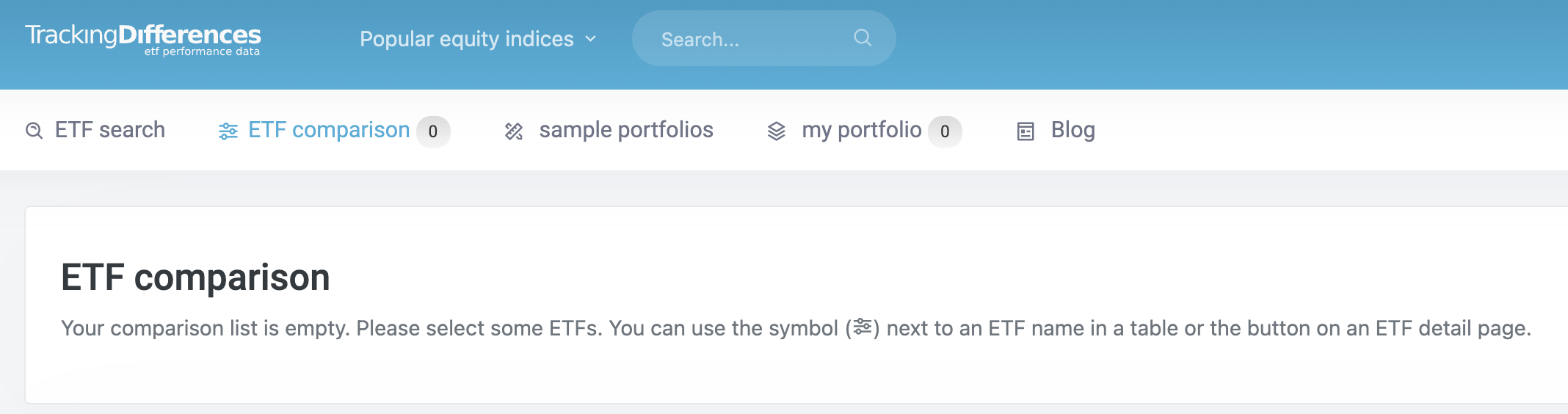
We can’t recommend the perfect ETF for you – only you can ultimately decide what suits you and your strategy. However, we can give you a good starting point for your search: trackingdifferences.com is a website that is worth using to compare different ETFs. Based on the criteria listed above, you are sure to find what you are looking for.
‘best’ ETF for you, you can of course also find a “worst” one. In our article ‘top flop stocks’, we have analysed three such hopeless cases in more detail. It may be worth taking a look at this to recognise and avoid these and similar money pits.

