
Bondora Review: An Analysis of Finances, Risk and the Loan Portfolio


With its performance in 2025, the Bondora Group can look back on its strongest year in the company’s history to date. The Group has recorded a sharp rise in profits, is taking important steps towards securing its target banking licence, and is strengthening its overall position in the highly competitive European lending market.
At the same time, the latest data indicates high default rates in the new expansion markets. Added to this is the structural separation of the Bondora Group from the Go & Grow investment product. How secure is Go & Grow following these changes, and what impact might they have on the expected 6% return?
In brief:
- In 2025, the Bondora Group achieved a record profit of around €9.5 million.
- There are various reasons behind Bondora’s sharp rise in profits, some of which have a bitter aftertaste.
- The company is performing well in its core market thanks to the quality of its portfolio and is increasing the proportion of loans repaid on time.
- However, even greater teething problems are on the horizon in the emerging markets, which investors should monitor closely.

P2P pioneer Bondora: 18 years’ experience
When it comes to peer-to-peer (P2P) lending, two names immediately spring to mind for most people: Mintos, the largest marketplace for personal loans, and Bondora. The Estonian company was launched back in 2008 and has been hugely successful ever since!
- Bondora was founded by Pärtel Tomberg at a time when the financial crisis had the world firmly in its grip.
- The company drew on lessons from the crisis to become one of the first providers to facilitate investments in personal loans.
- For the first 10 years, it operated as a ‘standard’ P2P platform, comparable to Mintos or other providers in my P2P lending ranking.
- In its early days, the company changed its name twice, but otherwise stuck to its original plan. This paid off: the company has been profitable since 2017.
- In 2018, it launched a new product: Bondora Go & Grow. It offers a fixed rate of return and daily access to the invested capital.
- The new offering took the market by storm and became an alternative to instant access savings accounts for many investors.
- The success of Go & Grow was so overwhelming that the traditional P2P products “Portfolio Manager” and “Portfolio Pro” quickly faded into the background.
- In 2023, the company therefore took the logical next step and discontinued these offerings entirely.
- In April 2026, Go & Grow will be spun off from its parent company, Bondora Group, and launched as an independent brand. The former Bondora Capital OÜ will be renamed Go&Grow OÜ and will operate independently of the Bondora Group in future.
Bondora now therefore offers only one form of P2P investment: Go & Grow. Here, you receive 6% interest per year, payments are made daily and you can withdraw your money at any time.
Before we look at whether this is really worth it, let’s take a look at the company itself:
What is Bondora?
The Bondora Group is a financial services company based in Estonia and the financing engine behind the business model. The company grants consumer loans to private individuals and handles their assessment, disbursement and management. These loans are financed by investors’ capital.
Go & Grow, on the other hand, is the group’s investment product, through which investors can put their money into the loan portfolio managed by Bondora and, in return, share in the returns generated by it.
This business model benefits everyone involved:
- Borrowers receive money quickly and easily, which they can use for urgent purchases or emergencies.
- Bondora generates high profits, which recently amounted to more than €9.5 million.
- We investors receive 6% interest per annum on our money through Go & Grow, allowing us to build up passive income with ease.
It is therefore no wonder that investors have had positive experiences with Bondora and that the business is growing steadily! More than half a million investors are already active on the platform today.
| Foundation | 2008 |
| Company headquarters: | Tallinn, Estonia |
| Management: | CEO Pärtel Tomberg (founder) |
| Financed credit volume: | 2,21 billion (06/2026) |
| Regulated: | Fully regulated |
| Annual report: | Audited annual report available; profit of €9.5 million in 2025 |
| Investors: | + 500,000 users |
| Returns: | 6 % |
| Buy-back guarantee: | Not applicable |
| Minimum investment amount: | 1 EUR |
| Auto-Invest: | Yes |
| Secondary market: | No – not applicable |
| Tax certificate: | Yes |
| Bonus programmes: | €5 sign-up bonus via my link |
Who is behind Bondora?
The P2P platform Bondora was conceived and founded by Pärtel Tomberg. And the success of recent years clearly shows that it was a very good idea!

Here are the most important facts about the founder and owner:
- Born and raised in Tallinn, the capital of Estonia, where Bondora is now based.
- Studied in England and the USA and holds a degree in International Business Management.
- He studied at a university in Oxford, but not the world-famous University of Oxford.
- Before founding Bondora and during its start-up phase, he held various management positions, mainly at large online mail order companies.
Tomberg currently holds 51 per cent of Bondora and thus has the final say over the company. For us investors, this is very good news: Here is a man with years of experience in the business world and in running his own company at the helm.
Around a quarter of the shares are held by an investor from Portugal. The remaining shares are held by the Global Founders Fund (formerly: “European Founders Fund GmbH & Co. Beteiligungs KG”).
This is the investment fund run by the Samwer brothers, who rose to prominence through their investments in companies such as Zalando, Delivery Hero and HelloFresh. Older readers will also be familiar with their ringtone company, Jamba.
Their fund also made a sound decision with Bondora, investing early in the successful P2P platform.
Let’s now continue with a review of the 2025 financial year to better understand the financial position of the Bondora Group, as well as the opportunities and risks this presents for Go & Grow investors.
Bondora Group 2025: Year in Review
Bondora is a well-established company that has been active in the lending sector for almost 20 years and currently provides financial services to its investors in 5 active European markets. The company is supported by over 200 employees from 25 countries.
The company’s success speaks for itself: The Bondora Group has now been profitable for the ninth year running. This solid growth demonstrates that Bondora is now one of the most robust companies in the P2P sector.
The financial report for 2025 has been publicly available for a few days now; it has been prepared strictly in accordance with IFRS guidelines and audited by KPMG. It contains exciting developments that are relevant not only to Go & Grow investors, but also to anyone who has not yet invested on the platform.

I’ve taken a closer look at the financial report and would like to outline the key developments and key figures for you, so that you can gain a transparent insight into the platform.
This will help you decide for yourself whether an investment in Go & Grow is still worthwhile, or whether its best years are already behind it and alternatives such as Monefit are now becoming more attractive.
Turnover and profit
Not only has the Bondora Group been profitable for the ninth year running, but in 2025 it also managed to significantly increase its profitability. Last year was the most profitable in the company’s entire history to date.
- Revenue growth: The Bondora Group’s revenue rose from €52.6 million in 2024 to €62.7 million in 2025, representing an increase of 19.2 per cent.
- Profit: The strong revenue growth has also led to a veritable explosion in net profit. In 2025, the Group generated a profit of around €9.5 million – almost ten times that of the previous year, 2024 (around €1.2 million), which was characterised by significant macroeconomic challenges.
- Profitability: The return on equity (ROE) jumped from 6% in 2024 to an impressive 40% in 2025. And this was achieved despite a significant increase in the number of investors.
- Dividend policy: Despite the strong profit performance, the Board has decided to retain the entire net profit and not to pay out any dividends. The company wishes to finance its growth increasingly from its own resources and is therefore deliberately not pursuing a dividend policy.
The reasons behind Bondora’s record profit
What are the reasons for the explosion in profit over the past year? I took a closer look at the financial report and came across two reasons.
1. Bad debts written off:
In 2025, Bondora significantly cleaned up its balance sheet, reducing reported receivables from over 25 million euros to 8.81 million euros.
The background to this is that the company has written off receivables totalling 20.18 million euros in full. These were defaulted loans, which are, however, an inherent part of this type of lending business and are not unusual. Bondora’s default rate currently stands at around 5.7%.
This move was prompted by the sale of a portion of non-performing Finnish loans to an institutional investor. After all, Finland is regarded as Bondora’s most important lending market.

2. Spin-off of Go & Grow:
This point is by far the most important. This year, the shareholders approved a comprehensive restructuring of the group. This involves separating the flagship product “Go & Grow” – both legally and operationally – from the rest of the Bondora Group’s lending business.
The former subsidiary Bondora Capital OÜ, through which Go & Grow is operated, will in future be known as “Go&Grow OÜ” and will operate under a new holding company, “Go&Grow Holding AS”.
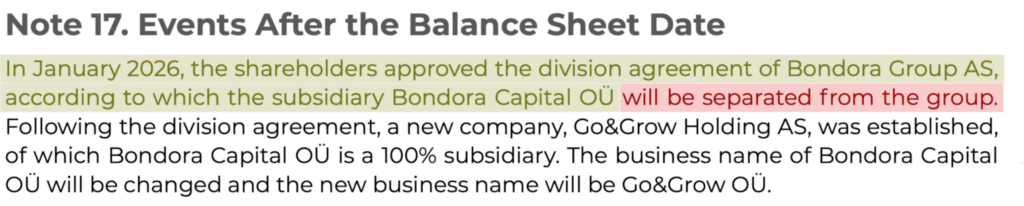
For investors, this separation may have both advantages and disadvantages. On the positive side, should problems arise in the traditional lending business, the investment product may be better protected from its risks.
At the same time, however, the separation could also mean that, in the event of a crisis, Go & Grow would no longer benefit to the same extent from the profitability of its former parent company. I cannot yet say exactly what the detailed legal implications of the new structure will be at this stage.
Both turnover and profit show that Bondora is on a solid footing to continue operating the business successfully in the future and to look after its investors.
However, anyone who is not satisfied with the spin-off of Go & Grow may find a suitable alternative in Monefit. The company’s profit of €13.5 million is even higher than Bondora’s, and there is no separation from the parent company here either. Read more about the platform in my Monefit review.
Bondora loan portfolio: How reliable are the loans?
The Bondora Group attaches great importance to professional risk management and the continuous optimisation of its loan portfolios.
Key figures such as the proportion of active loans, payment arrears, risk classes and regional distribution provide deep insight into the stability and sustainability of the business model.
Let’s therefore take a detailed look at the structure and development of the Group’s loan portfolio to gain a better understanding of its quality.
Returns
A glance at the figures from the Bondora Group’s latest loan portfolio statistics quickly reveals that the company has its loan portfolio well under control.
Bondora has built up a very solid return buffer. The projected internal rate of return (IRR) for the entire loan portfolio stands at an incredible 19.1% for 2026 – even after accounting for potential loan defaults. As investors, we receive a maximum of 6% of this, which results in this healthy buffer.

Default rates
The robustness of Bondora’s lending business stems from a consistent focus on quality: right from the outset of the lending process, Bondora carries out comprehensive credit checks. Once a loan has been successfully granted, borrowers’ repayment behaviour is continuously monitored.
This gives Bondora the greatest possible insight into every stage of the lending and repayment process, which is intended to ensure greater transparency and safeguard the stability of the portfolio in the long term.
And the success of this approach is evident:
- Active loans: Around 80 per cent of all loans granted remain active, whilst payment arrears have remained at a consistently low level over recent years.
- Risk classes: The vast majority of the portfolio consists of borrowers with high creditworthiness and low default risks. At the same time, the proportion of the best risk classes (AA to C) is rising steadily.
This strategy is complemented by flexible loan terms, which are tailored to the individual creditworthiness and repayment capacity of the borrowers.

However, on closer inspection of the markets, it becomes apparent that here, too, the devil is in the detail.
Finland is and remains Bondora’s core market and will continue to account for around 60 per cent of the total lending market in 2025.

There is also some encouraging news here: the key indicator PD12 has fallen significantly in Finland – from 11.85% in 2023 to 8.72% in the second quarter of 2025. This is particularly noteworthy given that, at the same time, the average interest rate on loans stood at a high 17.6% per annum.
Good to know:
PD12 (Probability of Default over a 12-month period) is the estimated probability that a debtor will be unable to meet their payment obligations within the next 12 months. It serves as a key risk indicator for assessing short-term credit or default risk.
Risks
At first glance, it certainly looks as though Bondora will be able to continue paying out daily interest reliably. But on closer inspection, we can see two hidden areas of concern:
- Area of concern 1 – The Netherlands: Compared with the buoyant Finnish market, the picture in the Netherlands is quite different.
Although Bondora emphasises that the majority of loans fall into the safe risk categories AA to C, the trend suggests a growing appetite for risk. The proportion of loans with the top ‘AA’ rating is falling from 64 per cent in 2025 to just 21 per cent in 2026.

At the same time, the proportion of ‘C’ loans has risen from 8% to 33%, meaning it has more than quadrupled. Anyone who used to invest manually on Bondora will also know that even credit rating class C already represents a significantly higher risk.
To me, this suggests that Bondora has relaxed its credit requirements in the Netherlands in order to increase the volume of lending.
- Problem area 2 – The expansion markets: The new expansion markets have so far performed significantly worse than the established markets.
In Denmark, for example, the PD12 default rate in the first half of 2025 ranged between 36.9% and 37.4%. This means that more than a third of the loans granted reach the status of an expected default within a year.

Latvia, too, has consistently very high default rates of around 30 per cent.

This shows that the expansion is associated with significant loan defaults and correspondingly high risks. By comparison, the PD12 default rates in the established markets of Estonia and Finland currently stand at just between 7.4% and 8.7%.
The expansion markets must therefore be cross-subsidised to some extent by the established markets.
How does Bondora perform when a loan defaults? The company also provides figures on this, which speak for themselves in clear and sober terms.
A clear difference is evident in the recovery rates for defaulted loans. Whilst Bondora is able to recover around 54 per cent of the capital after three years in Estonia and the Netherlands, the figure in its most important lending market, Finland, is just 31 per cent. There, the recovery processes take considerably longer.
In Estonia, 64 per cent of overdue loans are recovered after five years, whilst Finland only achieves a comparable recovery rate after seven years.

Although the recovery process is often protracted and takes place over a long period, Bondora manages to recover around two-thirds of all defaulted loans!
Loan defaults are a natural part of the lending business and cannot be completely avoided. However, Bondora demonstrates that they can certainly be managed through stricter checks and greater experience in the market.
Further exciting developments: Bondora is seeking a banking licence
One development that is very exciting for us as investors and should certainly be viewed positively is Bondora’s ongoing efforts to obtain a banking licence.
As stated in a letter from the Supervisory Board, Bondora Finance AS remains in the process of obtaining a banking licence. Bondora Finance AS is a new subsidiary under the Bondora Group AS holding company which has applied for a European banking licence.
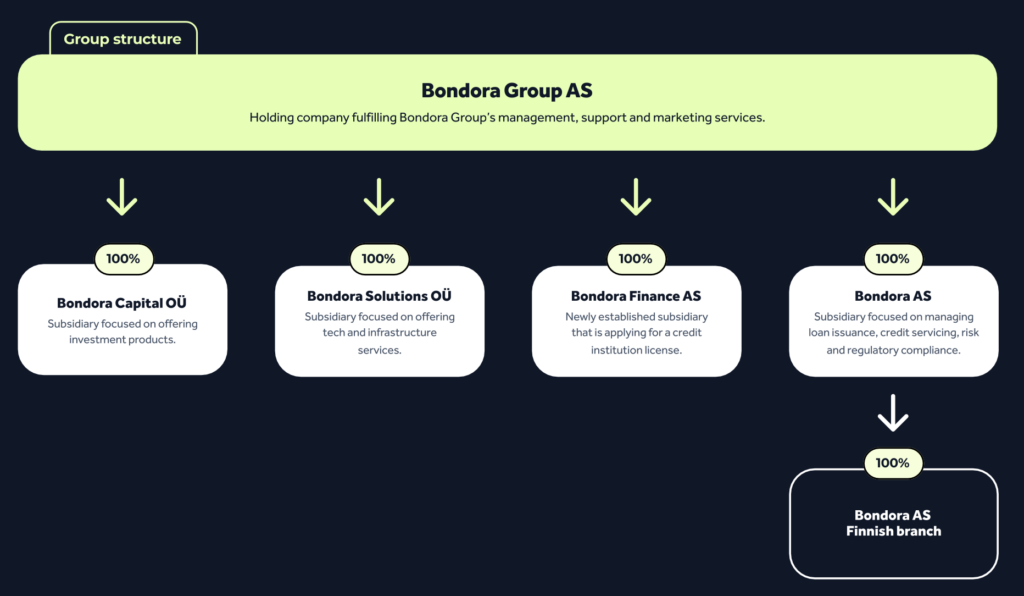
The fact that Bondora did not pay out any dividends to its investors in 2025 could therefore be explained by the fact that banking regulators require a certain financial buffer. The company’s cash and cash equivalents rose from €13.7 million in 2024 to €20.3 million in 2025.
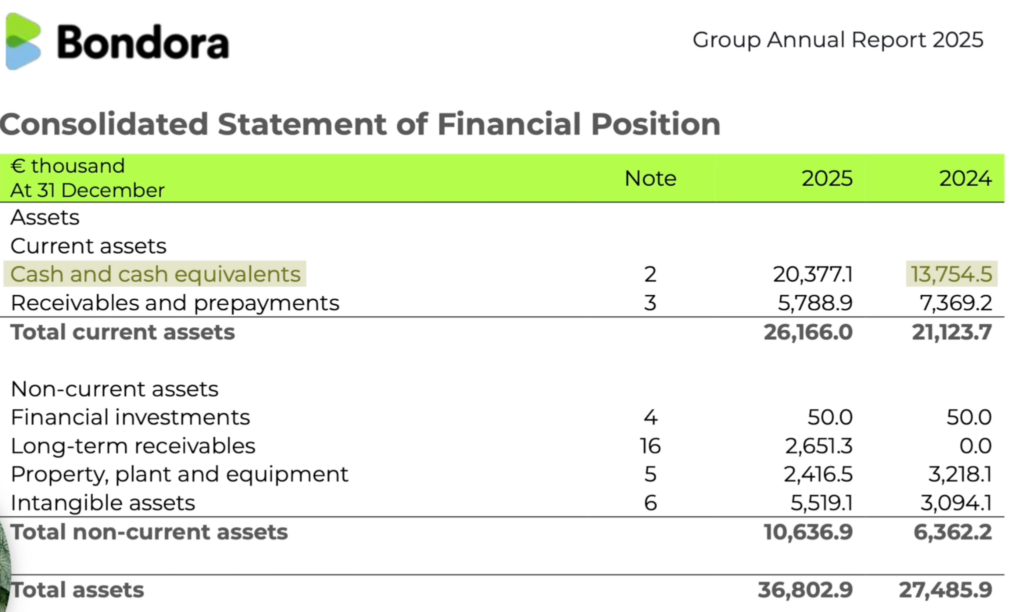
For us as investors, the retention of profits is generally a positive sign, though it may not have been entirely voluntary due to potential legal requirements.
The organisational and corporate spin-off of Go & Grow is also striking. This leads me to the obvious conclusion that the banking licence the company is seeking is the reason for the separation of the two business divisions.
My Bondora experience: My portfolio of just under €13,000
As a retail investor, as we have already explained in more detail, you can only invest via Bondora’s ‘Go & Grow’ investment product.
I have personally been invested on the platform for many years and am constantly expanding my portfolio.
I currently have just under €13,000 invested in Go & Grow, which is currently generating a daily return of just over €2.

New customers can regularly benefit from an attractive Bondora bonus. In my review, you’ll find all the key information about the various promotional programmes.
Having analysed the latest figures from the Bondora Group’s financial report, it’s clear to me that I’ll continue to invest via Go & Grow in the future. In 2025, the Group will achieve a profit of €9.5 million on total assets of €36.8 million, which is a more than impressive result.
So, for anyone looking to rely on a strong balance sheet and earn interest through an established company, Go & Grow could well be an exciting option. Especially as the Bondora Group has now been profitable for the ninth year running, thereby definitively proving its strength.
Conclusion: When profits hit record highs, it’s important to look at the downsides too
Things have certainly been looking bright for Go & Grow of late. The platform is steadily attracting more investors, and its parent company, the Bondora Group, is set to achieve a record profit in 2025, thereby significantly increasing its interest rate buffer.
The falling default rates in its core market of Finland and the increased potential returns for investors also show that Bondora is increasingly establishing itself in the highly competitive lending market.
However, record profits often cast a shadow, as a closer look at the statistics and the Bondora Group’s financial report reveals.
Firstly, the “Go & Grow” investment product is legally separate from the parent company, which raises the question of how well Bondora will treat its investors in the event of a crisis. Will the return be reduced, or will the group itself step in with liquid funds?
Furthermore, Bondora’s expansion is not going as smoothly as hoped. Markets such as Denmark and Latvia, with default rates of over 30 per cent, show that we are still at a very early stage here.
For me, however, Bondora – with its ‘Go & Grow’ investment product – remains an absolute heavyweight amongst P2P platforms, and one in which I will continue to invest. Over the years, the company has built up a strong interest buffer and demonstrated that its business model works.
Take a look at my Monefit review if you’d like to know more about this higher-yielding alternative platform.
FAQ: How secure is Go & Grow really?

