


Imagine you have a carefully constructed portfolio that is precisely tailored to your financial goals and your individual risk tolerance. However, in a world where financial markets are constantly in flux, your originally balanced portfolio can become unbalanced over time. Rebalancing allows you to counteract this imbalance.
In this article, you’ll find out in detail why this adjustment is so important, how to put it into practice, and what strategic approaches you can use. The methods outlined here are designed to help you avoid making emotional mistakes and to consistently pursue your long-term investment goals.
In brief:
- Rebalancing ensures that your portfolio always remains in line with your original target allocation.
- It helps to manage risks and avoid making emotional mistakes.
- By making targeted adjustments to your portfolio, you can secure higher returns in the long term and optimise your investment strategy.
The basics of rebalancing
Before we delve into the technical details, it is important to understand the basic concepts of rebalancing. In this section, I will explain exactly what rebalancing means and why it is so crucial for you as an investor.
What is rebalancing?
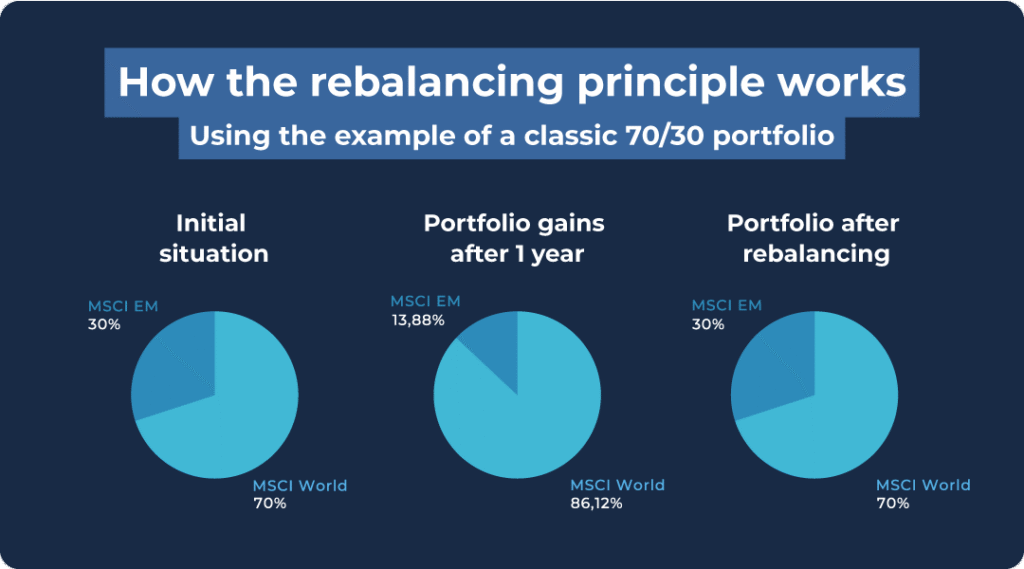
Rebalancing is the process of regularly reviewing your portfolio and restoring it to the weighting you originally set. For example, you might start with a carefully planned 70/30 portfolio, with 70% invested in shares and 30% in bonds.
Over time, asset prices may move in different directions. Whilst shares may rise sharply in value, bonds may only increase moderately. Without intervention, your portfolio could then consist of, for example, 80% shares and 20% bonds.
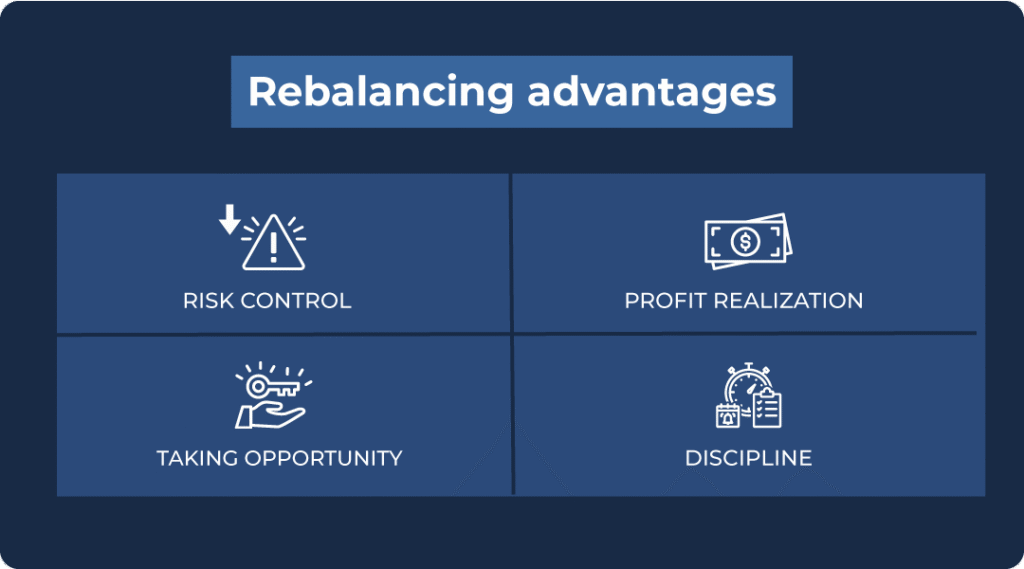
For you as an investor, this means that you actively manage your investment strategy, thereby bringing long-term stability to your portfolio. Rebalancing follows a counter-cyclical approach: you take profits when an asset class is overvalued and take advantage of favourable buying opportunities in undervalued sectors.
This method not only protects you from market downturns, but also allows you to systematically capitalise on the opportunities that arise during different market phases.
This is particularly important if you want to build wealth over the long term. Disciplined rebalancing helps you avoid making emotional mistakes and keeps your risk under control.
Definition of rebalancing:
- Basic principle: Restoration of the originally specified allocation
- Objective: To maintain your risk-return profile
Remember that rebalancing isn’t a rigid process; it needs to be tailored to your individual goals and current market conditions. This is the only way to ensure that your portfolio is always optimally balanced and that you make the most of the opportunities the market has to offer.

Investments always involve the risk of loss. The value of your investments
can go up or down. The forecast or past performance is no guarantee or
prediction of future results.
Do your own research or seek financial advice before making any invest-
ments. The WELCOME promotion is subject to Terms and Conditions. Gift
Shares are allocated randomly from a selection of eligible stocks, with high-
er-value shares awarded less frequently.
Why is rebalancing important?
As an investor, it is crucial that your portfolio always remains in line with your original strategy. If you have deliberately taken on a certain level of risk, you must not allow your portfolio to change unintentionally over time and let that risk get out of hand.
Regular rebalancing helps you to stay disciplined and avoid making emotional decisions that often stem from panic or greed. When you take profits whilst other parts of your portfolio are falling in value, you have the opportunity to buy into undervalued assets in a targeted manner.
This allows you to continuously adapt your portfolio to current market conditions. Diversification also plays an important role here. For example, you can expand your ETF portfolio to further spread the risk. Consistent rebalancing not only ensures better returns in the long term, but also helps you to maintain an overview and react flexibly to market developments.
By consistently rebalancing your portfolio, you ensure that you always stay on track, even when the market is volatile. This strategy is the cornerstone of long-term investment success and helps you to respond effectively in any market situation.
How rebalancing works
To fully understand the concept of rebalancing, it is important to break down the practical process into individual, well-structured steps. In this section, I will explain in detail how to systematically review and adjust your portfolio so that you remain in control and can act rationally at all times.
How does rebalancing work in practice?
The process of rebalancing can be broken down into four basic steps that will help you adjust your portfolio efficiently:
- Analysis: First, review your current portfolio and compare it with your target allocation. Take a close look at which positions have changed.
- Comparison: You identify deviations. For example, your portfolio may have shifted from an originally balanced allocation (e.g. 50% shares and 50% bonds) to a ratio of 60% shares and 40% bonds.
- Decision: You then decide which holdings to reduce and which to buy more of. Clear, pre-defined rules will help you avoid making emotional decisions.
- Implementation: Finally, you implement the rebalancing. You can do this either manually or using modern, automated tools that simplify the process for you. When doing so, you should ensure that you minimise transaction costs and do not rebalance too frequently.
It is important that you do not try to time the market, but instead act in a disciplined manner and in accordance with your pre-defined criteria. This approach enables you to keep your ETF risks under control at all times and to benefit from the natural fluctuations of the markets.
It is important that you take a systematic and structured approach so that you can maintain an overview in the long term and successfully implement your strategy.
Automated vs. manual rebalancing
Before you decide whether to rebalance your portfolio manually or use automated systems, you should carefully weigh up the pros and cons of both approaches.
With manual rebalancing, you retain full control over every transaction. This is ideal if you like to monitor the market yourself and make your own decisions. However, this requires time and discipline. This can be particularly rewarding for investors who want to build the best portfolio for beginners and actively work on their strategy.
Automated solutions, such as those offered by modern brokers and robo-advisors, monitor your portfolio in real time and automatically make adjustments as soon as predefined criteria are met.
This way, you can minimise emotional misjudgements and save valuable time that you can use for strategic thinking instead. This is particularly beneficial if you want to focus on long-term success and don’t want to have to worry about the finer details of your portfolio on a daily basis.
You can also benefit from an ETF savings plan, which helps you make regular investments without much manual effort.
Automated vs. manual rebalancing
- Manual: Full control, but requires a significant time commitment and discipline
- Automated: Reduces manual effort, minimises emotional reactions, ensures reliable implementation
Find the approach that best suits your lifestyle and investment goals, and make it part of your daily routine to ensure long-term investment success.
Investments always involve the risk of loss. The value of your investments
can go up or down. The forecast or past performance is no guarantee or
prediction of future results.
Do your own research or seek financial advice before making any invest-
ments. The WELCOME promotion is subject to Terms and Conditions. Gift
Shares are allocated randomly from a selection of eligible stocks, with high-
er-value shares awarded less frequently.
Strategies and methods in rebalancing
There are various strategies you can use when rebalancing. It’s not just about the technical aspects, but also about how you tailor your personal investment strategy to suit your individual needs.
Time-based rebalancing
With scheduled rebalancing, you set fixed dates on which to review your portfolio and make adjustments if necessary. This method is ideal if you want to establish a clear routine and avoid being unsettled by short-term fluctuations.
For example, you can decide to review your portfolio once a year or every quarter and make any necessary adjustments. This method gives you planning certainty and helps you keep track of things, even during quiet periods in the market.
For example, if you review your portfolio regularly, you’ll be able to spot early on whether the weighting of a dividend ETF has shifted. If so, you can take action in good time.
Advantages of scheduled rebalancing
- Predictability: Fixed deadlines create clear structures
- Risk minimisation: Regular checks prevent undesirable deviations
- Cost-effectiveness: Fewer transactions mean lower fees
This method allows you to keep a constant overview and avoid rebalancing too often or too infrequently. The frequency is a key factor in avoiding unnecessary costs and ensuring you don’t lose sight of your long-term investment goal.
Value-weighted rebalancing
With value-based rebalancing, your portfolio is adjusted automatically as soon as a certain percentage deviation from your target allocation is reached. You define a tolerance range for each asset class – for example, a deviation of 10%. If the proportion of an asset class exceeds this range, a trade is executed immediately.
This approach allows you to respond to significant price movements in a highly flexible and market-sensitive manner, ensuring that your portfolio remains optimally balanced at all times.
Modern tools and software solutions automatically notify you if the defined tolerance limits are exceeded. This allows you to respond in real time and ensure that your ETFs always remain in line with your original strategy.
A system like this not only reduces the risk, but also allows you to take advantage of good buying opportunities.
Hybrid approaches and individual strategies
It is not always enough to rely solely on a time-based or value-based approach. Often, a hybrid approach – where you combine both methods – is ideal. This involves setting fixed review dates, supplemented by automatic adjustments should extreme deviations occur.
This way, you benefit from the planning certainty of a fixed schedule whilst also enjoying the flexibility offered by the value-based approach. This approach allows you to tailor your portfolio perfectly to current market conditions without incurring unnecessary transaction costs.
For example, you could decide to review your portfolio on a quarterly basis, but also react immediately if an asset class deviates by more than 15% from the target allocation. This creates a dynamic balance that allows you to act calmly and prudently, even in volatile times.
Hybrid rebalancing approach
- Combination: Fixed intervals plus automatic threshold triggers
- Flexibility: Responds to extreme market conditions
- Advantage: An optimal balance between planning certainty and flexibility
A personalised hybrid approach allows you to implement your personal risk strategy in the best possible way. You’ll learn that there isn’t just one right way to do things, but that you can combine different methods to manage your portfolio as effectively as possible.
Costs, taxes and risks associated with rebalancing
In this section, we will examine in detail the various costs, tax implications and risks that may be associated with rebalancing. After all, it is not only important to understand the strategy, but also to take into account its associated side effects.
Transaction costs and fees
Every time you rebalance your portfolio, costs are incurred. Every transaction – whether it involves selling over-weighted positions or buying under-weighted assets – can result in fees that affect your returns.
It is essential that you always keep the cost-benefit ratio in mind in order to invest successfully in the long term. As well as direct brokerage fees, there may also be indirect costs, such as the spread between the buy and sell prices. These costs can add up if you rebalance your portfolio too often.
That is why it is important to consider alternative approaches such as cash flow rebalancing, where you deploy additional capital rather than paying tax on profits that have already been realised. This way, you minimise not only transaction costs but also your tax burden.
Cost factors in portfolio rebalancing
- Direct fees: brokerage fees, order costs
- Indirect costs: spread, transaction costs
- Tax considerations: Withholding tax on realised gains
- Strategy: Using cash flow rebalancing to minimise costs
The better you keep your costs under control, the more you can benefit from the profits you make. So it’s not just important to rebalance regularly, but also to do so efficiently.
Thorough cost planning and regular reviews will help you avoid unnecessary expenditure and optimise your strategy in the long term. This is a key factor in getting the most out of your investments over the long term.
Tax considerations
Taxes can have a significant impact on your net return. If you realise gains through rebalancing, withholding tax may be payable. It is therefore important to take tax implications into account in your planning. Make sure you are fully informed about the current tax regulations in your region and adapt your strategy accordingly.
It is often worth adopting strategies that minimise the tax burden.
By having a good understanding of the tax implications, you can ensure that you keep more of your profits in the long run and implement your investment strategy in the best possible way. It is therefore important to consider not only the returns but also the tax implications of your decisions.
Emotional challenges when restructuring
Emotional decisions are among the biggest challenges when it comes to rebalancing. You often find it difficult to sell positions that are performing well because you’re reluctant to give up the profits you’ve made. At the same time, you may be hesitant to invest in undervalued assets for fear of incurring further losses.
These emotional hurdles can cause you to stray from your clear, rational strategy and act impulsively. A clearly defined rebalancing plan is an indispensable tool that helps you remain disciplined and make rational decisions, even in turbulent times.
Imagine you’ve set yourself specific rules about when and how your portfolio should be adjusted. These rules will help you keep a cool head and stay focused on your long-term goals, even during periods of high market volatility.
By recording your decisions in an investment journal and regularly exchanging views with other investors (for example, on specialist forums), you will learn to control your emotions more effectively and act with discipline.
Tips on emotional discipline
- Fixed rules: Define clear criteria for reallocations
- Automation: Use tools that minimise emotional decision-making
- Long-term perspective: Always keep your long-term goals in mind
- Exchange: Talk to other investors to learn about best practices
This approach helps you keep your emotions in check and ensures that you act rationally, even in stressful situations.
Investments always involve the risk of loss. The value of your investments
can go up or down. The forecast or past performance is no guarantee or
prediction of future results.
Do your own research or seek financial advice before making any invest-
ments. The WELCOME promotion is subject to Terms and Conditions. Gift
Shares are allocated randomly from a selection of eligible stocks, with high-
er-value shares awarded less frequently.
Conclusion: Which rebalancing strategy is right for you?
Rebalancing is much more than simply shifting assets around. It is a disciplined strategy that helps you keep your portfolio aligned with your long-term investment goals.
By carrying out regular reviews and making targeted adjustments, you not only minimise the risks associated with investing, but also ensure you are in the best possible position to capitalise on market fluctuations.
In this article, you have learnt how to analyse your portfolio, which methods you can use, and how modern technologies can help you do so. This knowledge also helps me when rebalancing the Northern Finance portfolio.
It is particularly important to remain disciplined and stick to your rebalancing plan to avoid making emotional mistakes. With the strategies outlined here, you are well equipped to maintain control of your portfolio even in turbulent times and respond flexibly to market changes.
FAQ – Frequently asked questions about rebalancing

