
Set up an ETF savings plan – build up your assets in small steps


Have you decided to start building your wealth and actively manage your finances, and are you considering the best way to do so? Perhaps you have long-term goals you want to achieve, such as retirement provisions, financial security for your family, or building a house in the future. ETFs, for example, offer an attractive option for this. In this article, you will find out whether an ETF savings plan is right for you or whether a single investment makes more sense.
In brief:
- You will learn exactly what an ETF is and what the advantages and disadvantages of this type of investment are.
- We will show you exactly what a savings plan is, how it works, and what its advantages and disadvantages are.
- Whether an ETF savings plan or an individual investment is more suitable depends on your personal financial situation.
- You should definitely bear this in mind if you decide to make an individual investment and want to avoid losses.

Points
Points

Points
Points

Points
Points
Points
Points
Points
Points
Points
Points
Points
Points
Points
Points
Points
0 % without
Points
0 % without
Points
Points
Points
Points
Points
What is an ETF?
These are funds that are traded on the stock exchange and are based on an index. An ETF on the DAX, for example, invests in the 40 largest German companies. An ETF can invest in different asset classes, such as bonds, commodities or stocks.
Funds can be thought of as joint investment pools into which numerous investors contribute. Funds can be actively managed or passive, such as ETFs:
- Active management: This involves the work of a fund manager. This is a person who attempts to achieve excess returns and specifically selects the positions contained in the fund. You should be aware that there is no guarantee of these excess returns and that many fund managers are unable to consistently beat the market returns. In addition, there are costs involved, as active management must be paid for through increased fees.
- Passive asset classes: No fund manager is required here, as the ETF is based on an index and its composition is already fixed. The aim is to achieve the market return. If the underlying index changes, for example because one company goes bankrupt and another takes its place, the composition of the security automatically changes. Due to their passive nature, ETFs are significantly cheaper, as there is no fund manager to pay.
Good to know:
ETFs are essentially a long-term investment class that is not suitable for speculation. They are particularly popular for building up assets, providing for old age or when looking for ways to increase one’s own returns in general.
Are ETFs reliable?
Investments in ETFs are considered special assets. Banks and brokers are required to keep the money invested by their investors separate from the assets of the fund company. Normally, independent custodian banks are selected to hold the money.
This means that the money already invested in ETFs is protected. If your bank or broker becomes insolvent, you will not lose your money. Even if the custodian bank becomes insolvent, you will not suffer any disadvantages; a new administrator will then be sought.

The disadvantages of ETFs
Although ETFs can be very useful, there are risks involved. You should be aware of these potential disadvantages before deciding to invest so that you can better prepare yourself.
Like other securities traded on the stock exchange, ETFs are subject to price fluctuations. There can always be a major collapse in prices, as was the case during the coronavirus pandemic.
Although the price is recovering, it can be nerve-wracking for some investors who are not used to fluctuations and see ETFs in the red.
- You should be aware that price fluctuations in ETFs are completely normal and commonplace on the stock market.
- If you know that you react emotionally in such cases, it helps to invest smaller amounts at first to get used to the fluctuations.
- In addition, familiarise yourself thoroughly with your investment beforehand and consider a strategy. In an emergency, you will be prepared for the situation and can feel more secure.
In addition, you should only invest money in ETFs that you do not currently need. This way, you will not have to sell shares at unfavourable prices and realise losses. It is advisable to save up an emergency fund so that you are prepared for unforeseen expenses, such as buying a new washing machine.

Are there any other disadvantages?
Just like stocks, for example, ETFs are risky if they are not diversified. If you want to invest your money wisely, you should ensure that your risk is spread appropriately. Thematic ETFs, for example, focus on specific technologies that could play a major role in the future.
They only invest in a specific area and usually contain significantly fewer positions than broadly diversified global ETFs. Although they often offer the chance of attractive ETF interest rates, they also come with a higher risk and are less suitable for beginners.
Example:
Global ETFs are particularly popular with investors and should be considered when selecting ETFs. These investments focus on achieving the highest possible level of diversification. An MSCI World index contains over 1,600 positions and is therefore ideal for high risk diversification. Investments are made in a total of 23 different industrialised countries.
Furthermore, ETFs can differ in how they work. There are physical and synthetic ETFs. Physical ETFs actually purchase the securities included in the index.
The synthetic version, on the other hand, also known as Swap ETF, is characterised by a type of swap transaction between the bank and the fund company; the actual securities are not purchased. This involves counterparty risk if one of the contracting parties is unable to meet its obligations and, for example, becomes insolvent.
The way it works is somewhat more complex, but there are regulations in place to provide protection through UCITS. In practice, the potential risks are limited to a maximum of 10 per cent and are protected by collateral. Nevertheless, synthetic replication carries slightly higher risks than physical replication.

The advantages of ETFs
As already mentioned, ETFs are passively managed and therefore do not have active management. This makes them a low-cost asset class, with ongoing costs known as TER. You can expect costs of between 0 and 0.8 per cent of your invested capital. A typical global ETF usually charges fees of around 0.2 per cent.
Another positive aspect is the opportunity for diversification. With ETFs, you can ensure that you have as many different positions as possible in your portfolio:
- If a company becomes insolvent, this loss can be offset by the numerous other assets.
- With just one security, you can easily invest in hundreds of assets.
- Ensure sufficient risk diversification across different companies, sectors and countries in order to significantly reduce your risks.
In addition, there are opportunities for attractive ETF returns. Traditional investments such as building society savings agreements offer hardly any interest and are often not worthwhile. ETFs, on the other hand, can invest in stocks and are among the most profitable investments.
High returns can also help to offset inflation. Inflation is a general increase in prices. Rising inflation can increasingly devalue your money if you have not invested it. As a result, over a longer period of time, you will be able to buy fewer and fewer services and products for the same amount of money.
Transparency is also a positive feature. You can view the exact composition of your security on the providers’ websites. This also helps you to avoid overlaps and cluster risks if you want to invest in several ETFs.
ETFs are an easy-to-understand asset class and are suitable for both beginners and advanced investors. In addition, once you understand how they work, they require very little effort. You can also invest very small amounts, allowing everyone to participate in the market.

Set up an ETF savings plan?
Once you have decided to invest in ETFs, further questions remain, including whether you should set up an ETF savings plan or make a single investment. Below, we will look at which option is better suited to your situation.

What is an ETF savings plan?
You may be asking yourself, ‘What is an ETF savings plan?’ An ETF savings plan invests a predetermined amount at regular intervals in a security that you have selected. To do this, you give your bank a standing order or direct debit authorisation to allow regular debits.
ETF savings plans are usually set up on a monthly basis, but you can also set up plans that debit and invest on a quarterly or half-yearly basis. You can change this at any time so that your savings can be adjusted to your financial situation.
Set up a stock savings plan using an ETF? You can do this at most banks and brokers starting from as little as one euro, making this type of investment ideal for beginners. Students, for example, can also start building their wealth early on.
If you invest money automatically every month, you save time and effort:
- Once set up, debits and investments in the exchange-traded fund are handled automatically.
- This can also be beneficial for people who would invest less if they had to deal with investing money manually, which is why a certain consistency in your wealth accumulation is guaranteed.
Savings plan vs. individual investment
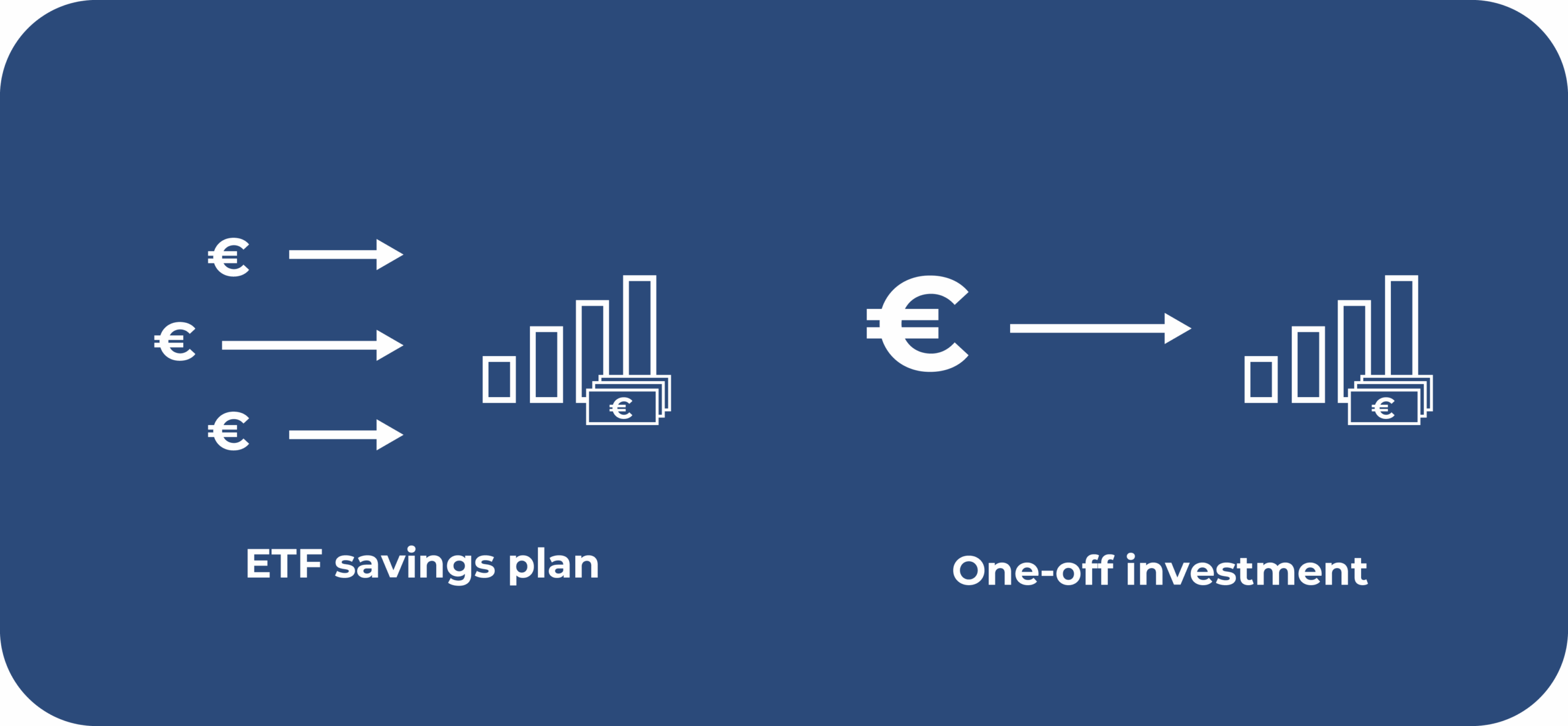
Is it better to buy ETFs or set up a savings plan? That depends on your personal preferences and financial situation. An important factor to consider is the return. If you already have a larger sum available that you would like to invest in ETFs, a single investment may be appropriate.
If you invest a large sum as a whole, your assets immediately start working for you and generating interest. If you invest the same amount through an ETF savings plan, a large amount cannot yet work for you and remains unused in your account. In this case, it may well be worthwhile to make an individual investment.
However, if you decide to make a single investment rather than opting for a fund savings plan, you must pay close attention to the entry point. If you buy at a particularly high price, this may have a negative impact on the expected return.
Attention!
If you have planned a very long investment horizon, poor entry points can be offset to some extent, but should not be underestimated.
Take advantage of the cost average effect
In addition, you can benefit from the cost average effect. As prices change constantly and vary from month to month, the price approaches an average price over time. This effect is particularly noticeable when you invest over long periods of time. Incidentally, an ETF savings plan comparison can help you compare the potential costs of ETFs.
The entry price is also irrelevant. If you decide to make a single investment, you need to be careful about when you invest. This can be crucial, especially with larger sums, and can influence your future returns on the ETF.
High flexibility of savings plans
- You can adjust and change your personal ETF savings rate at any time.
- If you have more money available in a month, you can easily invest more.
- If, on the other hand, your car suddenly needs to go to the garage, you can reduce your savings rate for that month or pause it.
- You can also choose whether you want to invest monthly, quarterly or half-yearly.
- A savings plan therefore enables you to tailor your finances perfectly to your financial circumstances.
ETF savings plans are generally aimed at investors with a long investment horizon.
Can a payment plan help?
Incidentally, something that is often not mentioned but is nevertheless worth bearing in mind is that, in addition to the entry point, the exit point of the exchange-traded fund also plays a role. A payout plan can help here. It is advisable not to sell all shares at once, but rather to spread the sale over several months or years.
Savings plans are particularly well suited to people who do not have a lot of money available at once, want to start investing early and want to work consistently on building up their assets.
A small monthly amount can also be selected if you still feel uncomfortable with investing and would like to ‘try it out’ or get used to it first.
A savings plan can be set up quickly and easily, and the start date is irrelevant due to the automated debits at specific times. With an ETF return calculator and an ETF savings plan calculator, you can develop your strategy and get an overview.
But beware!
Incidentally, not all existing ETFs are eligible for savings plans. Therefore, check in advance in a share savings plan comparison whether your desired security is eligible for a savings plan.
| ETF savings plan | ETF single investment | |
| Opportunities | – Minimal effort – Consistent wealth accumulation in small steps – Small amounts are sufficient – Cost averaging effect or average price – High flexibility of your savings rate – Entry point is irrelevant | – Entry point can offer an opportunity – Maximum use of the compound interest effect and thus higher return potential |
| Risks | – If a large sum is already available, the return may be lower until the entire sum has been invested – Not all ETFs are eligible for savings plans – When prices are particularly low, there is no opportunity to profit from them due to fixed booking times | – Large sum required – Unfavourable entry point may reduce returns |
Conclusion: Set up an ETF savings plan and work consistently on building your assets.
Exchange traded funds have become an increasingly popular investment in recent years, and for good reason: they offer low fees, attractive return opportunities, the possibility of high diversification, high transparency and ease of understanding. This makes them a suitable investment for beginners and advanced investors alike.
Once you have decided on an investment, the question remains whether you want to make a single investment or set up an ETF savings plan. This depends on your personal financial situation.
If you don’t have a lot of money available yet, but want to start investing and participating in the market as early as possible, monthly, consistent saving is a good option. This has the advantage that you only have to set it up once and don’t have to worry about when to start. In addition, you can benefit from the cost average effect.
If, on the other hand, you have received a larger gift and would like to invest the sum wisely, a single investment could be a sensible choice. This gives you the opportunity to maximise the compound interest effect by allowing your money to start working for you early on.
However, you need to consider the timing of your investment so that your future returns are not reduced. Whichever type of investment you choose, ETFs are an interesting investment with the potential for attractive returns. Learn more about ‘Trade Republic savings plan recommendation’ here.
Points
Points
Points
Points
Points
Points
Points
Points
Points
Points
Points
Points
Points
Points
Points
Points
Points
0 % without
Points
0 % without
Points
Points
Points
Points
Points
FAQ ETF savings plan – Frequently asked questions

