
Trade Republic savings plan or buying: which is better?


As investors, we are constantly faced with the question: should I set up an ETF savings plan with Trade Republic, or is it better to buy shares directly? In this article, we’ll take a look at the differences together. We’ll also explain in detail when each strategy makes the most sense.
In brief:
- Trade Republic offers more than 2,600 ETFs as part of a savings plan and for direct purchase.
- ETF savings plans are available from as little as €1 a month, can be flexibly adjusted and benefit from the cost-averaging effect.
- One-off purchases allow for a larger investment sum and the immediate benefit of compound interest, but they depend on good market timing.
- The cost-averaging effect smooths out price fluctuations, whilst the compound interest effect maximises returns when you invest early.
- A combination of a regular savings plan and a one-off purchase can bring together the benefits of both approaches.
Trade Republic: Savings Plan vs. One-off Purchase
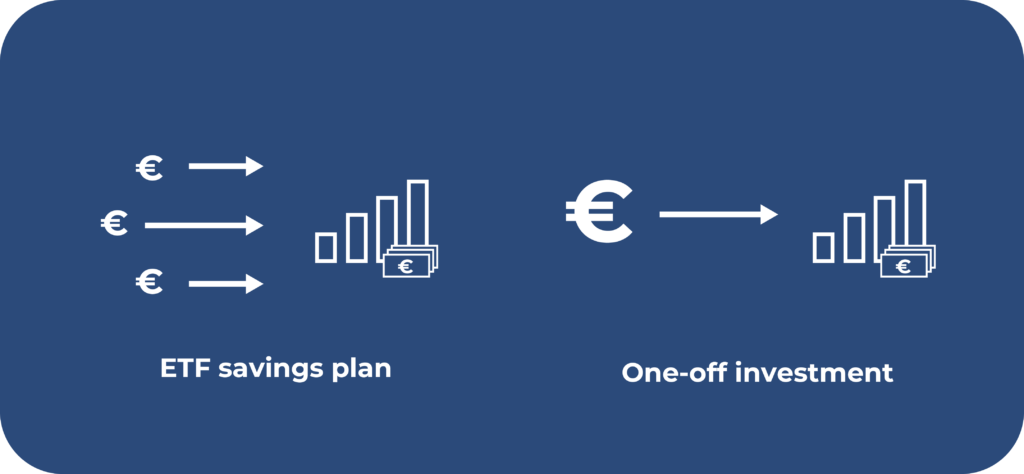
At Trade Republic, you have two main ways of investing in ETFs: you can set up a regular savings plan, where small amounts are invested on a regular basis, or you can buy ETFs directly as a one-off investment. Both options have their pros and cons. And it’s important that you understand them before making your decision.
- ETF savings plan: Regular investment of a fixed amount, for example €1 per month.
- Single purchase: A one-off investment of a larger sum. This involves putting all your eggs in one basket straight away, and you can benefit from the power of compound interest if you get in early and invest wisely.
- Costs at Trade Republic: No custody fees, regular savings plan transactions are free for most ETFs, and there are no hidden costs.
- Flexibility: Savings plans can be adjusted or paused at any time, whereas with a one-off purchase, you decide when to buy and how much.

How does the Trade Republic ETF savings plan work?
Imagine you don’t have a fortune yet, but want to build one up over the long term. This is where a savings plan comes in. With an ETF savings plan at Trade Republic, you decide how much you want to invest. You can start with as little as €1 a month.
The big advantage is that you invest regularly without having to worry about the ‘right time’.
Good to know:
Not everyone has already saved up a substantial amount. Naturally, people without savings also want to plan for their future or achieve financial goals. An ETF savings plan is an excellent way to do this, as you can start with as little as one euro a month.
How does the one-off purchase work on Trade Republic?
With a one-off purchase, you invest a larger sum all at once. This can be a good idea if you’ve inherited money, received a bonus payment or have simply been saving up for a while.
The effect of compound interest is more pronounced when making a one-off purchase of ETFs. This is because if you invest early and wisely, your money can grow faster through the reinvestment of returns.
But be careful: the risk is higher if you buy at the wrong time (for example, when prices are high). This could reduce your return. It is therefore worth keeping a close eye on the market and analysing it carefully.
Would you like to learn more about buying individual shares and find out when the best time to start is? If so, we highly recommend reading our article on the well-known ‘buy the dip’ strategy. Find out now exactly how it works and what better alternatives are available to you as a retail investor.
Trade Republic savings plan or buying: a comparison of the pros and cons
Whether you should opt for a savings plan or a one-off purchase depends largely on your personal circumstances and goals. The key differences between a savings plan and a one-off purchase on Trade Republic are:
| Criterion | ETF savings plan | One-off purchase |
| Start-up capital | Starting from just €1 | Only makes sense for larger sums |
| Fees at Trade Republic | No execution fees, no custody fees | No custody fees, but third-party charges may apply |
| Timing | No risk thanks to the cost-averaging effect | Timing is crucial, price risk |
| Compound interest effect | Builds up slowly over the years | Maximum impact right from the start |
| Flexibility | Customisable, pausable | Less flexible after purchase, and subject to further transactions and fees |
Why a savings plan is the better choice for many people
A savings plan is like an automatic system that takes the stress out of constantly having to keep an eye on share prices. You simply choose a savings amount and the ETF once, and then everything runs automatically.
A savings plan is a great solution, particularly for those just starting out in their careers or for people who can’t or don’t want to keep a constant eye on the market. You build up your wealth bit by bit and benefit from market trends in the long term, without having to worry about entering the market at an unfavourable time.
When a one-off purchase makes sense
A one-off purchase is ideal if you already have a substantial sum available and want to invest it in a targeted manner. This allows you to benefit from the power of compound interest, as you are investing your entire capital from the outset. If you have a good grasp of the market or are taking advantage of a correction, this can really pay off. However, you should be aware that there is a greater risk of choosing the wrong moment and seeing prices fall after your purchase.
Trade Republic savings plan or buying: our experience
We still remember our first experiences with Trade Republic very well. Back then, we had 2,000 euros to play with. It wasn’t exactly a fortune, but it was enough to leave us wondering: should we invest it all at once, or would it be better to set up a savings plan?
At first, we were convinced by the idea of a one-off investment. The power of compound interest sounded promising, and we wanted to start benefiting from it as soon as possible. So we invested the entire sum in an MSCI World ETF. Two weeks later, a bear market hit.
The share price fell sharply, and our portfolio was down 8 per cent. The portfolio was immediately in the red. Looking back, it wasn’t a disaster, of course, but it was still very frustrating. After all, the timing of our entry was simply poor.
So we set up a savings plan as well. It was really simple: €200 a month, all on a fully automatic basis. And that was a real turning point. No more stress about monitoring share prices, no more agonising over the ‘right’ moment. Today, we’re glad we combined the two: the one-off purchase got us started with investing, whilst the savings plan ensures long-term stability.
If we’d started the savings plan straight away and spread the total amount over three or four months, the market correction would have worked in our favour. The reason for this is that, because the share price was lower, we would have received more shares for the same amount of money. We would therefore have achieved an even better return in the long term.
Good to know:
What have we learnt from this? Don’t wait for the perfect moment. Just get started! And if you’re unsure: a savings plan takes the pressure off and helps you stay on track in the long run.
The cost-averaging effect or the compound interest effect. Which is more beneficial?
Perhaps you’ve also wondered whether it’s better to invest small amounts regularly or to put a large sum in all at once? This is exactly where the cost-averaging effect and the power of compound interest come into play.
Both have their pros and cons. Which approach suits you best depends on your personal circumstances. Let’s take a closer look at them together.
| Property | Cost-average effect | Compound interest effect |
| Type of investment | Regularly (e.g. monthly) | A single, large sum |
| Effect | Average price due to fluctuating exchange rates | Income is reinvested and grows |
| Risk | Lower due to spread-out purchases | Depending on when you join |
| Suitable for | Beginners, long-term savers on a tight budget | Investors with capital who are monitoring the market |
| Advantage | Less stress, no need to time the market | Maximum returns over a long investment horizon |
When is the cost-averaging effect worthwhile?
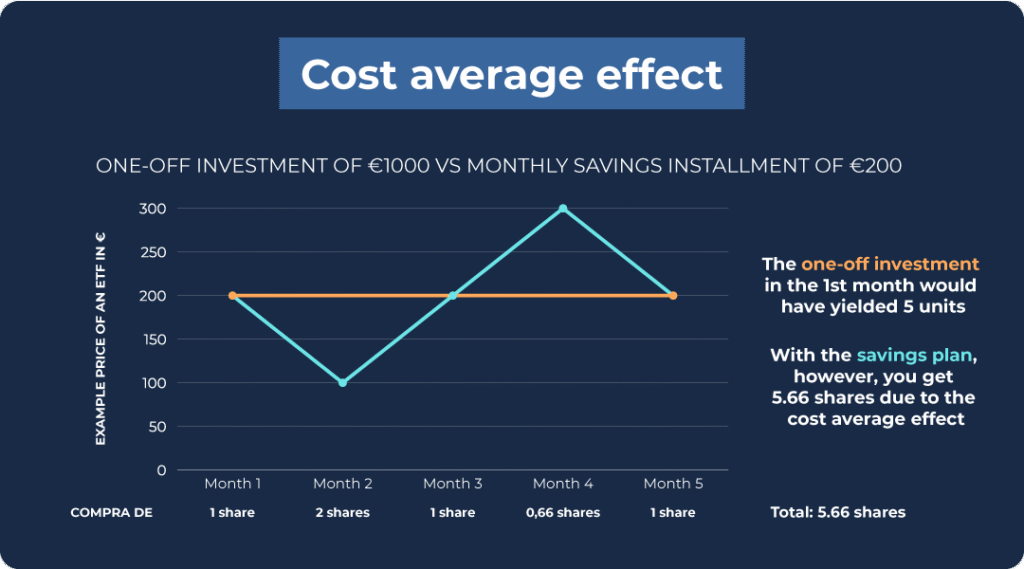
If you’re just starting out with investing or simply want to save regularly, the cost-averaging effect is perfect for you. For example, you invest a fixed amount every month, regardless of where the market stands at the time.
Sometimes you get better prices, sometimes worse. In the end, this evens out thanks to the resulting average price.
The great thing about it is that you don’t have to worry about when the perfect time to start is. It happens automatically whilst you carry on saving without a care in the world. This is a brilliant strategy, especially for those just starting out in their careers or anyone who simply wants to build up their wealth over the long term.
What’s more, with Trade Republic, you can get started for as little as €1 a month. It really is within everyone’s reach. So there are no more excuses to stop you from investing.
When does the effect of compound interest pay off?
The power of compound interest is truly remarkable if you have capital that you want to invest in an ETF straight away. The rule here is: the longer your money remains invested, the more it can grow. This is because your returns – in the form of price increases or dividends – are reinvested and generate further returns themselves. This is the famous ‘snowball effect’, which really gains momentum over the years.
However, timing is key here: if you buy when prices are low, you can make more in the long run. But if you buy at the wrong time, it can be painful at first. That’s why this strategy is best suited to experienced investors who know the market a bit and can assess the risks.

Make the most of Trade Republic’s features: savings plans and buying
Both approaches have their respective advantages and disadvantages. So why not make the most of both strategies?
For example, if you have a larger sum of money, you can invest it as a one-off payment and let the power of compound interest work in your favour right from the start. At the same time, you can set up a savings plan which, month after month, ensures stable average prices thanks to the cost-averaging effect.
This combination isn’t just clever, it’s also reassuring. So you no longer need to worry about whether you’ve picked the best time to invest. Your money starts working for you straight away and continues to do so in the long term. What’s more, your capital is spread out over several instalments.
Whether you opt for a savings plan or a one-off purchase with Trade Republic is entirely up to you. A savings plan is ideal if you want to save for the long term and smooth out market fluctuations. A one-off purchase is worth considering if you want to invest straight away and take advantage of the power of compound interest.
We started straight away by buying individual shares and, following a dip in the market, set up a regular savings plan as well. Had we invested directly via the savings plan, we would have received more ETF units thanks to the lower prices on the stock market. Looking back, however, we are still very happy with this combination.
So now you’re wondering which option is best for you? Why not do both? That way, you can invest wisely and be prepared for any market conditions.
FAQ – Frequently asked questions about Trade Republic savings plans or buying

