

Most savers are aware that shares are the most lucrative form of investment. Nevertheless, they are put off by the sheer number of listed companies in Europe and around the world. A good investment option is to invest in a European ETFs. In this article, you can learn more about the pros and cons of European ETFs.
In brief:
- An ETF portfolio should be broadly diversified in order to reduce risk
- The US is very strongly represented in traditional global portfolios, accounting for just over a third of the total
- These six indices are designed to increase the proportion of European assets in your portfolio. One index is particularly well suited for this purpose

Points
Points

Points
Points

Points
Points
Points
Points
Points
Points
Points
Points
Points
Points
Points
Points
Points
0 % without
Points
0 % without
Points
Points
Points
Points
Points
Advantages of ETFs
Index funds, also known as exchange-traded funds (ETFs), track a stock market index such as the DAX. This is a passive form of investment and differs from actively managed funds. Actively managed funds are run by a fund manager who makes decisions on the purchase of specific shares. Studies show that just 10 per cent of international fund managers achieve a better return than the classic, well-known global equity index, the MSCI World.
ETFs are significantly cheaper than investing in actively managed funds. There is no need to make investment decisions about specific shares, as the ETF tracks a particular index. Investing in ETFs does not take much time and is not complicated.

Why diversification is crucial for your ETF portfolio
A well-diversified ETF portfolio plays a crucial role in helping you achieve your long-term investment goals. Diversification refers to spreading your invested capital across different asset classes, regions, sectors and assets in order to spread the risk and minimise potential losses.
By spreading your money across a broad range of assets, you can minimise the impact of negative events on individual companies or sectors. For example, if a company in your portfolio makes negative headlines or a sector goes through a slump, the losses can be offset by positive developments in other areas.
ETFs offer an ideal way to diversify, as they track an entire index and thus cover a broad range of companies and sectors. You can find the best ETFs that specialise in various markets such as Europe, the US, emerging markets, specific sectors or themes. This way, you have access to a wide range of shares without having to select each company individually.
Another advantage of diversification is that it reduces the risk of losses caused by market price fluctuations. By spreading your capital across different asset classes, which may perform differently, you can reduce the overall volatility of your portfolio. This can be particularly important if you are following a long-term investment strategy and wish to protect yourself against sharp price fluctuations.
However, it is important to note that diversification is no guarantee of profit and cannot protect you from all risks. Market trends can be unpredictable, and there is no way to completely eliminate the risk of loss.
Before diversifying your ETF portfolio, it is advisable to consider your individual investment objectives, time horizon and risk tolerance. Careful planning and regular review of your portfolio are crucial to ensuring that it aligns with your financial goals and supports you on your path to investment success.
Why invest in Europe?
The foundation of a well-diversified portfolio consists of a fixed-term deposit account, a call money account and, for example, an equity ETF tracking broadly diversified indices. A classic example of this would be the MSCI World Index. This comprises a total of more than 1,500 shares from 23 different countries.
Most traditional global ETFs hold a significant proportion of US companies. Should economic problems arise in the US, this will affect all investors. Broad diversification is important for reducing risk and cushioning the impact of market fluctuations on the portfolio.
Example:
According to its own figures, the FTSE All-World Index covers 90 to 95 per cent of market capitalisation. If you look more closely at the breakdown, you can see that the US accounts for around 59 per cent, whilst Europe makes up 17 per cent. In the spring of 2021, the US share of the MSCI World Index stood at 67 per cent – almost two-thirds.
The reason for the heavy weighting of the US in the indices lies in the criteria used to construct them. The MSCI World, for example, is primarily based on market capitalisation. A company’s market capitalisation corresponds to the current market value of all its shares that are tradable on the stock exchange.
Good to know:
If the aim is to create a global portfolio that is as market-neutral as possible, weighting by market capitalisation is generally a sensible option. However, if European stocks account for more than two-thirds of the portfolio, this can limit its diversity. A European ETF is therefore a suitable way to increase the European component of the portfolio.
What European indices are there?
Providers compile all indices based on the market capitalisation of the companies’ shares. The higher a company’s market capitalisation, the greater its weighting in the index. There are six well-known indices in Europe, three of which include only companies from the eurozone. The other three also include other European countries, such as Switzerland.
The wide range of indices allows investors to pursue different investment strategies and tailor their portfolios to their individual investment objectives.
Stoxx Europe 50
The Stoxx Europe 50 Index comprises the 50 largest companies in Europe and represents a total of 17 countries. Companies from the United Kingdom dominate the index, accounting for approximately 27.6 per cent, followed by Switzerland with 21.6 per cent and France with 19.6 per cent. This index focuses on the largest and most established companies in Europe.
Stoxx Europe 600
Unlike the Stoxx Europe 50, the Stoxx Europe 600 Index comprises a total of 600 companies from the same 17 countries. This broadly diversified index includes large, medium-sized and small companies. The largest weightings are held by the United Kingdom (24.5 per cent), France (17.3 per cent) and Switzerland (15.1 per cent). Due to the large number of companies, this index offers more comprehensive coverage of the European market.
Euro Stoxx
The Euro Stoxx Index comprises only companies from the eurozone, i.e. the countries that use the euro as their official currency. Currently, 300 companies from 11 countries are included in this index. The largest holdings are in France (33.8 per cent), Germany (28.3 per cent) and the Netherlands (11.2 per cent). The Euro Stoxx Index allows for a specific focus on economic developments within the eurozone.
Euro Stoxx 50
Like the Euro Stoxx, the Euro Stoxx 50 Index focuses on companies from the eurozone. However, it comprises a limited number of just 50 companies from 11 countries. The largest weightings are held by France (38.8 per cent), Germany (31.7 per cent), the Netherlands (11.2 per cent) and Spain (9.5 per cent).
Due to its limited size and the fact that it comprises the largest companies in the eurozone, the Euro Stoxx 50 is the most closely watched European index.
MSCI Europe
The MSCI Europe Index is a sub-index of the MSCI World Index and comprises shares of large and medium-sized companies from 15 European countries included in the MSCI World Index. This index is also based on market capitalisation and comprises the top 85 per cent of all shares in each country.
In addition, the MSCI Europe Index also includes countries outside the eurozone, such as the United Kingdom, Switzerland and Norway. The UK has the largest weighting in the index, at 24.4 per cent. In total, the index comprises 438 companies from 15 European countries. This index offers broader geographical diversification and enables investors to benefit from companies in countries outside the eurozone as well.
MSCI EMU
The MSCI EMU Index focuses on companies from the eurozone and comprises a total of 244 of the largest companies from 10 eurozone countries. This index primarily represents medium-sized and large corporations that play a significant role in the eurozone economy.
The largest constituents of the MSCI EMU Index include France, Germany and the Netherlands. France accounts for the largest share at 35.1 per cent, followed by Germany at 26.9 per cent and the Netherlands at 13.5 per cent. These countries play a key role in the European economy and are instrumental in the stability and growth of the eurozone.
| Index | Number of companies included | Number of countries represented | Annualised performance (2016–2021) | Annualised volatility (2016–2021) |
|---|---|---|---|---|
| Euro Stoxx 50 | 50 | 8 | 9,3 % | 19,2 % |
| MSCI Europe | 434 | 15 | 4,67 % | 14,2 % |
| Stoxx Europe 50 | 50 | 9 | 7,5 % | 16,5 % |
| Stoxx Europe 600 | 600 | 17 | 8,6 % | 16,8 % |
The Euro Stoxx 50 is often chosen because of its popularity. When you compare the various indices, the Euro Stoxx 50 stands out in particular, with its comparatively high returns. However, if you look at its volatility, you will also notice the downside: this index is subject to greater fluctuations.
Compared to the Euro Stoxx 50, the Stoxx Europe 600 has performed only slightly less well, whilst exhibiting lower volatility. If you take a closer look at the index, further advantages become apparent: the Stoxx Europe 600 comprises 600 companies from 17 countries, whereas the Euro Stoxx 50 comprises only 50 companies. With the Stoxx Europe 600, you therefore also have a more diversified portfolio.
Good to know:
This index would therefore be well suited to giving a portfolio a stronger European focus and reducing the proportion of US holdings slightly. The largest holdings in the Stoxx Europe 600 are Nestlé at around 2.97 per cent, ASML at 2.36 per cent and Roche at 1.98 per cent, followed by Novartis, LVMH, Unilever and SAP.
European ETFs – This is what your new global portfolio could look like
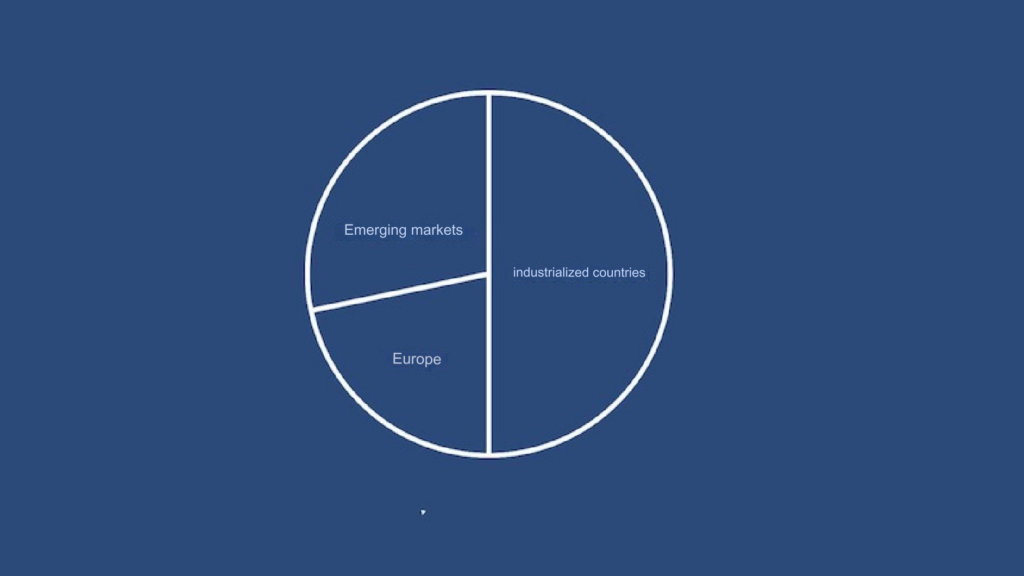
A traditional global portfolio includes both developed and emerging markets in order to achieve the broadest possible diversification. A popular allocation among passive investors follows the ‘70:30’ principle: 70 per cent is invested in developed markets and 30 per cent in emerging markets.
If you now feel that the proportion of US assets in your portfolio is too high and you decide to start investing in another ETF, the percentage breakdown of your investment will have to change. As the proportion of US assets in the developed markets ETF is high, this portion will need to be reduced.
Worth knowing:
A ‘50:30:20’ allocation would be suitable for this, for example. This means that, going forward, 50 per cent of your investments will be in developed markets, 30 per cent in emerging markets and 20 per cent in the new Europe ETF.
Conclusion: European ETFs as a sensible addition to your portfolio
A securities account should consist of a variety of core components: equity funds that generate long-term returns, and safe investments with high liquidity that minimise risk. Another important aspect of security is diversification when building an ETF portfolio.
Overall, this broad diversification has the advantage of offsetting fluctuations and thus reducing the investment risk. In traditional global portfolios, however, the proportion of US assets is very high, which reduces the portfolio’s diversity.
One way to reduce the proportion of US stocks slightly is to invest in European-focused index ETFs. The best-known of these is the Euro Stoxx 50. Its popularity is also the reason why it remains a frequent choice. Although it offers the highest relative performance, it is not particularly broadly diversified and is subject to high volatility.
The Stoxx Europe 600, on the other hand, has only slightly underperformed, but it is much more broadly diversified and does not fluctuate significantly. This ETF is a good choice for expanding the European component of your portfolio.

FAQ – Frequently asked questions about European ETFs

