


Do you also dream of working less, being financially secure, and earning more money with less effort? The popular book ‘Cashflow Quadrant’ by author Robert T. Kiyosaki deals with precisely this topic. In this article, you will learn more about the Cashflow Quadrant model and the connections between different types of people and their ways of earning money!
In brief:
- The book Cashflow Quadrant discusses four different ways to earn money.
- Employees and self-employed people convert their time into money. The more they work, the more they can earn.
- Large entrepreneurs and investors earn their money with the help of their assets or their employees and their work performance.
- Kiyosaki explains why people who do not invest money can never achieve financial freedom.
Who is Robert Kiyosaki?
Robert Kiyosaki is a well-known American businessman. He founded Rich Dad Company and Rich Global LLC. The entrepreneur has published numerous books on financial education, and you may be familiar with his particularly popular book, Rich Dad, Poor Dad.
This bestseller sold worldwide. Cashflow Quadrant and Rich Dad’s Guide to Investing also made it into the top 10 bestseller lists of the Wall Street Journal and the New York Times.
In his books, you can learn how to build passive income. This can be achieved in various ways, such as through company investments or real estate.
He also divides expenses into assets and liabilities. Liabilities are when you buy a car or pay the rent, for example, i.e. when you spend money on something. Assets include money that generates income in turn.
Financial review is also important in his teaching. The school system is designed to provide academic education so that students can subsequently take up permanent employment.
Good to know:
However, if you want to achieve financial freedom, you need to generate passive income, either as a businessman or as an investor.
The employee
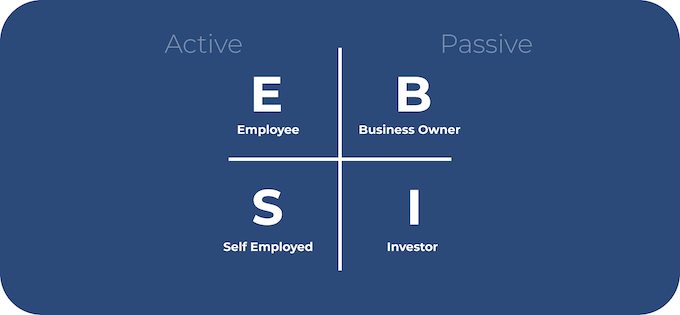
The Cashflow Quadrant is a financial model consisting of four different ways to generate income. Each corner of the model represents a different path, each with its own advantages and disadvantages. Every earner can find themselves in one corner of the quadrant.
The first part concerns employees. Security is an important issue for employees: they seek long-term stability and sign a contract to commit themselves to a company for a certain period of time.
According to Kiyosaki, this desired feeling of security is a reaction born of fear. That is why employees try to improve their financial situation by climbing the career ladder within a company.
Attention!
A characteristic feature of this group is that employees work in a foreign system in order to earn money. Typical thoughts of an employee with regard to work would be statements such as ‘I want a secure job with a good salary and nice colleagues’.
This way of earning money could also be explained differently: employees exchange their own time to make money. Every day, they work for a certain number of hours in order to receive wages that are contractually agreed in advance. Time and money are closely linked: the more time invested, the more money the employee earns.
One advantage of this type of income is the increased security. Unlike self-employed people, for example, employees know exactly how much they will earn each week or month. This allows them to plan better and avoid unpleasant surprises. Paid holiday and health insurance are also often included.
Good to know:
Disadvantages often include less free time. In many cases, the salary is comparatively low. Since time is exchanged for money, the work performed is often greater than the actual wage.

The self-employed
Self-employed people and small business owners differ from employees in that they do not have a strong desire for security. They prefer to be in control and want to be their own boss. By specialising in a particular area, they can achieve financial success.
Self-employed people have to invest a lot of time if they want to earn well. Their income depends largely on how much work they can do. Here, too, time and salary are closely linked. Self-employed people do not delegate tasks to others, which costs them additional time.
Self-employed people have the advantage of being in control. They can manage their own time and thus also decide how much they earn. At the same time, self-employment also involves risks:
- Many small business owners and self-employed people fail within the first five years.
- The reasons for this are often a lack of equity capital or insufficient review.
Worth knowing:
Small business owners and self-employed individuals aim to invest their own skills and be well compensated for their time. In doing so, they want to take on responsibility and enjoy their independence.

The entrepreneur
An entrepreneur wants to turn his vision into reality. To do this, he looks for suitable people for various areas, such as marketing, whom he can trust. He builds his own system by setting up a business and hiring people to manage different areas.
Unlike self-employed persons or small business owners, he mainly takes on management tasks. He assigns other tasks that arise within the company to qualified individuals.
Entrepreneurs are often well connected. They find it easy to find partners or new customers. They make contacts at events and show enthusiasm.
Several decades ago, a significant amount of equity capital was required to establish one’s own business. Thanks to advancing digitalisation, this has changed. Today, it is possible to establish a business with significantly less capital.
Large entrepreneurs often have very high profits. They are also better able to manage their time. However, they bear an increased risk of losing money. They have a lot of responsibility for themselves, but also for the company and all its employees.
Good to know:
The entrepreneur therefore works less in the company itself and more on the company. He ensures that the system runs smoothly and initiates improvements. Necessary work is delegated to others.
The investor
Perhaps you are also an investor and strive for financial freedom through the targeted use of capital. Investors use assets to generate further money. Investors’ money works for them and continues to grow in the long term. They look for ways to invest their assets as profitably as possible in order to make more out of them.
Investors have the great advantage of being able to build up passive sources of income. This means you don’t have to actively spend time in the long term to further grow your wealth. However, depending on the asset class, there are different risks involved. Examples of such investment opportunities would be P2P or ETFs. You can find out more about these here.
Good to know:
It is not possible to move into the investor quadrant without first succeeding in one of the other three. First, you should find ways to earn money. Then you can consider how to start growing this existing capital.
Fundamentals of the Cashflow Quadrant
The different sides of the cash flow quadrant are particularly important. On the left side, you will find employees and self-employed people, who have many similarities. They focus on actively earning money. Entrepreneurs and investors, on the other hand, want to find passive ways to earn money. Where do you stand?
| E and S quadrants | B and I quadrants |
| Earnings depend on your own work performance and the time invested. | Other people generate their own income through their work. |
| When you are not working, you no longer have an income. | Assets generate passive income – regardless of one’s own professional activity. |
| High earnings are possible, but only if a lot of time is invested. | It can lead to very high earnings, while leaving more time free. |
| Income is limited to the period during which one is actively working. | Unlimited income potential with increasing improvement of the system. |
Good to know:
Which quadrant suits a person has a lot to do with character traits. There are people who are perfectly happy in an employment relationship and have problems with the uncertainties of being self-employed, for example. Conversely, others feel too restricted and lack independence as employees.
In his book, Kiyosaki emphasises the importance of investing. He sees it as the real key to financial freedom. Here’s what happens when people never become investors:
- Money will define the limits of your life.
- People who never invest work hard all their lives to build their wealth.
- They are often dependent on others, such as the state or their own family members.
- They will worry about money their whole lives.
- You will never discover the meaning of financial freedom.
It is interesting to note that people view the other quadrants as uncertain from their personal perspective: someone who works permanently for a company sees investors or self-employed people as high-risk. Income can be irregular in these cases and does not allow for fixed planning.
Investors and entrepreneurs, on the other hand, see employment as risky. Employees are often subject to the whims of a boss and are in a relationship of dependency. This knowledge can help you to question your own perspective and find an individual hybrid model tailored to your needs in order to achieve your financial goals.
Attention!
Such individuals will have many financial worries and are often dependent on outside help. Only people who review the topic of investments and passive income will be able to experience financial freedom.
Build wealth passively with these asset classes
If you want to be in the quadrant for investors, you could, for example, invest money in ETFs or P2P lending. To do this, you can invest time once to learn the basics of the asset classes. Then it’s time for concrete implementation: specific ETFs or lending are selected in a targeted manner and money is invested.
Once the investment has been made, this type of income generation is passive. Both asset classes can be used to build up passive, long-term wealth, for example to prepare for a carefree retirement or to secure the financial future of your family.
Diversified investment in stocks – ETF asset class
ETFs can be traded on the stock exchange and are investment funds. Unlike active funds, they do not have a fund manager. These managers must also be paid, which is why ETFs have the advantage of being significantly cheaper.
What exactly you invest in with ETFs varies. For example, there are bond ETFs and stock ETFs. An ETF on the S&P 500 contains the 500 largest companies in America by market capitalisation. With just a single ETF, it is possible to invest in a large number of companies.
This brings with it the advantage of diversification or spreading risk. If one company becomes insolvent, the loss is ‘absorbed’ by the other companies in your ETF. Diversification is an excellent strategy for reducing risk in a portfolio.

To this end, it is advisable to invest not only in a large number of companies, but also in different countries and sectors. If you are interested in several ETFs, you can review the securities they contain on the providers’ websites and check for overlaps in order to avoid cluster risk.
You don’t need to worry about the time involved either. You can invest in ETFs either through a single purchase or by means of a monthly savings plan. This offers the following advantages:
- Regular investing
- Low effort (runs automatically)
- Also possible with small amounts
- Cost average effect: You purchase your shares automatically at different times. The entry point is not particularly important here.
- High flexibility: You can adjust your savings rate at any time.
- Pause: If something comes up and you need your money for something else, you can easily pause your savings plan.
Attention!
The MSCI World is particularly beginner-friendly. This index includes the 1,600 largest companies worldwide. It invests in industrialised countries and enables investors to build a broadly diversified portfolio with just one ETF.
P2P – High potential returns through lending between two private individuals
P2P lending offers an alternative to ETFs. It is a lending transaction between one private individual and another. This transaction is brokered by a P2P platform; a bank is not required.
P2P lending offers high potential returns, unlike traditional asset classes such as building society savings agreements. This allows you to build up your assets over the long term. One advantage is that you can start with small amounts and try out the asset class first.

Diversification also plays a role here: ideally, you should invest smaller amounts in a large number of loans in order to reduce the risk of default. Lending is classified according to credit ratings by the respective P2P platform. These serve to give investors an overview of how risky their investment in a particular loan is:
- Risk and return are closely linked: the higher the potential return, the higher the risk.
- P2P lending always carries a default risk: the borrower may not be able to repay the borrowed money, including interest.
- One way to reduce this risk is diversification: invest in different credit ratings.
Like ETFs, P2P lending is not a complex investment. Many providers now offer automated P2P lending. You choose the term and credit rating of the lending yourself and set up the framework for your financial strategy. The tool then invests according to your preferences.

Conclusion: Passive income with the cash flow quadrant
Kiyosaki’s model shows you four different ways people can earn money: as employees, self-employed persons or small business owners, large business owners, and investors.
The left side of the model, i.e. employees and the self-employed, invest their time and receive money in return. The right side, large entrepreneurs and investors, earn their money in other ways: they profit from the services of their employees or use existing capital to create new wealth.
In his book Cashflow Quadrant, Kiyosaki emphasises the importance of investing. He shows that people who never invest and only spend money have to work hard their whole lives. The entrepreneur stresses that people who do not invest can never achieve financial freedom. However, if you learn about investing and start building passive income early enough, you can build wealth in the long term! You can find out more about wealth building here.

