
Accumulating or distributing ETFs? Differences + advantages


If you want to invest in an exchange-traded fund, you have a choice: ETFs can be accumulating or distributing. Is automatic reinvestment or regular payouts better? We have the answers!
In brief:
- If an ETF is accumulating, profit distributions are automatically reinvested in the fund. On paper, this ensures a better return.
- If an ETF is distributing, the profits are regularly credited to your account. However, the fund’s price also rises less sharply.
- Both variants lead to approximately the same total return.
- There are advantages and disadvantages in each case, for example when it comes to taxes. Your personal strategy will determine which method you should choose!
Accumulating or distributing ETFs? The difference explained
You have completed the Trade Republic account opening process or registered with another broker and want to finally invest in ETFs. But when it comes to choosing, you are faced with a huge list of technical terms: replication, total expense ratio/ETF costs, tracking difference, currency risk… and, of course, the distribution method.
But don’t worry: it’s easier than you think! Today, we’re going to look at the distribution of exchange-traded funds. There are only two options to choose from: distributing or non-distributing.
ETF: An exchange-traded fund is a collection of shares, bonds, commodities, cryptocurrencies or other assets. Instead of buying all the securities contained in the fund individually through your broker, you can simply purchase the fund itself. You then receive a share in all the products contained in the fund.
This makes investing much easier and safer. You acquire a good mix of several securities and don’t put all your eggs in one basket.
Index: Which shares and other assets are included in an ETF is determined on the basis of predefined lists, known as indices. This is a major difference between ETFs and funds: there are no expensive fund managers who select assets manually. Instead, an index is used as a template and the content is adjusted automatically.
Such an index can contain very different products: for example, the 40 largest companies in Germany (‘German Stock Index’, “DAX”) or all US government bonds with a maturity of less than twelve months (‘IDC US Treasury Short Term Index’). The number of available indices is enormous, and the number of ETFs is correspondingly large!
Distribution: Some stock companies distribute part of their profits to investors in the form of dividends. With bonds, on the other hand, interest is paid out, and with cryptocurrencies, income is generated from staking or lending. There are two possible uses for this money: it can be paid out to investors or reinvested directly.
Distributing: If an ETF is distributing, the income from dividends, interest, etc. goes to the investors. In this case, you receive regular payments that are deposited in cash into your account. Since this money goes to the investors, the price of the fund does not change as a result (although price changes due to other causes are of course still possible).
Accumulating: If an ETF is accumulating, dividends and interest remain in the fund and are not paid out. The money can be used to purchase additional shares, bonds, cryptos, etc. This further increases the value and thus the price of the entire fund. The term ‘accumulating’ aptly comes from the Greek word thēsauros, meaning “treasure” or ‘treasury’.
The good news is that you will ultimately achieve roughly the same profits regardless of whether an ETF is accumulating or distributing. So there is no risk of spoiling your returns by making the wrong choice. The decision as to which option is right for you depends more on your personal strategy and financial goals.

Investments always involve the risk of loss. The value of your investments
can go up or down. The forecast or past performance is no guarantee or
prediction of future results.
Do your own research or seek financial advice before making any invest-
ments. The WELCOME promotion is subject to Terms and Conditions. Gift
Shares are allocated randomly from a selection of eligible stocks, with high-
er-value shares awarded less frequently.
Distributing ETF
If an ETF is distributing, you can expect regular payments to your account. When the payments are made (for example, once, twice or twelve times a year) depends on the respective fund and can vary greatly.
The amount of the distributions also varies from product to product. Some special dividend ETFs offer payments of 10% and more! Of course, such offers are also associated with a corresponding risk. If you prefer to play it safe, you should choose a more stable investment product with lower payouts.

The distributing option is ideal for anyone who wants to profit from their investments right from the start. Regular payouts mean you always have additional capital at your disposal, which you can use to finance everyday expenses or treat yourself to nice extras.
Depending on the size of your portfolio, you could use this money to pay your monthly mobile phone bill, car insurance or even your rent. Or you can treat yourself to a trip to the cinema, a meal in a good restaurant, a holiday, or whatever else takes your fancy. Of course, you can also invest the distributions in another financial product.
However, this brings us to a possible disadvantage of a distributing ETF: in order to reinvest the money, you have to execute a transaction with your broker. Depending on the provider, this may incur varying fees. For example, with Scalable Capital or Trade Republic, you pay €1 for each investment.
With other service providers, these costs can be even higher. If you receive regular distributions and repeatedly invest them in other products (or in the same ETF), this can quickly add up. If an ETF is accumulating, these additional costs do not apply, as no reinvestment is required.
Need more information about the best brokers for buying ETFs? You can find everything you need to know in my articles on Scalable Capital review and Trade Republic review!
Accumulating ETF
If an ETF is accumulating, any dividends or interest remain directly in the fund. This means you do not receive any cash payments; instead, this money automatically increases the capital of the investment product. The fund operator can now purchase more shares of the assets contained in the fund.
This makes the entire ETF more valuable and its price rises. On paper, this results in greater gains than with a comparable distributing fund. In reality, however, the return is roughly the same – only the location (in the fund or in your account) changes.
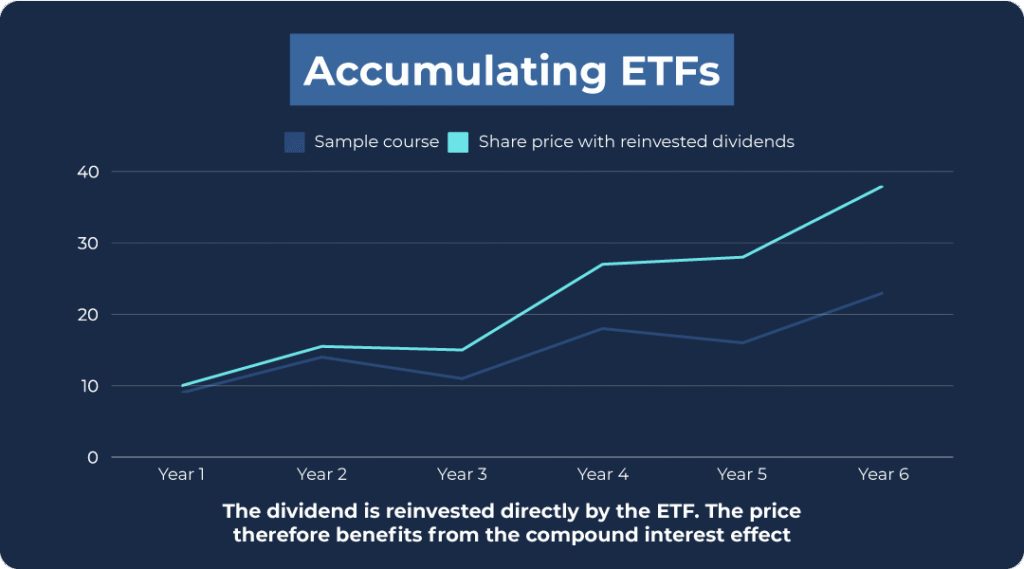
A reinvesting ETF therefore increases in value more quickly, as the distributions are automatically reinvested. As a result, you will achieve a higher profit when you sell your shares one day. Until then, however, you will come away empty-handed.
This accelerated growth also results in a significant compound interest effect: the reinvested capital generates new profits, which in turn generate new profits, which in turn generate new profits… resulting in a strong snowball effect. This would not be the case (or only to a lesser extent) with a payout.
In combination with an ETF savings plan, the non-distributing option is particularly well suited for long-term wealth accumulation. You simply save automatically for several years and can later (for example, when you retire) enjoy a large sum in your securities account.
However, you should also be aware that you are exposing yourself to a certain amount of risk with a reinvesting ETF! This is because if problems arise (stock market crash, economic crisis, etc.), your entire investment will be affected. In the meantime, you will not have received any payouts that could cushion the damage somewhat.
Good to know:
Not every exchange-traded fund generates dividends or interest. Some products (e.g. commodity ETFs or a pure Bitcoin ETF) do not pay out anything and are only worthwhile because of their potential price growth. Nevertheless, they are still referred to as accumulating, even though there is actually nothing to accumulate.
Accumulating or distributing: which is better?
First things first: both forms are useful and have their raison d’être. The right question is therefore not ‘which is better’, but ‘when and for whom is which form better?’.
You probably already have an automatic preference for one of the two options. It may well make sense to listen to your intuition and choose that option! After all, the financial products in your portfolio must ultimately suit you and ‘feel right’ for you – especially if you are planning a long-term investment.
On the other hand, buying assets that you are not completely convinced about can cause a number of problems. Do you constantly check your trading app, feeling stressed, or keep asking yourself whether you have invested in the wrong products? Then your selection is most likely not suited to your personality!
This makes it more difficult to stick to your investment strategy in the long term, remain steadfast even during crises and crashes, and avoid panic selling. So don’t let anyone talk you into anything and, when in doubt, listen to your gut feeling!
If you really don’t have an opinion yet and need more information about accumulation and distribution, we have compiled a handy list of advantages and disadvantages:
Advantages of accumulation
- If an ETF is accumulating, its price rises faster because the distributions remain in the fund. The value of your investment and your entire portfolio will continue to increase. This allows you to build up your assets more quickly and is particularly useful if you are aiming for a specific amount (‘I want to have €250,000 in my portfolio by my 40th birthday’).
- Non-distributing products have a stronger compound interest effect. This is because the money is used to purchase new shares, which in turn generate new profits, which are then used to purchase new shares. This process continues indefinitely and accelerates growth
- There is a significant tax advantage when an ETF is accumulating. The profits are not paid out and are not subject to the regular withholding tax, but to a so-called ‘advance lump sum’. This charge is lower and a larger portion of the payouts goes back into the fund and generates new growth. Only when you sell your shares later does the tax office take action. In the meantime, however, the lack of taxation has already brought you a hefty gain.
- The faster growth can be very motivating. It just feels good to see a big green plus when you look at your portfolio.
Investments always involve the risk of loss. The value of your investments
can go up or down. The forecast or past performance is no guarantee or
prediction of future results.
Do your own research or seek financial advice before making any invest-
ments. The WELCOME promotion is subject to Terms and Conditions. Gift
Shares are allocated randomly from a selection of eligible stocks, with high-
er-value shares awarded less frequently.
Disadvantages of accumulation
- An accumulating ETF is a gamble, as you are betting everything on a later payout. However, if something goes wrong in the future and prices collapse, your efforts will have been in vain. With a distribution product, on the other hand, you would already have earned some cash.
Perhaps you invested in a reinvesting financial sector ETF, but a new financial crisis destroys 90% of its value. Or you put large sums into 3D printing ETFs, but better technology makes the printers obsolete. If prices do not recover, that’s it for your investment. You should be able to live with this risk.
- You need perseverance. Regular payouts have a positive effect on investors’ minds and motivate them to continue saving and working on their own assets. If, on the other hand, the profits remain in the fund, there are no regular cash gifts to keep you going.
- Even during price slumps, crises or massive crashes, reinvesting products can dampen your mood. After all, you have bet everything on price growth! Your fund will most likely recover from these setbacks, but it can be quite stressful until then.
Advantages of distribution
- The biggest advantage is undoubtedly that you benefit from your investment right from the start. This means you don’t have to wait for a specific date to sell your shares in order to make a profit.
- If you are unlucky and your fund’s prices fall permanently, you will at least have earned some returns by then. This reduces your risk and the potential loss.
- There is a break-even point at which the acquisition costs have been amortised. For example, a product with an annual payout of 10% would have recouped its purchase price after ten years (not including inflation). At 5%, it would take 20 years, and so on.
If you make it to this point, the investment has financed itself and you can look forward to future price developments with confidence.
- Regular payouts are motivating and help you to consistently pursue your savings goals.
- The payments allow you to be more flexible with your investments. You can put the profits into other asset classes and invest in P2P lending or a call money account, for example. This allows you to diversify your portfolio bit by bit.
The classic instant access savings account is a must in any investment mix! My articles on instant access savings accounts, Scalable Capital interest rates and Trade Republic interest rates provide a good insight into the best offers.
Disadvantages of distribution
- If an ETF is distributing, you will have to pay significantly more tax in the long term. Every distribution is subject to tax – for the majority of investors, this means a withholding tax of 25% plus solidarity surcharge and, if applicable, church tax. So if your profits exceed your saver’s allowance of €1,000 per year, you will have to pay 26.375% of your income to the tax office.
This represents a financial disadvantage for long-term investments compared to accumulating offers. This is because the latter only have to pay tax once, at the time of sale. Until then, the profits can continue to be used almost undisturbed.
- Capital gains are lower when dividends and other payments are made out. If your goal is to save as much money as possible, you should not rely on distributing funds.
- If you plan to reinvest your payout (in the same or a different financial product), you may incur additional costs and expenses. The usual brokerage fees apply to such transactions. Although it is now possible to invest money completely free of charge (for example, by setting up a free savings plan with a neobroker and deleting it after execution), you still have to invest time and energy in reinvestment.
Investments always involve the risk of loss. The value of your investments
can go up or down. The forecast or past performance is no guarantee or
prediction of future results.
Do your own research or seek financial advice before making any invest-
ments. The WELCOME promotion is subject to Terms and Conditions. Gift
Shares are allocated randomly from a selection of eligible stocks, with high-
er-value shares awarded less frequently.
Conclusion: Whether to choose a reinvesting or distributing ETF is a question of your strategy
How an exchange-traded fund handles profit distributions is a key question when selecting the right product. An ETF can be distributing or reinvesting (saving).
If you want to receive smaller amounts of money on a regular basis that you can spend directly or reinvest, the distributing option is ideal for you. However, keep in mind that each payment is subject to tax and the price growth will be lower.
If an ETF is accumulating, dividends or interest remain in the fund and increase its value. In this case, you can expect a stronger price increase, but you will only benefit when you sell your shares. This additional risk is also made attractive by tax savings. This is because you do not have to pay tax on automatic reinvestment. The tax office only takes action when you sell your shares.
Both forms are fundamentally sensible and generate very similar returns. The decision is largely a question of your personal preference and financial goals. If you are planning to build up your assets in the long term and can do without additional cash, it is best to choose a reinvesting ETF.
If, on the other hand, you want to benefit immediately from
FAQ – Frequently asked questions about accumulating ETFs

