
Choosing the right ETF – correct ETF selection


Whether it’s retirement planning, building a house, protecting against inflation or long-term wealth accumulation, there are many reasons to invest your money. ETFs are an excellent choice for all these goals and more. But with so many securities available, which ones should you invest in? In this article, you will learn which aspects and key figures you should consider when selecting ETFs.
In brief:
- In this article, you will learn what costs you should consider when deciding on an ETF.
- What does physical vs. synthetic replication mean, and does it involve increased risks?
- What types of distributions are available when selecting ETFs, and which option is best suited to your portfolio?
- Find out how large the fund volume and age of your ETF should be and why this matters.
- Learn more about how to build your financial investment strategy and what questions you should ask yourself when choosing a suitable ETF.

Points
Points

Points
Points

Points
Points
Points
Points
Points
Points
Points
Points
Points
Points
Points
Points
Points
0 % without
Points
0 % without
Points
Points
Points
Points
Points
How to choose the right ETFs? Here’s how!
The time has come: you want to invest your money wisely and are considering ETFs. Below, we present some important key figures and aspects that you should consider before making your ETF selection.

Investments always involve the risk of loss. The value of your investments
can go up or down. The forecast or past performance is no guarantee or
prediction of future results.
Do your own research or seek financial advice before making any invest-
ments. The WELCOME promotion is subject to Terms and Conditions. Gift
Shares are allocated randomly from a selection of eligible stocks, with high-
er-value shares awarded less frequently.
Costs of your ETF
In order to achieve the highest possible ETF returns, costs should be kept as low as possible. High ongoing fees will reduce your returns in the long term. Ongoing costs in particular can have a significant impact on your profits.
The ongoing costs are stated as the TER or total expense ratio. This refers to the total cost ratio, which indicates the annual fees incurred for your ETF. This figure is made up of the fees that your bank or broker deducts from the fund volume to cover their own costs.
In addition, there are transaction costs. These are one-off costs, for example if you want to invest a large amount in an ETF. The costs vary depending on the bank or broker. Often there are percentage costs, a flat fee or ETFs that can be purchased free of charge.
Depending on the ETF provider, custody fees may apply. However, it is advisable to find a broker who will allow you to hold your securities free of charge. It is worth comparing different brokers online to find out the exact details of what they offer and get an overview of the options available to you.
Finally, you should be aware of possible spreads. A spread is the difference between the bid and ask price. This can result in high costs, especially if you buy and sell outside of official trading hours.
Good to know:
If you decide to invest regularly in an ETF, for example through a monthly automatic deposit, the costs are often significantly lower than for a one-off investment.
Consider replication types when making your selection
There are basically two different types of replication that are distinguished when selecting ETFs: physical and synthetic ETFs. Below, we explain how they work.
An ETF is based on an index and attempts to replicate it as closely as possible. Physically replicating means that the security replicates the index on a one-to-one basis. The respective weightings are the same. If an ETF is fully replicated, it is replicated in its entirety.
This approach has advantages, such as high transparency. However, it is a disadvantage when large ETFs with many stocks are to be replicated, as it is significantly more complex, time-consuming and therefore associated with higher costs. For this reason, there are securities that are subject to partial replication, also known as ‘sampling’:
- The index is not shown as in the original to avoid high costs.
- Instead, only a few stocks are selected and purchased to represent the index.
- Those that are most significant in the index are purchased. Stocks that are only represented with a very low weighting are not purchased.
The second variant involves synthetically replicated securities. Here, the aim is not to replicate the index as accurately as possible; completely different securities may also be included.
Instead, a contract is concluded with a swap partner. The partner undertakes to pay the dividend, for which it receives a fee from the swap counterparty. This gives rise to the following risk:
- A synthetic replicating ETF relies on its partner fulfilling its obligations.
- If he fails to meet his obligations, collateral is often used.
- This risk is legally limited by the UCITS Directive.
- This limits potential losses to a maximum of 10 percent, with 90 percent protected by collateral.
- In reality, the risk of losses is low; in most cases, collateral of well over 90 percent is provided.

Fund volume: How much should it be?
The fund volume of an ETF indicates how much money has been invested in this fund and is an important factor when selecting your ETF. If you read that an ETF has a volume of 50 million euros, this means that a total of 50 million euros has been invested in the ETF.
But why is this figure important? An ETF in which a lot of money has been invested has firmly established itself on the market. The higher the amount invested, the more established the security. A fund volume of 100 million euros is considered large.
The larger an ETF is, the more profitable it is for the provider. If an ETF is very small and not worthwhile for investors, it can be closed again. You would be informed of this so that you can plan ahead and reallocate your money in good time, thus avoiding a total loss of your ETF investment. This risk is significantly lower with larger ETFs.
However, not all small ETFs are bad. Thematic ETFs, such as solar ETFs, specialise in specific sectors and usually have significantly lower fund volumes. They are riskier and therefore suitable for investors with experience, but they can also offer opportunities.
However, if you are a beginner and are just starting to build up a global portfolio, you should focus on ETFs with a high fund volume of at least €100 million. If you want to plan for the long term and play it safe, you can opt for an ETF with a volume of €500 million.

Tracking difference and tracking error
An important indicator when selecting your ETF is the tracking difference. This describes the difference between the performance of the benchmark index and the selected index within a specific period.
The closer the tracking difference is to 0, the more similar the performance of the securities are. It is important for you to know that the TR takes into account all costs associated with a security. This makes it a useful indicator.
However, this figure relates to the past, which means that no reliable information about the future can be derived from it. It is worth looking at the TR over a longer period of time. This will ensure that the provider can guarantee the quality of the representation across different market phases.
Tracking difference and tracking error are often used interchangeably, but they are not synonymous. The tracking difference is the actual deviation. The tracking error, on the other hand, represents the dispersion of the ETF price around the mean value of the index, thus showing the standard deviation of the fund return.
Select distribution type: reinvestment or distribution
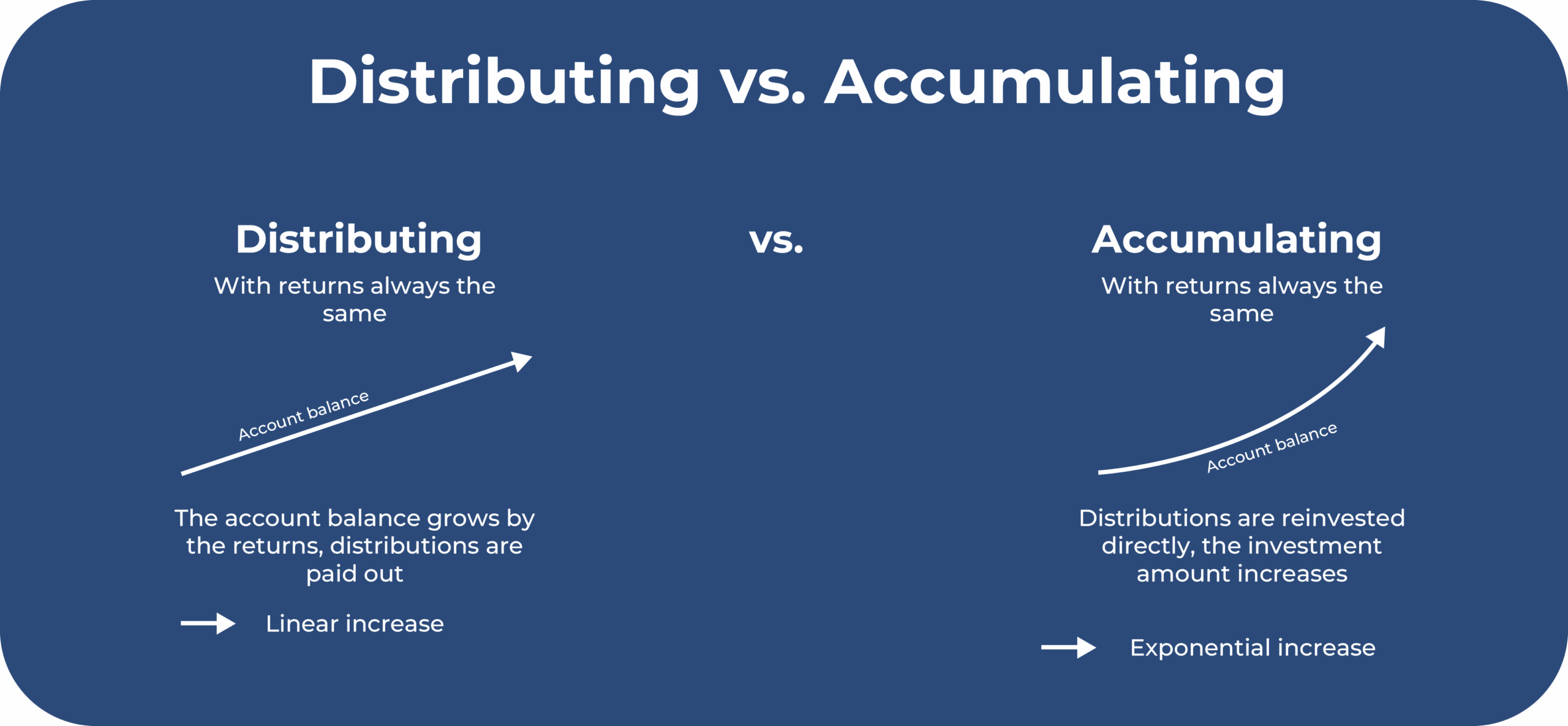
The difference between accumulating and distributing ETFs is what happens to the profits they generate. This decision can affect your returns when investing for the long term.
If you choose a distributing security, you can benefit from regular payouts. These are transferred directly to your account at regular intervals. You can use this money to buy small items or invest the profits in other asset classes.
If you opt for the compounding version, your profits will be reinvested in the same asset class, i.e. they will also be invested. This happens automatically; you don’t need to do anything else. This allows you to benefit from the compound interest effect:
- If you opt for an accumulating option, the profits you have made will be reinvested.
- This means that the profits generated in the future can also contribute to achieving further returns.
- The total amount of your assets working for you will therefore increase.
- The compound interest effect contributes to higher returns and is therefore particularly attractive for long-term investors seeking the highest possible returns.
Good to know:
No distribution type is inherently better or worse than another. The type you choose is a matter of personal preference and can be based on your goals. For some, regular distributions are motivating and help them stick with their investments. Others want to maximise returns and save for the long term, so they choose an accumulating ETF.
ETF selection: Why should you consider age?
Like the fund volume, the age of an ETF provides information about how well established the security is on the market. A long history normally leads to a higher fund volume and sufficient liquidity.
The older the fund, the more information you as an investor will receive about the past performance of your potential security. The ETF should be at least five years old in order to provide sufficient and reliable data.
However, this does not mean that ETFs are inherently better if they are older. Even an older ETF can perform poorly, for example. Nevertheless, age can have advantages and provide clues. If an ETF is relatively old but has a low fund volume, this could be seen as an indication that it will be closed and therefore not worth investing in.
Savings plan vs. one-off investment?
Depending on your investment objective, you should first check whether your ETF is eligible for a savings plan. If, on the other hand, you only want to make a one-off investment, you do not need to consider this aspect.
A stock savings plan for investing in one or more ETFs has a number of advantages. If you set up a regular savings plan, you don’t have to worry about the right time to start.
- With a savings plan, for example, monthly payments are made to your securities account automatically and without any additional effort on your part.
- You don’t need to select the exact time here.
- Due to the many small payments, the price approaches an average, which is also known as the cost average effect.
Another advantage is that you can save regularly and automatically and work on building up your assets, even starting with very small amounts. You don’t have to wait until you have saved up a large amount of money; you can start right away.
However, if you have inherited a fortune that you would like to invest, a one-off payment is often worthwhile. This allows your assets to start working for you and generating returns early on. However, you need to pay attention to the entry point so that you do not buy at a very expensive price. A high payment can have an impact on your future returns.
Savings plans are often offered free of charge. So before you decide on a specific security, consider whether regular savings or a one-off payment is better suited to your financial strategy.
Investments always involve the risk of loss. The value of your investments
can go up or down. The forecast or past performance is no guarantee or
prediction of future results.
Do your own research or seek financial advice before making any invest-
ments. The WELCOME promotion is subject to Terms and Conditions. Gift
Shares are allocated randomly from a selection of eligible stocks, with high-
er-value shares awarded less frequently.
Choosing the right ETF – depending on your strategy
Many personal factors influence your decision, which is why you should develop an investment strategy before choosing a specific ETF.
You may be asking yourself, ‘How safe are ETFs?’ This question is closely linked to your personal risk profile. Are you someone who gets nervous quickly, or can you keep calm even when there are sharp fluctuations?
If you are interested in secure investments and would like to save with an ETF, a high degree of diversification is recommended. This means investing in a security with as many stocks from different countries and sectors as possible in order to significantly reduce potential risks.
If you invest in only one or a few stocks, it is possible that they will become insolvent and you will lose large sums of money. If, on the other hand, you invest in several hundred stocks, this is very unlikely to happen. Your portfolio is balanced, the risk is spread across many different companies and is significantly lower overall.
- If you have already built up a broad-based portfolio and are now ready to take risks in order to generate higher returns, completely different securities may be suitable for you.
- Thematic ETFs often focus on innovative ideas and technologies and may therefore be more suitable for you.
- However, these are significantly less diversified and therefore riskier.
This example shows how important it is to consider your own investment strategy and figure out exactly what you want to save for, when you want to achieve your goal and how much risk you are comfortable with. These answers will have a major impact on your options.
Good to know:
The MSCI World Index, for example, invests in the 1,600 most important companies in industrialised countries and is a very popular choice. With just one ETF, you can invest in numerous different companies from different sectors and countries. This allows you to significantly reduce the risk of your investment.

Fund domicile – important when choosing an ETF?
The place where the ETF was launched is called the fund domicile. This also plays a role. Not all existing ETFs are authorised in Germany and tradable on national stock exchanges.
We are mainly interested in European ETFs. These can be easily identified by the abbreviation ‘UCITS’ in their name. Common fund domiciles include Ireland and Luxembourg due to tax advantages and legal regulations. ETFs are also available in Germany.
- UCITS stands for ‘Undertakings for Collective Investments in Transferable Securities’.
- In Germany, the term OGAW is more commonly used, which stands for ‘Organismus für die gemeinsame Anlage in Wertpapiere’ (organism for collective investment in transferable securities).
- These European directives are intended to guarantee better investor protection.
- Only ETFs that comply with the regulations may be traded.
Conclusion: Selecting the right ETF
If you are new to investing or exchange-traded funds, the selection can seem a little overwhelming. However, if you take some time to familiarise yourself with the aspects discussed, you will quickly build up your knowledge and find the perfect ETF for you.
Pay attention to important key figures such as the tracking difference, the total expense ratio, the fund domicile, the distribution type and the replication method. In addition, you should ensure that the fund volume is high enough and that the ETF is older and has already established itself on the market.
It is also important that you consider your financial strategy in advance. This includes your specific goals and how you intend to achieve them. Once you have thoroughly considered the aspects mentioned above, nothing can go wrong with your ETF selection! Learn more about ‘top ETFs’ or ‘ETF risks’ here.
Points
Points
Points
Points
Points
Points
Points
Points
Points
Points
Points
Points
Points
Points
Points
Points
Points
0 % without
Points
0 % without
Points
Points
Points
Points
Points
FAQ – Frequently asked questions

