
Good ETFs for Trade Republic: Top 10 for your savings plan



The popular broker Trade Republic offers over 2,000 ETFs – so choosing the right one can be difficult! The right product can offer attractive interest rates and good protection through diversification, while other investments may disappoint or even result in a loss.
Reason enough to take a closer look at the best ETFs on Trade Republic! I have compiled my list of the top 10 for 2026 for you.
In brief:
- ETFs are packages of several stocks. They offer you good diversification, which can reduce your risk.
- Despite its many advantages, success is by no means guaranteed. You therefore need to choose the right products.
- I will show you the most important key figures and aspects you can use to identify good ETFs on Trade Republic.
- I will also present my list of the 10 best ETFs that you can buy directly or as part of a savings plan with Trade Republic.
How to find good ETFs on Trade Republic
If you are completely new to this topic, you should first take a look at my comprehensive guide to ETFs. There you will learn all the basics about exchange-traded funds!
Which exchange-traded fund is worth investing in, and which ones will lose money in 2026? Finding the right answer to this question is no easy task, but it is extremely important for our success on the stock markets. ETFs have advantages and disadvantages, and profits are by no means guaranteed! This applies to every ETF, regardless of the broker.
My list of the best ETFs at Trade Republic is an ideal starting point for your ETF search. After all, the wide selection can make it difficult to find the right investment.
The share packages are extremely flexible! There are funds for long-term wealth accumulation or short-term trading, huge global ETFs or tiny niche funds, leveraged products, ETFs that bet against an index, and much more. There is no single ETF investment strategy that will satisfy all investors.
If you have found an interesting product here, you should take a look at the most important criteria and check whether they suit you and your investment strategy.
These characteristics should match your goals and possibilities:
- Risk: Every investment on the stock market involves the risk that you will not achieve the expected returns or even incur losses. Even a total loss of an ETF is theoretically possible, but extremely unlikely. Higher risks are often (but not always!) associated with greater opportunities for returns. A good ETF should offer you the right balance between risk and potential returns.
- Volatility: Risk is often equated with price fluctuations, but this is not correct. Volatility describes how much the price of an asset moves up and down; risk, on the other hand, is the probability that your expected ETF return will not materialise. If you have weak nerves and tend to panic sell, the best ETF for you is one that fluctuates only slightly (= low volatility).
- ESG criteria: If you care about the environment, your fellow human beings and ethical corporate governance, you should consider an ESG fund. The abbreviation stands for ‘environmental, social and governance’.
- Distributing or accumulating: Some stock companies distribute their profits to investors in the form of dividends. If such companies are included in an exchange-traded fund, there are two possibilities: The payments are distributed to ETF investors (distributing) or automatically reinvested in the fund (accumulating). Whether an ETF should be accumulating or distributing depends on your preferences.
In addition, there are factors that play an important role in all exchange-traded funds, regardless of your personal strategy:
- Minimum volume: A good ETF should manage assets of at least €100 million. With smaller amounts, there is a risk that the operator will close the fund because it is not profitable. In this case, you will get your money back, but if the price is currently down, you will incur a loss due to the ‘forced sale’. However, it is not necessarily true that larger fund volumes lead to higher returns.
- Costs: Every exchange-traded fund incurs annual costs, but these are significantly lower than other products when comparing ETFs with funds. Ideally, these expenses are offset by the profits generated. Nevertheless, it is important to look for low fees so as not to jeopardise your returns.
- Replication method: The operator of a fund can either actually buy the stocks it contains (called “physical replication” or “full replication”) or simply secure the rights to them (“synthetic replication”). Most investors prefer the former option, as it is simpler and safer. However, with some products, synthetic replication is unavoidable. Make sure that the replication method suits your level of experience!
For more tips and tricks on successful investing, I also recommend taking a look at my guide, “ETFs for Beginners.”

My top 10 list for 2026: the best ETFs on Trade Republic
The following list is a compilation of what I consider to be the best ETFs currently available on Trade Republic. It is the result of intensive testing and my decades of personal experience. Ultimately, however, it is always a very subjective selection that you should not follow blindly. Only you can make the final decision that fits your strategy!
Attention! This list is not intended as investment advice! I am simply presenting a few titles that I consider attractive based on my personal criteria. Before making a purchase, you should therefore thoroughly review all of the products listed and/or consult a professional investment advisor!
All ETFs are based on an index: a list published and updated by financial service providers such as MSCI, Financial Times Stock Exchange (FTSE) or S&P Global Ratings. The various fund operators use the same indices, so there are almost always several products to choose from.
If you would like to invest in the popular MSCI World Index, for example, you can choose from ETFs offered by Vanguard, iShares, Amundi, Xtrackers and more. They all have minor differences in terms of costs, replication method, fund size, etc., so you have a good selection to choose from. It would be impossible to present all the options, so I have listed only one ETF as an example for each index in my list of good ETFs at Trade Republik.
By the way: My list of good ETFs at Trade Republic is not a ranking, which means that number 1 is not better than number 2, 3, 5 or 10.
All Country World Index Produkte
| Name | iShares MSCI All Country World UCITS |
| ISIN | IE00B6R52259 |
| Volume | 22 billion euros |
| Total expense ratio (TER) | 0,2 % |
We start our list of good ETFs at Trade Republic with one of the most popular classes of all: All Country World products. I am using the iShares MSCI All Country World as an example, as it is particularly large and well known. However, the offerings from Amundi, Xtrackers and other providers work just as well, only the total expense ratio may differ here.
They are all based on the MSCI All Country World Index and contain around 1,600 stocks from around the world. The broad distribution is considered particularly safe and ensures high returns. Unfortunately, there is a strong concentration on US stocks: securities from the United States account for around 57%. As a result, with an ACWI fund, you are always heavily dependent on the US economy.
MSCI World
| Name | iShares Core MSCI World |
| ISIN | IE00B4L5Y983 |
| Volume | 110 billion euros |
| Total expense ratio (TER) | 0,2 % |
Emerging market investments have lost popularity. Both emerging market ETFs and the classic 70-30 portfolio (70% developed markets, 30% emerging markets) have failed to impress recently. Developed markets currently appear significantly more attractive, which could explain the incredible popularity of the iShares Core MSCI World.
The absolute heavyweight (volume: over 90 billion euros!) includes large and medium-sized equities from 23 industrialised nations. With 1,600 stocks included, you are investing in a very diversified portfolio, but you also have to accept a regional concentration: almost two-thirds of the companies included are from the USA!
With its low cost of 0.2%, solid diversification and attractive returns, the Core MSCI World has won the hearts and portfolios of investors. This isn’t the first time I’ve featured it either: it was already on my list of Trade Republic ETFs for a long-term savings plan.
MSCI Emerging Markets
| Name | iShares Core MSCI Emerging Markets |
| ISIN | IE00BKM4GZ66 |
| Volume | 32 billion euros |
| Total expense ratio (TER) | 0,18 % |
As I mentioned earlier, emerging market products have not had an easy time in recent years. Nevertheless, they should not be missing from Trade Republic’s list of good ETFs! Although they cannot compete with US-focused products, they fill an important and attractive niche!
Funds such as the huge iShares Core MSCI Emerging Markets, with a volume of more than €20 billion, have a real life of their own! They react differently to upturns, crises and crashes than the larger industrialised country ETFs. This makes them an exciting addition to your portfolio.
And their returns are by no means disappointing: double-digit returns are not uncommon for the iShares Core MSCI Emerging Markets, much to the delight of investors. This is made possible by good diversification, with Chinese, Indian and Taiwanese stocks each accounting for around 20% of the portfolio.
Global Clean Energy
| Name | iShares Global Clean Energy UCITS |
| ISIN | IE00B1XNHC34 |
| Volume | 2.4 billion euros |
| Total expense ratio (TER) | 0,65 % |
Global Clean Energy is an index for renewable energies that has recently suffered significant losses and is also very expensive, with costs of 0.60 to 0.65% per year (depending on the provider). So why does it appear in my list of good ETFs on Trade Republic? Quite simply because it has great potential! 1.9 billion euros
The current downturn looks particularly dramatic, as the discovery had gained extremely in value in previous years (due to the COVID pandemic, the war in Ukraine, etc.). In addition, Donald Trump’s second term in office – he is not exactly a fan of renewable energies – is currently working against the industry.
However, these slumps do not change the positive outlook for the future: in the long term, there is likely to be no way around clean energy and the 30 companies in this ETF. Investors seem to agree, having already invested an impressive €1.9 billion in the fund! Compared to the top ETFs, however, the slightly higher costs should be taken into account.
Please note that with this product, you are investing in a single industry and taking on considerable risk. The fund may not realise its potential for several years or, in the worst case, never. Nevertheless, I consider it a good ETF with excellent future prospects.
MSCI World SRI
| Name | iShares MSCI World SRI UCITS |
| ISIN | IE00BYX2JD69 |
| Volume | 6.2 billion euros |
| Total expense ratio (TER) | 0,20 % |
Sustainability is a tricky issue when it comes to investments: initially, it has no demonstrable positive effect on average returns. However, more and more investors are turning to environmentally friendly and socially responsible investment products in order to limit the damage caused by their investments.
Whether this makes a real difference or is just greenwashing, as some experts claim, is something you will have to decide for yourself. If you want to invest sustainably, the MSCI World SRI could be right for you. This index filters the popular MSCI World according to ESG standards.
Of the 1,600 companies in the global index, around 400 positions remain. The decision between the regular MSCI World and the SRI variant has little impact on your overall return. However, it could help you sleep more peacefully and contribute to positive change in the long term.
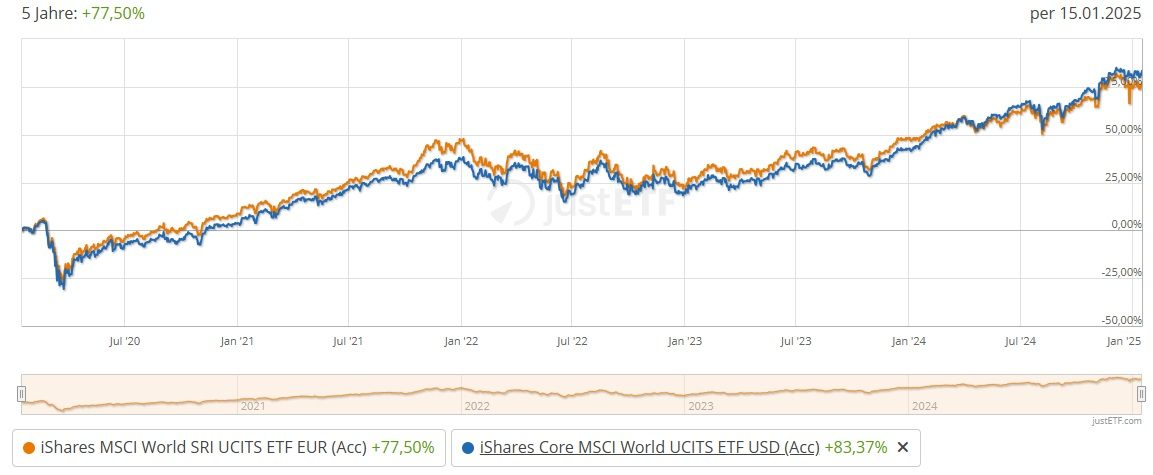
There are hardly any differences between the MSCI World SRI (blue) and MSCI World (red) indices. The key question here is therefore how important sustainability is to you personally.
Nasdaq 100
| Name | Amundi Nasdaq-100 II UCITS |
| ISIN | LU1829221024 |
| Volume | 4 billion euros |
| Total expense ratio (TER) | 0,22 % |
The Nasdaq 100 is a stock index of the 100 largest companies listed on the US stock exchange Nasdaq. However, financial companies are not included. Investors love this index because of its high returns; but in the event of a crash, the setbacks are also considerable!
As usual, you have several good ETFs to choose from if you want to invest in the Nasdaq 100. The Amundi fund presented here is slightly cheaper than its competitors, but unfortunately uses synthetic replication. Variants with full replication as well as distributing and accumulating forms are also available, providing flexibility.
S&P 500
| Name | Vanguard S&P 500 UCITS |
| ISIN | IE00BFMXXD54 |
| Volume | 25 billion euros |
| Total expense ratio (TER) | 0,07 % |
The S&P 500 is probably the best-known stock index in the world. It includes the 500 largest US stock companies, including heavyweights such as Apple, Nvidia, Amazon and Microsoft. Investing in this index via an ETF is extremely lucrative. Other investors agree: the largest fund (from issuer iShares) has a volume of over €100 billion!
To add a little more variety to my list of good ETFs on Trade Republic, I would like to introduce you to the Vanguard S&P 500 UCITS instead. With over €18 billion, it is still extremely large! Like all S&P 500 funds, it also boasts very low costs of just 0.07%.
Given such low fees and the enormous profit potential, it is hardly surprising that the S&P 500 Index is one of the most popular investment products around!
STOXX Global Select Dividend
| Name | iShares STOXX Global Select Dividend 100 UCITS |
| ISIN | DE000A0F5UH1 |
| Volume | 4 billion euros |
| Total expense ratio (TER) | 0,46 % |
Receiving regular dividend payments is very appealing to investors and can motivate you to continue building your wealth. The STOXX Global Select Dividend is an ideal index for building up such payments! It comprises the 100 companies from Europe, North America and Asia with the highest dividend yields.
Currently, you can expect dividends of 4.8% per year. This means that capital gains will naturally be somewhat lower, but still very attractive: you can certainly expect double-digit gains. In return, you will have to pay slightly higher fees of 0.46% per year.
However, these expenses are easily offset by the dividends! If you are pursuing a dividend strategy or simply looking for additional cash flow, this is the right choice for you: For dividend hunters, the STOXX Global Select Dividend is one of the best ETFs at Trade Republic.
MSCI World Small Cap
| Name | iShares MSCI World Small Cap UCITS |
| ISIN | IE00BF4RFH31 |
| Volume | 6.7 billion euros |
| Total expense ratio (TER) | 0,35 % |
Not all investors want to save for decades – some exchange-traded funds are also suitable for short- and medium-term strategies and even for active trading! Those who want to realise their profits more quickly usually opt for investment products with higher volatility. Such fluctuations make it easier to achieve a positive return.
The MSCI World Small Cap could be a good ETF for investors looking to invest for several months to a few years. This is because it fluctuates much more than other products. This is due to its composition: it offers access to small companies (by market capitalisation) from industrialised countries.
An incredible 3,300 such stocks are included! This makes it by far the most comprehensive product in my list of good ETFs at Trade Republic. The diversification between the individual companies is excellent, as no single stock accounts for more than 0.25% of the fund.
Unfortunately, there is a strong concentration in the US: more than 58% of companies are based in the United States. This could be one possible explanation for the increased volatility. Nevertheless, small-cap ETFs remain an exciting asset class that can quickly pay off!
MSCI Europe
| Name | iShares Core MSCI Europe UCITS |
| ISIN | IE00B4K48X80 |
| Volume | 14 billion euros |
| Total expense ratio (TER) | 0,12 % |
If you have invested in one or more of the funds from my list of the best ETFs on Trade Republic, you will probably soon realise that you have far too many US stocks in your portfolio! The MSCI Europe Index is ideal for balancing this out. It contains the 416 largest stock companies from the European Union and the United Kingdom.
This makes it an attractive counterweight to the S&P 500, Nasdaq or MSCI World. The returns are also impressive: double-digit gains have been recorded regularly in recent years! Added to this are low costs of just 0.12% and a large volume of 8 billion euros.
Conclusion: Good ETFs at Trade Republic for every type of investor
Trade Republic is not Germany’s most popular neobroker for nothing! My list of the best ETFs can help you find your way around the wide range of stocks and ETFs on offer.
There you will first find the classics: with the MSCI ACWI as a basis, you can invest broadly in the global economy. The MSCI World, on the other hand, focuses exclusively on industrialised countries, but is also broadly diversified. In the ‘SRI’ variant, an investment also meets social and environmental criteria.
With the S&P 500 and the Nasdaq 100, you are investing directly in the US economy. Alternatively, Trade Republic offers the MSCI Europe, a very good ETF that includes European stock companies. An emerging markets ETF, i.e. a fund for stocks from emerging markets, can also be an interesting addition to your portfolio.
A more specific option is based on the Global Clean Energy Index. Here, you are investing in renewable energies, but you may have to wait a little longer for your profits. The MSCI World Small Cap (small companies from around the world) and the STOXX Global Select Dividend (ETF focusing on dividends) are also special offers that could suit your personal strategy.
Of course, all ETFs presented are available on Trade Republic via direct purchase free of charge through a savings plan. You can find out how this works, how the broker earns money and where you will be asked to pay in my article on ‘Trade Republic: Hidden costs?’.
FAQ – Frequently asked questions

