


You may currently be wondering how you can invest your money as profitably as possible. Shares offer one way of doing this: you can benefit from a company’s performance and build up your wealth in this way. But how exactly does it work? In this article, we’ll show you how this type of investment works and how you can get started!
In brief:
- In this article, we’ll show you how company shares work, what risks are involved, and why you should consider investing in shares
- We’ll show you why diversification is so important and how this approach can help you reduce potential risks
- You will also learn more about the factors you should bear in mind if you wish to invest in company shares
What are stocks?
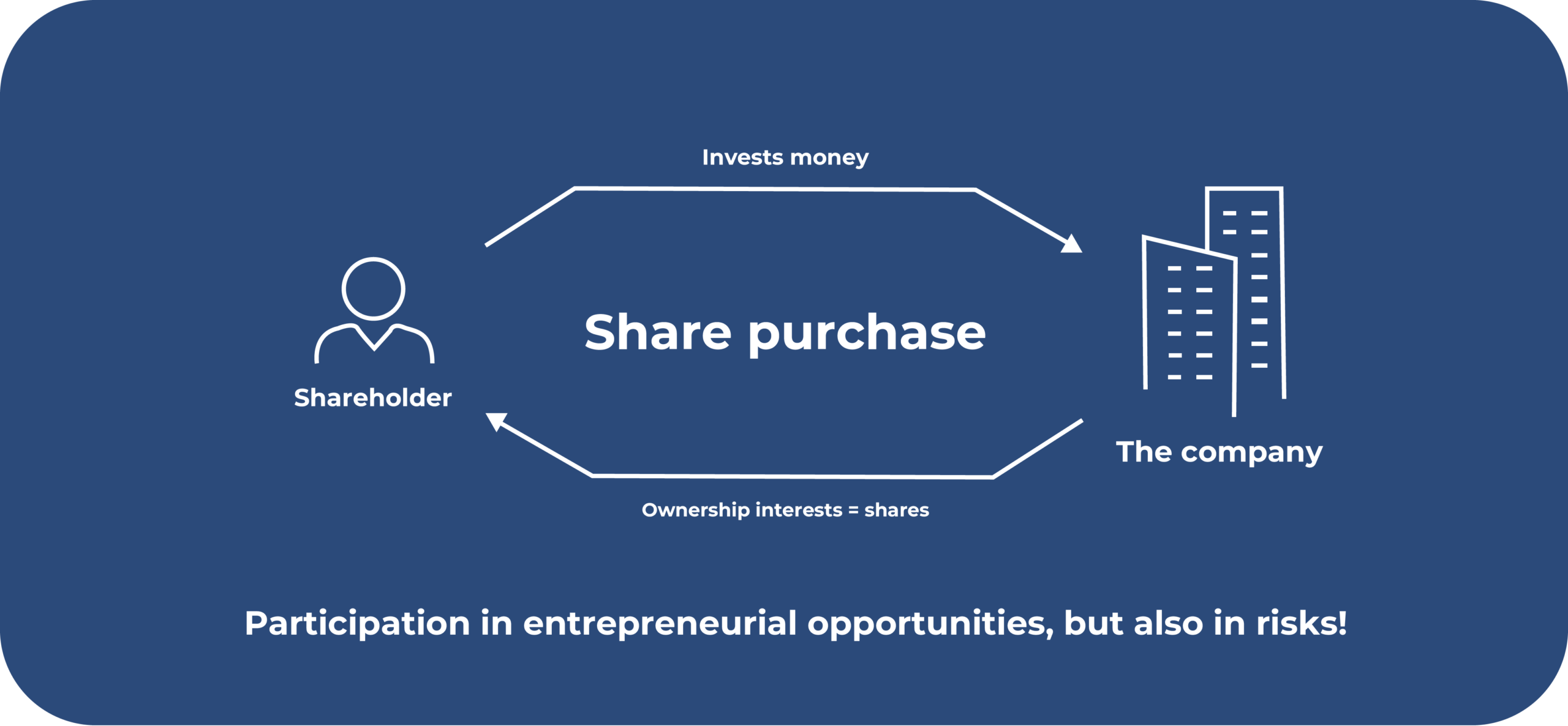
If you decide to invest in a share, you become a co-owner of a company. This comes with certain rights: for example, depending on the type of share, you may be entitled to attend the annual general meeting and take part in decision-making alongside the other shareholders. Small shareholders tend to view shares primarily as an investment and are less likely to exercise their voting rights.
Good to know:
The fundamental aim of buying shares is to profit from the selling price. Shareholders hope to buy shares at a low price and, thanks to positive performance, sell them at a higher price at a later date.
There are, however, other ways to benefit from this investment. When companies make a profit, they may decide to pass it on to their shareholders in the form of dividends. Some investors deliberately develop a dividend strategy so that they can benefit from regular payments.
This is not a requirement, but there are companies that make such payments on a regular basis. Alternatively, companies can use their profits in the following ways, for example:
- Build up a financial cushion for difficult economic times
- Invest in research
- Reinvest profits in new projects
But how exactly does trading in company shares work?
- This investment is mainly traded on the stock market
- Supply and demand determine the share price
- If there is strong demand for a particular company’s shares, the price rises
- In addition, there are a number of other factors, such as current news and political developments
What types of shares are there?
Broadly speaking, there are four different types of company shares: ordinary shares, preference shares, registered shares and bearer shares.
As mentioned earlier, when you buy a share, you may be granted a voting right. You can use this, for example, to vote at the annual general meeting on whether dividends should be paid out and how much they should be. This applies to what are known as ordinary shares. If you have bought several shares, the number of your voting rights will also increase.
If you opt for a preference share, you do not have the right to vote. Instead, shareholders holding such shares usually receive a higher dividend. This also benefits the company: it can increase its equity capital without having to relinquish any rights.
A further distinction is made between bearer shares and registered shares. The holder of a bearer share is entitled to exercise all rights and fulfill all obligations. The disadvantage for companies is that they do not have full information about the structure of their shareholder base.
In contrast, registered shares are recorded in a register containing the names of all shareholders. Only those whose names appear in the register can enjoy the benefits and exercise their rights. Transferring shares is more complicated, but provides companies with more information.

How risky are shares?
Before you invest your money in company shares, it is important to consider the potential risks involved so that you can take appropriate precautions and be prepared.
Company shares are traded on the stock exchange and are therefore subject to price fluctuations:
- These can be substantial in some cases; for example, during an economic crisis, the value may fall by 50 per cent
- Due to the significant fluctuations, company shares are generally considered a long-term investment, allowing for such price movements to be smoothed out
If you invest in individual company shares, this carries a company-specific risk. It is never possible to predict how a particular company will perform. If you have invested in just one company and it goes bankrupt, you could lose your entire investment. It is therefore advisable to ensure that your portfolio is sufficiently diversified.
In addition, there is an industry-specific risk:
- For example, if you have invested in several companies in the same sector and negative trends are becoming apparent due to current political regulations, this applies to all shares in companies within that sector
- Therefore, one should not only diversify across several companies, but also across different sectors
In addition, there is a country-specific risk. If you have invested solely in a particular country, your investment is dependent on that country’s economic performance. Crises may arise that are confined to a single country, such as a natural disaster. In such a case, all company shares from that country would be affected.
Good to know:
As with all other securities traded on the stock market, there are risks associated with company shares. However, you can effectively mitigate these risks if you have done your homework on the investment beforehand. Two key tools for managing these risks are a high degree of diversification and a long-term investment horizon.
Why invest in shares?
Despite the potential risks, there are good reasons to invest in shares. Traditional savings products that used to offer high interest rates, such as savings accounts or building society savings plans, are now of little help when it comes to building wealth. These days, you need other investment options, such as company shares.
Company shares are among the investments offering high returns; you can benefit from capital growth and dividends. Your money can simply work for you and help you build wealth over the long term.
Another reason is inflation:
- This refers to a general rise in prices
- High inflation rates mean that your money loses its value
- For the same amount of money, you can afford fewer and fewer products and services
- Traditional investments won’t help you keep pace with inflation, but company shares can
In addition, you can benefit from compound interest if you invest in company shares over the long term. Profits you have already made can be reinvested to generate further returns. In this way, the total amount working for you grows steadily, and over time, wealth accumulation becomes faster and more effective.
Also, investing in shares has never been easier than it is today. Thanks to digitalisation, anyone can now invest money via their laptop or smartphone. All you need is an account with a broker or a bank, and you can start investing in no time.

There are a few things you should bear in mind before investing in company shares. Below, we’ve put together some tips to help you.
Define clear objectives
You can only invest successfully if you’ve set yourself some goals. Ask yourself why you want to invest. Do you want to buy a house in the future or top up your future pension? You might also want to provide for your family financially or help your children pay for their driving lessons in the future.
If you know exactly what your goals are, you can make a much more realistic assessment of how much money you’ll need and how long you’ll have to invest. Only when you have a clear understanding of your goals can you develop a suitable strategy and tailor it to your individual circumstances.
Reducing risk through diversification
When discussing potential risks, we have already mentioned sector, country and company risk, for example. All these risks arise when your invested capital is not diversified but is concentrated in a single company, country or sector.
This comes with risks. It is impossible to predict exactly how certain sectors will perform. That is why you should minimise your risk by spreading your investments. To do this, invest in a wide range of company shares, countries and sectors.
If, for example, you invest all your assets in a single share, that company could go bankrupt. In such a case, you could suffer a total loss, meaning you could lose all your money. If, on the other hand, you invest in a number of different companies, any losses will be offset by profits from other investments.
Reduce costs
High costs can reduce your profits in the long run. It’s essential that you keep these as low as possible so that you can generate a higher return in the end. This involves several factors, such as choosing your broker or bank.
There are plenty of resources online to help you compare banks and brokers. All the possible costs are listed here, so you can make sure to keep them as low as possible and avoid reducing your returns. Take a look at my stock broker comparison here.
You also have the option of setting up a savings plan for many company shares, allowing you to invest at regular intervals:
- Not all banks offer savings plans that are free of charge
- You can save a lot of money here if you look out for a free savings plan
- You should also compare trading fees to find the best possible deal for you
Good to know:
There are also transaction costs to consider, for example. You should therefore keep the number of transactions to a minimum and avoid constantly moving your assets around.
Please note the start date
When investing in company shares, the timing of your buy and sell decisions plays a key role due to price fluctuations. If you buy at a particularly high price, this can reduce your returns.
If, for example, you invest via a share savings plan, the timing doesn’t matter, as investments are made automatically on specific, pre-determined days. This means you have no way of changing the time.
- How important the timing of your investment is also depends on the length of your investment horizon
- If you’re looking at a very long investment horizon, you can expect the fluctuations to even themselves out; the timing isn’t particularly important in this case
If you tend to focus on the short term and want to trade shares, the timing of your entry is very important. Traders aim to make a profit by capitalising on short-term market fluctuations. This type of trading is significantly riskier and is not suitable if you have no experience.
An alternative to shares?
It can be time-consuming to pick out lots of individual company shares to build and diversify your portfolio. There’s an easier way: using ETFs, or exchange-traded funds. These are funds traded on the stock exchange that track an index and aim to replicate it as closely as possible.
One example of an index could be the DAX. By investing in a DAX ETF, you would be investing in the 40 largest German companies. ETFs are funds; they can invest in company shares, commodities or bonds.
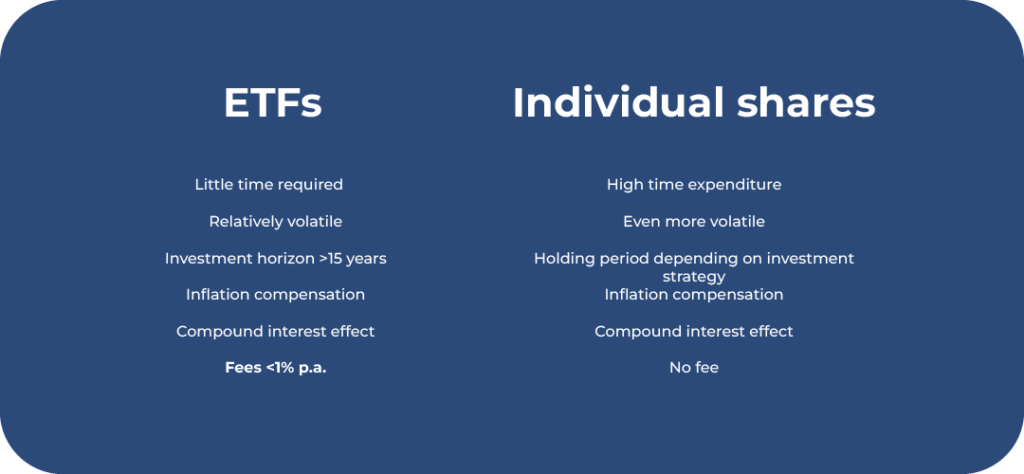
The advantage is that they offer a very high degree of diversification with just a single security:
- If, for example, you opt for the MSCI World Index – a very popular index for ETFs – you can invest in the 1,600 leading companies in developed countries
- ETFs are also a very cost-effective investment option, due to their passive management style
Company shares allow you, as an investor, to benefit from capital growth and dividends. They offer a higher return than traditional investments, can help you combat inflation and protect your money, and help you build wealth through the power of compound interest.
These opportunities come with various risks. These include the fact that company shares are subject to price fluctuations. You should also bear in mind company-specific risk, sector risk and country risk. You can mitigate these risks by ensuring sufficient diversification and adopting a long-term investment horizon.
We’ve also provided some tips to bear in mind if you’re thinking of investing in company shares. Think carefully beforehand about why you want to invest, so that you know how much you’ll need and can work out a strategy. You should also pay attention to the timing of your investment and aim to keep costs to a minimum. Find out more here.
FAQ – Frequently Asked Questions

