
Here’s how to replicate the Norwegian Government Pension Fund using ETFs!


The Norwegian sovereign wealth fund, officially known as the Government Pension Fund Global (GPFG), is one of the world’s most successful funds and now manages over US$2 trillion (as at 31 December 2025). With its broad range of asset classes, spanning global equity markets, bonds and property investments, the fund consistently delivers impressive returns, thereby securing a sustainable pension provision for future generations in Norway. In this article, we take a closer look at the fund’s performance and show you, as an investor, how you can replicate the Norwegian sovereign wealth fund’s portfolio using just five ETFs.
In brief:
- The Norwegian Government Pension Fund achieves an average annual return of 6.64%, which contributes to the population’s retirement provision.
- At 71%, equities account for the largest share of the fund’s assets.
- Investments in renewable energy infrastructure are expected to yield an above-average return of 18% by 2025.
- Investors can replicate the portfolio of the Norwegian pension fund using just five ETFs, thereby investing in their retirement provision at a low cost.
The Norwegian Government Pension Fund: Returns for the previous year (2025)
The Norwegian Government Pension Fund’s performance last year was certainly impressive. We have taken a closer look at the 2025 annual accounts and calculated the specific return figures.
Last year, the Norwegian Government Pension Fund generated a return of no less than 15.1% for the population’s retirement provisions.

Investments always involve the risk of loss. The value of your investments
can go up or down. The forecast or past performance is no guarantee or
prediction of future results.
Do your own research or seek financial advice before making any invest-
ments. The WELCOME promotion is subject to Terms and Conditions. Gift
Shares are allocated randomly from a selection of eligible stocks, with high-
er-value shares awarded less frequently.
The breakdown of returns by asset class:
- Shares: 19.3%
- Fixed-income bonds: 5.4%
- Non-listed property: 4.4%
- Unlisted investments in renewable energy infrastructure: 18.1%
The fund’s equity allocation stands at 71.3% – a figure I consider favourable, although I believe it could be increased further. Bonds account for 26.5%. The smallest allocation is to non-listed property and investments in renewable energy infrastructure, which together account for 2.1%.
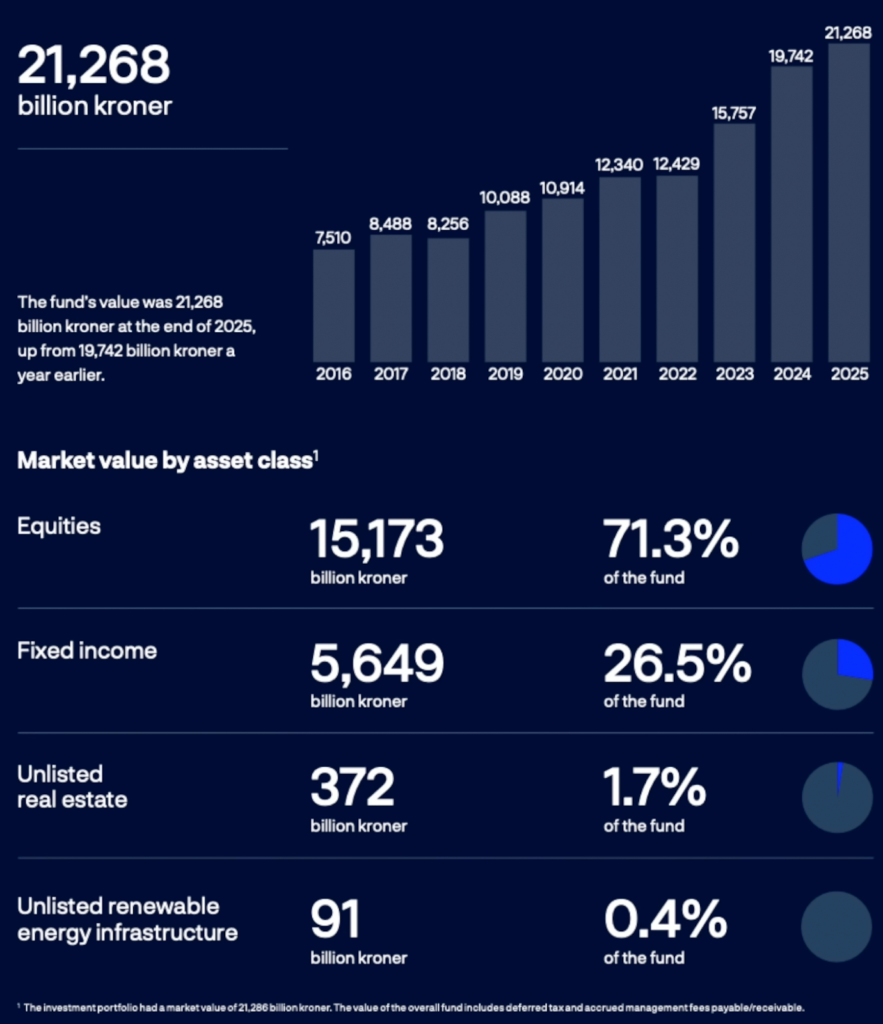
Since its inception in 1998, the Norwegian Government Pension Fund has achieved an average return of 6.64%. That is a 0.74% increase in returns compared with 2020, demonstrating just how well things have gone in recent years.
The following chart shows the annual return as a bar chart. It is clear from this that positive returns were achieved in most years. At the same time, the volatility of the average return (blue line) has decreased over the years. The performance of the Norwegian sovereign wealth fund is therefore becoming increasingly reliable.

We’ll now take a look at the fund’s key drivers and inhibitors of returns, and explore how you can replicate the Norwegian sovereign wealth fund using ETFs to secure your retirement savings.
Norwegian Government Pension Fund: Equity Performance
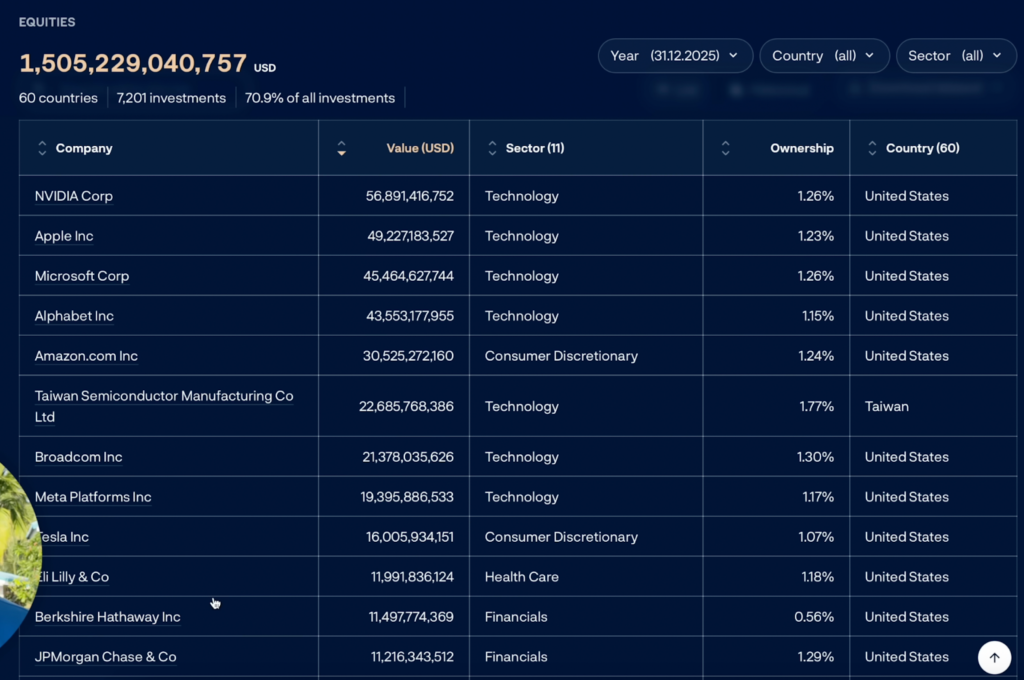
Through its equity investments, the Norwegian pension fund invests in the world’s largest companies, holding substantial stakes in some of them. The fund has invested just under US$57 billion in NVIDIA, representing 1.26% of the company’s total value.
Other companies include Apple, Microsoft, Amazon and TSM, in which the Norwegian sovereign wealth fund also holds a stake of more than 1%, as illustrated in the chart below.
Markets outside the US, particularly China, Switzerland, Taiwan and Canada, also delivered strong returns last year. Another interesting point for all ETF investors is that the US is significantly underweighted at 54.7% compared with one of the best-known ETFs, such as the MSCI World, in which the US currently accounts for 71%.
The sovereign wealth fund is also underweight in emerging markets: China, the world’s second-largest economy, accounts for just 3.6% of the fund. In my view, that is a mistake. European markets, on the other hand, are much more strongly represented.

The sector breakdown of the Norwegian Government Pension Fund is, in turn, very similar to that of the MSCI World Index, with technology shares leading the way, followed by financial institutions and consumer goods.
Norwegian Government Pension Fund: Bond Performance
Within the bond category, the Norwegian sovereign wealth fund invests most of its money in government bonds. However, these yielded the lowest return in 2025, at just 4.1%.
It is interesting to note that government-backed bonds have yielded a return of 7.7%, which is almost double that figure.
Covered bonds generated the highest return for the Norwegian sovereign wealth fund last year, at 11.7%.

Good to know:
Bonds issued by the government of one country in the currency of another country are regarded as sovereign bonds. Finland and Denmark issued US dollar-denominated bonds in 2025 in order to diversify their financing.
It is interesting to observe the trend in the proportion of the Norwegian pension fund accounted for by bonds. The following graph shows how this figure has risen since 2020 and has even doubled since then.

Investments always involve the risk of loss. The value of your investments
can go up or down. The forecast or past performance is no guarantee or
prediction of future results.
Do your own research or seek financial advice before making any invest-
ments. The WELCOME promotion is subject to Terms and Conditions. Gift
Shares are allocated randomly from a selection of eligible stocks, with high-
er-value shares awarded less frequently.
Norwegian Government Pension Fund: Property Performance
With regard to its property investments, the Norwegian sovereign wealth fund invests directly in the entire property, which it then owns in its entirety. One example of this is America’s Tower in New York, which the fund has acquired.
However, around half of all property investment goes into offices, which are generally struggling with the trend towards more working from home.
The limit on the fund’s property investments is 7% of the fund’s total assets. The fund is gradually approaching this limit and will invest substantial sums in this position in 2024 and 2025.

The rental yield for 2025 stands at 4.4%, which is slightly higher than the average of 4.0%. Below you can see the breakdown of property investments by sector and country.
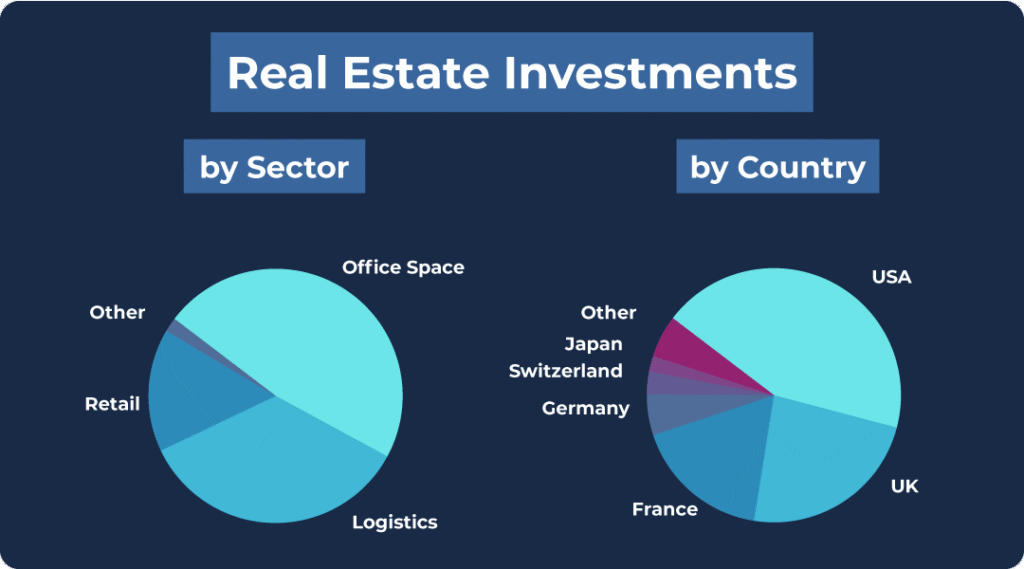
Just under half of the total property portfolio is represented by publicly traded shares, such as REITs. In addition, 1.4% of the total fund is invested.
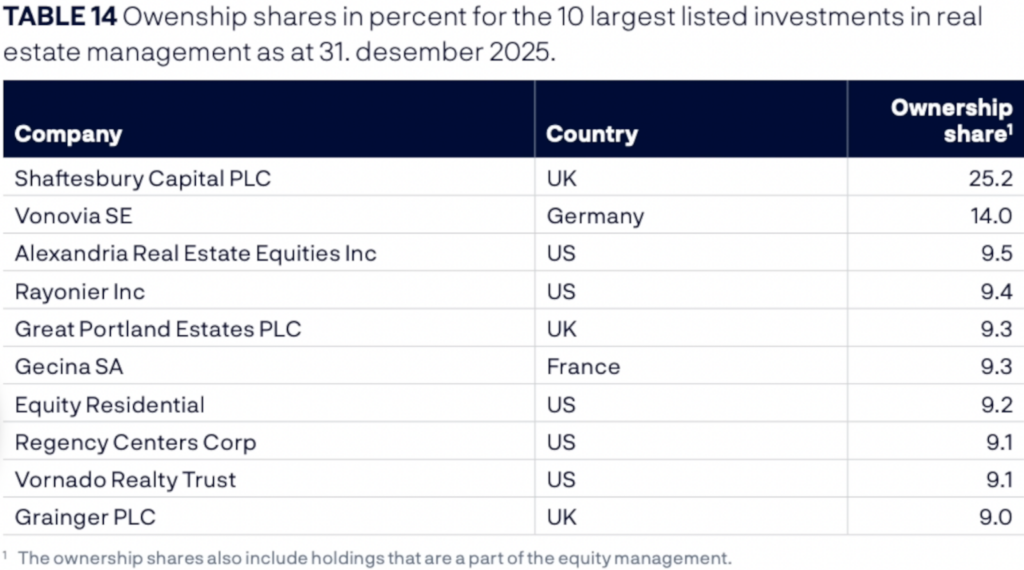
You can see the fund’s largest holdings in the chart below; the fund holds between 9% and 25% of each of these.
Norwegian Government Pension Fund: Performance of unlisted investments in renewable energy infrastructure
Thanks to its exposure to the sector of non-listed investments in renewable energy infrastructure, the fund achieved an incredibly strong return of 18.1% in 2025.
However, the fund has a very low exposure to this sector, at just 0.4%, which equates to US$5.9 billion. However, the Norwegian sovereign wealth fund sees a bright future for renewable energy and says that there is currently more money to be made from it than in the past. Investments are therefore to be increased.
Last year’s investments included two offshore wind projects in Denmark and Germany, as well as investments in the German electricity transmission network through the purchase of shares in TenneT.
The fund typically acquires a 49% minority stake in large-scale individual wind and solar power projects.

Investments in renewable energy appear to have been very profitable for the Norwegian sovereign wealth fund. As an investor, you’re probably wondering how you can replicate this sector in your own portfolio.
Unfortunately, there are currently very few ETFs focused on renewable energy. One of the best-known is the iShares Global Clean Energy Transition ETF. However, it has been in the red ever since it was launched in 2008. Even over the last five years, investors have made a loss with this ETF.
Personally, I prefer to invest my money through Ventus Energy. Here, too, I invest in renewable energy projects and receive a fixed annual return of 16% plus cashback. In addition, I have the option of exiting projects early via the Early Exit scheme should they no longer suit me.

I currently have €15,000 invested in Ventus, and my actual return is actually 22%. Take a look at my latest review of Ventus Energy to find out more about the platform.

Ventus Energy is currently undergoing restructuring and is not accepting new investors or investments. That's why I'm investing my new funds on Monefit. As a welcome gift, you'll receive a €5 bonus + 0.75% (for 90 days).
Let’s now take a look at how you can replicate the Norwegian Government Pension Fund using ETFs.
Norwegian Government Pension Fund for retail investors: These are the ETFs you need
To hold a stake in the Norwegian Government Pension Fund, you must be a Norwegian citizen. If that isn’t you, you have the option of replicating the Norwegian Government Pension Fund using ETFs.
We’ll start with the fund’s largest asset class, namely equities – these account for 71%. To this end, we use the same index as the Norwegians: the FTSE Global All Cap Index.
First of all: the index is not available in this form within the EU and is traded exclusively in the UK in British pounds. This makes currency exchange and trade relatively expensive. For this reason, we use a suitable alternative: the Vanguard ESG Global All Cap ETF.

As the Norwegian pension fund also adheres strictly to ESG guidelines, this is the appropriate index.
For the 26% invested in bonds, we use two ETFs:
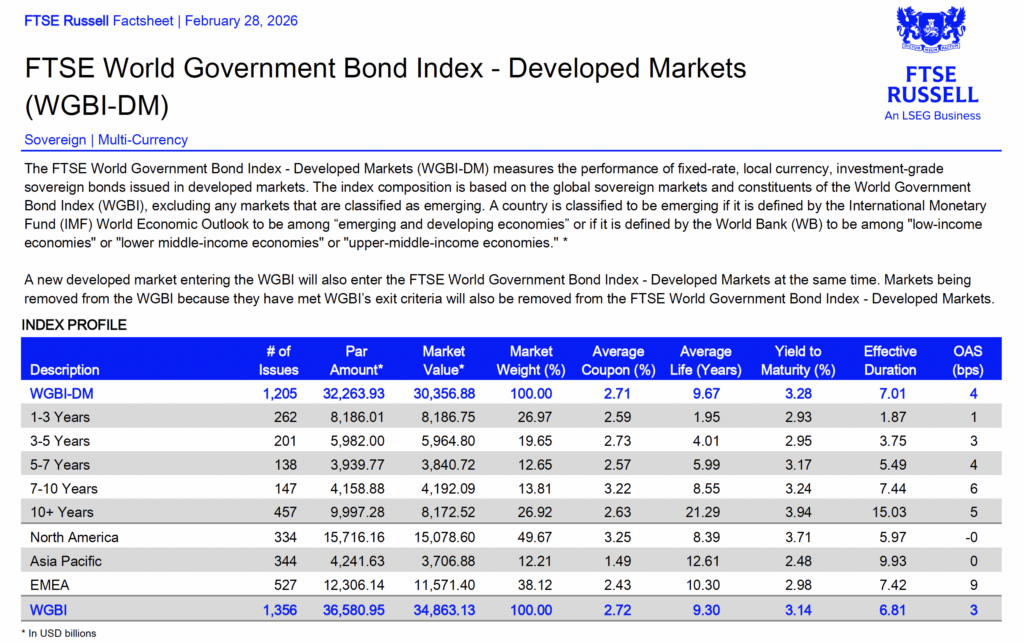
- FTSE World Government Bond Index – Developed Markets
- iShares Global Corporate Bond ETF
The former tracks government bonds from developed countries and invests the majority of its funds in North America, followed by EMEA (Europe, the Middle East and Africa) and Asia-Pacific. The FTSE World Government Bond Index deliberately does not invest in emerging markets.
The iShares Global Corporate Bond ETF, on the other hand, tracks corporate bonds from around the world that have an investment-grade rating.

For the 1.7% of the Norwegian pension fund allocated to property, we use the VanEck Global Real Estate ETF. This fund is broadly diversified across 100 holdings and has assets under management of €346 million.

Last but not least, let’s take a look at renewable energy. As mentioned earlier, we could use the iShares Global Clean Energy Transition ETF for this, but given its very poor historical performance, I would opt for an alternative such as Ventus Energy.
The table below provides an overview of the ETFs you’ll need to replicate the Norwegian Government Pension Fund yourself.
Investments always involve the risk of loss. The value of your investments
can go up or down. The forecast or past performance is no guarantee or
prediction of future results.
Do your own research or seek financial advice before making any invest-
ments. The WELCOME promotion is subject to Terms and Conditions. Gift
Shares are allocated randomly from a selection of eligible stocks, with high-
er-value shares awarded less frequently.
Replicating the Norwegian Government Pension Fund using ETFs
| Asset class | Recommended ETF | ISIN | 3-year performance (as at 17 March 2026) |
| Shares | Vanguard ESG Global All Cap UCITS ETF (Acc) | IE00BNG8L278 | 54,06% |
| Bonds (government) | Xtrackers Global Government Bond UCITS ETF | LU0690964092 | -1,44 % |
| Bonds (corporate) | iShares Global Corporate Bond UCITS ETF | IE00B7J7TB45 | 9,57 % |
| real estate | VanEck Global Real Estate UCITS ETF | NL0009690239 | 27,39 % |
| Renewable energy | iShares Global Clean Energy Transition UCITS ETF Alternative: Ventus Energy with 16% interest + cashback | IE000U58J0M1 | -6,45 % |
Conclusion: You can easily benefit from the Norwegian Government Pension Fund
The Norwegian sovereign wealth fund, the Government Pension Fund Global (GPFG), is regarded internationally as a model for sustainable wealth creation. The fund is broadly diversified across all asset classes, including equities, bonds, property and renewable energy, with equities accounting for the largest share of the fund’s total assets at 71%. Since its inception, the fund has generated a positive return in most years, currently averaging 6.64%. Whilst direct investment is restricted to Norwegian citizens only, as a private investor you need not miss out on the benefits of this strategy. With just 5 carefully selected ETFs, you can easily replicate the Norwegian bond fund. This allows you to benefit from the fund’s performance and secure your own retirement provision for the long term.
FAQ: Why is the Norwegian Government Pension Fund of interest to investors?

