
Investment options in 2026: an overview of your choices


Anyone looking to invest their money wisely these days is quickly overwhelmed by the vast array of options available. Deciding whether to invest in shares, save through ETFs, go for the traditional route of government bonds, give P2P lending a go, venture into gold investments or try their hand at cryptocurrencies seems an impossible task. Every form of asset management has its pros and cons. In this article, you’ll learn how to build a diversified portfolio.
In brief:
- With rising prices and inflation, it is becoming increasingly worthwhile to invest independently
- The internet is full of all sorts of tips and advice, and it’s easy to get overwhelmed
- A well-thought-out strategy and a carefully considered approach are essential
Some preliminary thoughts on your investment
Before you invest blindly in a particular type of investment, you should draw up a clear plan of what you want to achieve with your investment and be clear about the following steps. The fact that you’re reading this article is the first step in the right direction.
If you want to invest your money, you’ll at least want to preserve the value of your assets. This means keeping pace with ever-present inflation. But why is that so important?
Inflation means that the same amount of money, for example €10,000, no longer has the same value as it did some time ago. So, for example, 10 years ago you could buy more with €10,000 than you can now. You can clearly see the loss of value of money in everyday examples. The most common example would be a scoop of ice cream. Whilst this cost just under €1.50 in most German cities in 2022, the average price is now €1.70.
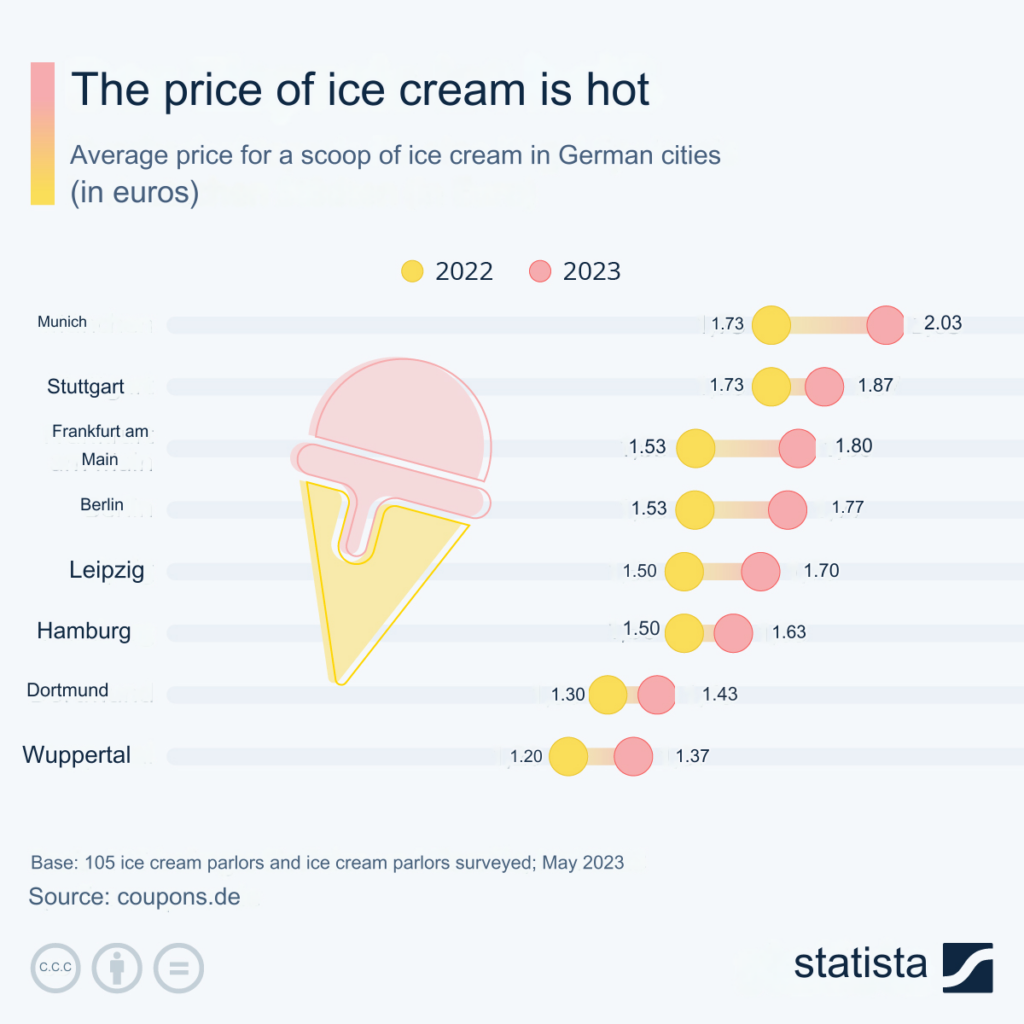
Source: Statista
Your primary goal when investing should therefore be to beat this inflation, so that your money does not lose value. This happens, for example, if you simply leave your money sitting in your bank account. It would not grow in value there; instead, without you even realising it, you would become poorer.
The second major goal of investing is wealth creation. The aim is not simply to preserve the value of one’s money, but also to grow it. This self-declared goal makes sense for a number of reasons
- Building a passive income stream
Who doesn’t dream of a 13th month’s salary? By investing wisely in various investment vehicles, this is certainly possible. What matters with these investment vehicles is a high return and stability.
- Building up a supplementary pension
Pensions in Germany are falling year on year. For people on lower incomes, this is often not enough to live on in old age. If you start investing in your future now, it could well pay off. For this sub-goal, you should focus on long-term investments.
- The final factor could be setting aside some savings. It never hurts to be prepared for unexpected events. An unforeseen accident, problems with your home or other issues. Building up a nest egg alongside your other finances could be worth its weight in gold should you find yourself in a difficult situation.

Further considerations and steps to take before you invest
Once you have decided on the purpose of your investment, you should give the matter further thought and take some preliminary steps before making your first transfer or investment. You can regard the following steps as a sort of primer.
Pay off your debts first
If you tend to keep jumping at new ideas and trying out the latest investment opportunity, it’s best to pause for a moment. If you still have outstanding loans, pay those off first. The interest on such loans is usually higher than the expected returns on your investments. (Bear in mind that paying off your debts isn’t always a smarter move than saving, but it usually is.)
Take stock of your total assets
Get a clear overview of your finances. It’s fine if this takes a bit of time. You should go through all your accounts and really take a close look at your current contracts and so on. After all, having a certain amount of capital is a good starting point for investing.
This assessment also takes your personal circumstances into account. How secure is your income, or rather, how much do you earn? Are you a civil servant or self-employed? Do you have a family? How much can you set aside each month? Based on your answers, you’ll be able to get a good idea of the size of your investment and your risk tolerance.
High potential returns = Higher risk
Of course, we’d all love to achieve the highest possible returns, enough to cover a thirteenth month’s salary. However, these aren’t handed to you on a plate. Shares traded on the stock market, for example, can offer you a better return than forms of investment such as call money and fixed-term deposits. In return, though, you’ll have to accept price fluctuations and greater risks.
The longer you save, the better
When it comes to investing in the stock market, the difference between success and failure usually comes down to the length of the investment. For example, if you buy shares at a high price and then sell them in a panic during a crisis, much of your investment could be wiped out. That is why, with most investments, the key is to stay calm. Long-term strategies, in particular, pay off this way.
Wide distribution – the more, the better
If you consider a range of different investment options when building your portfolio and include them in it, the risk of a total loss is reduced. You are making use of the principle of diversification, in much the same way as funds or ETFs do.
Improving returns through low costs
Very few sensible forms of investment are completely free of charge. In most cases, there are costs involved in managing your money or investing it. Whilst instant access and fixed-term savings accounts are often almost free, custody accounts for share investments or funds usually incur a management fee. These can sometimes run as high as 2%. A more cost-effective alternative is what are known as index funds, also called ETFs. These incur no management fees and can often be invested in via neo-brokers without an initial fee.
Good to know:
Don’t rush into an investment. You should always bear these basic rules and considerations in mind before making any investment. If you act hastily, in 99% of cases you’ll simply lose your money.
3 steps to investing in different types of investments
We’re now going to give you an exclusive step-by-step guide on how to make your investment. This will help you prepare for the process as effectively as possible, and once you’ve chosen your investment option, you can start investing straight away.
- Step: Determine your investment horizon and savings goal
We have already discussed savings goals. As a general rule, it always makes sense to plan and make long-term investments. A time frame of up to five years is referred to as a short-term investment, five to ten years as a medium-term investment, and anything over 10 years as a long-term investment.
A look at the performance of the MSCI World index shows just how rewarding long-term investments can be. This index tracks the world’s most successful companies and is a popular fund index (i.e. ETF), which is often used for regular savings plans.
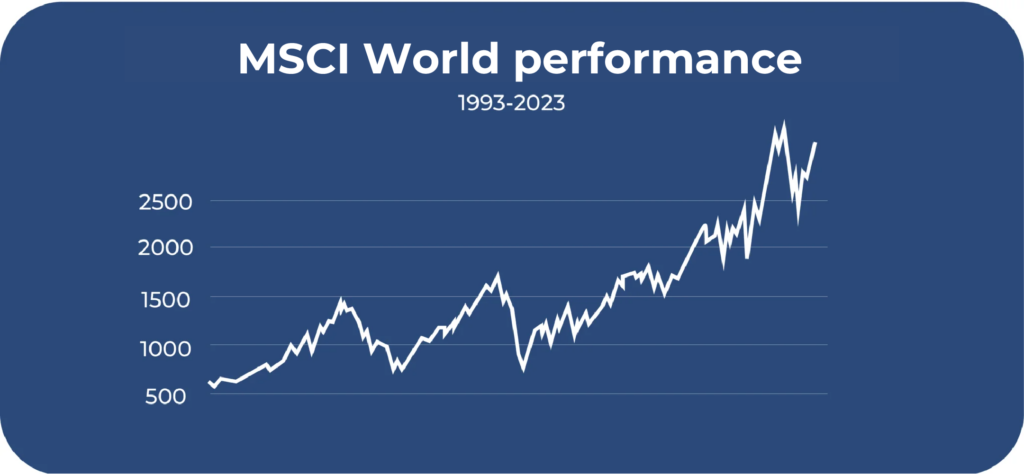
It is clear that the index is steadily increasing in value. The average annual return from 1975 to 2022 rose by 9.5%. A good figure, albeit over a correspondingly long period. The graph also shows that the loss during the longest market slump – from September 2000 to March 2003 – amounted to 54%. It is therefore clear that long-term investing, in particular, has its advantages.
You should ask yourself three questions before choosing an investment option:
- How long can you go without that money?
- How many losses can you cope with in the meantime?
- How much money would you like to have at the end of the investment period?
- Step: Allocate the money correctly
Now you should think carefully about how you want to achieve the goal you have set yourself. You can choose from a wide variety of investment types and asset classes.
Of course, we don’t want to give anything away just yet. You can now scroll down, have a look at our tips for each class, and then continue with the guide once you’ve made your decision.
- Step: Invest and keep calm
You should now have a plan for what you want to invest in and how. Now it’s time to put it into action. Depending on the type of investment, there are various providers to choose from.
When considering traditional options such as current accounts and fixed-term savings accounts, you’ll need to choose a bank. Bear in mind that it’s not just your local banks that are worth considering. Online banks also regularly offer attractive interest rates. Make sure you consider every option.
If you’re thinking of investing in shares, funds and ETFs, it’s often worth comparing different brokers. This often involves comparing providers, such as the neo-brokers Scalable Capital and Trade Republic, to determine which one is best suited to your needs.

These are the best investment options in terms of return and risk
The time has come: we’re now going to introduce you to our top investment options. Please note that these are not recommendations nor do they constitute financial advice; rather, they are intended to give you an idea of what you can do to get a step closer to your financial goals.
However, we want to limit ourselves somewhat when it comes to investment options. Of course, you can also invest your money in property and commodities. In our view, however, the most sensible approach involves call money, fixed-term deposits, shares or ETFs, as well as P2P lending.
1. Call money
Probably the safest and most conservative way to invest and save your money. You save your money in a call money account, which is legally protected by a deposit guarantee scheme within the EU.
| Advantages | Disadvantages |
| Safe storage of your assets. No negative impact on your assets, for example due to falling prices. | Low returns. These are set by the bank in the form of interest rates and are usually not particularly high. Furthermore, unlike with shares, for example, they cannot increase. |
| Available and accessible every day – you have full control over your savings, making it ideal for your emergency fund. | No flexibility despite being available every day. You can’t change much or reposition things. |
| Protected by the European deposit guarantee scheme. |
2. Fixed-term deposit
This type of investment is also considered very safe. In terms of the account type, it works in a similar way to a call money account, but without the option of daily access. In return, however, you receive higher returns.
| Advantages | Disadvantages |
| Safe storage of your assets. No negative impact on your assets, for example due to falling prices. | Nevertheless, the returns are low. These are set by the bank in the form of interest rates and are generally not particularly high. Furthermore, unlike with shares, for example, they cannot increase. |
| A slightly higher return than with a call money account. | As it isn’t available on a daily basis, it’s not really suitable for money you need to access frequently. You should also base the term and other details on your specific needs. |
| Protected by the European deposit guarantee scheme. |
3. Shares and ETFs as savings plans
The third investment option involves investing in shares. This involves setting up a savings plan, which means making a fixed monthly investment in the relevant asset. Of course, you can also invest in any asset via a one-off investment.
Individual share savings plan:
You invest in a share of your choice every month. It doesn’t matter how big the company is, as you can often invest in fractions of a share (at least with most online brokers)
| Advantages | Disadvantages |
| High dividends can provide a source of passive income. | Choosing the right company can often be overwhelming, which may lead you to make a hasty decision – or not make one at all. |
| By investing in fractions of shares, you can invest in specific companies in a targeted manner. | By focusing on a single share, you become heavily reliant on it. Crises or other changes can have a major impact on your savings plan. |
| Investing in a single share is a bit of a gamble. You’re always on the lookout and can always find a share that might actually be a better fit. |
ETF savings plan
An ETF tracks an index such as the DAX or the MSCI World. The ETF in question automatically invests in the shares included in the index, without any human intervention.
| Advantages | Disadvantages |
| Low costs; some providers don’t even charge any fees for investing in ETFs. | The ETF savings plan is somewhat “left to its own devices”. Depending on their focus, the indices are entirely at the mercy of the economy. This applies particularly to ETFs that track the global economy. |
| They are completely independent; the relevant index is not monitored by humans but operates automatically. | A degree of caution is advised when it comes to so-called “thematic ETFs”. These are sometimes based on simple trends and do not constitute a genuine index. Examples would include crypto ETFs and the like. |
| In some cases, very high returns are possible. On average, ETF returns stand at a solid 7%–8%. | |
| Established ETFs sometimes have a lower cost-average effect due to the large number of investors per ETF. |
4. Peer-to-peer lending
The term P2P stands for ‘peer-to-peer’. P2P loans are personal loans that you can lend out yourself. They fall under the category of ‘crowdlending’, a sub-category of crowdfunding. There are now also platforms and marketplaces where these loans are traded. There, you can choose a loan that suits you or appeals to you. The platform sets the interest rates at which you invest.
| Advantages | Disadvantages |
| Investing in a large number of loans is also possible for private individuals. | The risk of default if a borrower is unable or unwilling to pay – this is where diversification helps. |
| You can look forward to high returns! The average interest rates on these loans range from 10% to 14%. | P2P marketplaces sometimes misjudge the creditworthiness of certain borrowers, as some of them lack sufficient experience. |
| Regardless of whether banks grant loans, there are also P2P marketplaces that operate quickly and efficiently. |

Conclusion: Take control of your own financial planning
That brings us to the end of this guide. In fact, the topic of different investment options is becoming increasingly interesting for many people. Yet it often seems more complicated than it actually is. The three main types of investment are instant access savings accounts, fixed-term deposits, and shares/funds/ETFs. By adopting a diversified approach to saving in these assets, tailored to your goals, there’s not much standing in the way of building your own wealth.
You might also be interested in topics such as “The 10 best investments”, “Investing in P2P lending” or “ETFs for beginners”? Find out more here.
FAQ – Frequently asked questions

