


I’ve been living very frugally since I was 18, and some people call me a frugalist. Others, on the other hand, think I’ve joined the FIRE movement. After 10 years of living frugally, I’m now taking stock and explaining why I stopped doing so last year. In this post, you’ll learn all about frugal living and gain an insight into my personal financial milestones.
In brief:
- Frugalism is a lifestyle based on conscious consumption and keeping spending to a minimum.
- The FIRE movement (Financial Independence, Retire Early) has the clear aim of achieving financial independence and early retirement through extreme saving and investing.
- As a (budding) frugalist, you shouldn’t just focus on cutting back on your spending; above all, you should actively work on increasing your income.
- Frugal living can provide you with enormous financial security and reduce everyday stress, but it also has potential drawbacks that are worth considering.
What is a frugalist: frugal living explained
Before we look at how my frugal lifestyle has affected my wealth accumulation, it makes sense to start by defining a few terms. What is a frugalist, and how does it differ from the FIRE movement?
Definition of frugal: Frugalism is a lifestyle in which people consciously live frugally, drastically reduce their spending and invest as much money as possible in order to achieve financial independence as early as possible.

A frugalist is therefore characterised by a lifestyle marked by great thrift. The FIRE movement is very similar to the concept of frugalism. Nevertheless, there is a small but important difference.
Definition of FIRE: The FIRE movement (‘Financial Independence, Retire Early’) is a concept whereby people aim to achieve financial independence through extreme saving and investing, in order to retire much earlier than usual.

Both concepts are interlinked and focus on saving. However, frugalism is primarily about living more frugally, whereas the FIRE movement can be seen more as a strategy for retiring early.
In short: frugalism is the means (living frugally), the FIRE movement is the end (early retirement).
When it comes to frugalism and FIRE, it’s often only extreme examples that are highlighted – particularly in the media. As a result, many people assume that you have to lead the most extreme lifestyle in order to retire early.
I see things differently, though. That’s why today I’m going to give you a completely transparent insight into my personal journey of minimalism and frugal living after 10 years of living on a tight budget. Let’s get started!

Investments always involve the risk of loss. The value of your investments
can go up or down. The forecast or past performance is no guarantee or
prediction of future results.
Do your own research or seek financial advice before making any invest-
ments. The WELCOME promotion is subject to Terms and Conditions. Gift
Shares are allocated randomly from a selection of eligible stocks, with high-
er-value shares awarded less frequently.
My journey as a frugalist: the first steps towards frugality
I started living frugally when I was 18, so about 10 years ago. At the time, I was still studying law, living with my parents and had virtually no money in my bank account.
I didn’t have much interest in my studies. However, one lecture left a lasting impression and had a major influence on my career in business: a guest lecture by Christian Lindner, Germany’s current Minister of Finance.

In his talk at the so-called “Fuck-Up Night”, Lindner spoke about his own failure as an entrepreneur in the 2000s.
The message of the talk: Don’t dwell on your failures; instead, see them as an opportunity to do better next time. After all, failure is simply part and parcel of entrepreneurship.
That talk reinforced my desire at the time to try my hand at entrepreneurship and get rich that way. And so 2015 marked the year I fully jumped on the FIRE bandwagon.
To achieve this goal, I knew even back then that I needed, above all, to increase my income, as there is virtually no upper limit to how much one can earn. But you can only cut back on your spending so far. My business was to lay the foundations for this endeavour.
Hint:
Many people make the mistake of trying too hard to cut back on their spending instead of increasing their income. This often leads to frustration in everyday life and a less fulfilling life.
After six months, I dropped out of my law degree and decided to study business administration at Leuphana University in Lüneburg – taught in English. And that was one of the best decisions I’ve ever made.
During that time, I lived on €800 a month: €400 came from child benefit, with a bit of pocket money on top from my parents, and another €400 from a student loan. So I deliberately took on debt and didn’t take on a part-time job, so that I could devote myself entirely to my studies and a potential business venture.
And that’s a mistake many frugalists make: they forget that their human capital – in other words, their own productivity – is worth far more than just saving a euro or two every day.
I wanted to live more frugally than my fellow students, so I cut back on a lot of things. In fact, I even managed to have €50 left over at the end of the month from my €800, which I invested in the MDAX at the time to get used to investing.
Living frugally and building a business: The launch of Northern Finance
My frugal lifestyle during my student days not only introduced me to the world of investing and the various types of investment, but also marked the launch of my own company: Northern Finance.
My university in Lüneburg provided me with tremendous support, particularly during my early days at Northern Finance.
These included:
- Idea pitches: with valuable feedback from lecturers and fellow students
- Startup Weekend: where a business idea was developed as a team
- One-to-one meetings: Feedback from lecturers helped me get on the right track
Even after the Startup Weekend, I stuck with my Northern Finance idea and kept developing it further. Meanwhile, I continued to live frugally: I got by on cheese sandwiches from Penny and second-hand clothes.
In the picture below, you can see my first home office. It’s kept simple and minimalist, with plenty of improvisation – but it works.

It was in this room that the first YouTube videos for Northern Finance were created. Back then, they were still just PowerPoint slides, and my goal was to reach 1,000 subscribers by the time I started my semester abroad in China – a target I actually achieved.
Investments always involve the risk of loss. The value of your investments
can go up or down. The forecast or past performance is no guarantee or
prediction of future results.
Do your own research or seek financial advice before making any invest-
ments. The WELCOME promotion is subject to Terms and Conditions. Gift
Shares are allocated randomly from a selection of eligible stocks, with high-
er-value shares awarded less frequently.
My first earnings with Northern Finance as a frugalist
During my semester abroad in China, I filmed one video a week and posted it on YouTube. My earnings in the first year: €0.
But just a year later, in 2018, the tide turned. Suddenly, I was earning money from my videos: €400 a month through affiliate links.
Whilst my fellow students had part-time jobs at bakeries and the like, I was able to scale my earnings and build up my passive income. The more people watched my videos and subsequently invested, the more I could earn. My income was therefore no longer tied to the time I spent working.
However, I continued to practise frugality with discipline. My thrifty lifestyle in China continued successfully.
In 2019, I wrote my bachelor’s thesis and linked it to my business by writing about P2P lending platforms in the Baltic states. To do this, I filmed numerous interviews with the various platforms on site – and, of course, used the videos straight away for my Northern Finance YouTube channel. Feel free to take a look at my current P2P portfolio.
By the summer of 2019, I had already managed to increase my income to €2,000 a month. Around the same time, I also started an internship in corporate banking at HSBC. This enabled me to increase my monthly investment to €1,000 – even as a student.

In March 2020, I finished my degree and had the opportunity to join HSBC Bank. However, by that point, Northern Finance was already providing me with a substantial income of €2,500–3,000 a month. So I wanted to see how far I could go with it.
As I was living at home again during this period and therefore didn’t have to pay rent, I was able to increase my savings from €1,000 to €2,000 a month. I had hardly any expenses and simply carried on living frugally. Frugalism had by then become an integral part of my lifestyle.
The growth of Northern Finance: frugality for higher returns
After the first lockdown in the summer of 2020, I decided to pack my bags and move to Cyprus. By that point, I already suspected that I could build something bigger with Northern Finance and that Cyprus would therefore be the more attractive location.
In Cyprus, I continued my frugal lifestyle, renting a budget flat for €500 a month and buying a cheap SUV for €3,500. My expenses at the time amounted to €1,200, even though my income was over €3,000.
I deliberately kept my income at the level of a student’s budget and thus avoided falling victim to lifestyle inflation – the very epitome of frugalism.
Tip: Lifestyle inflation
describes the phenomenon whereby people raise their standard of living as their income increases – for example, by moving into more expensive homes, eating out more often or spending more. As a result, expenditure often rises at the same rate as income, meaning that, despite having more money, people save or invest hardly any more.
This strict control over my spending, which has already become second nature to me, allows me to sleep soundly at night and enables me to continue growing Northern Finance. As a result, by the end of 2021 I had managed to grow my portfolio to €19,000.
Over the years, Northern Finance has continued to grow. By maintaining a steady focus on the business, I have been able to increase my income and, as a result, my savings rate.
In 2022, I have already invested €5,800 per month, thereby increasing my total portfolio to €70,200, as shown in the chart below.

In the following year, 2023, my monthly investment fell slightly to €3,400, yet my portfolio continued to grow. By the end of the year, it had already reached €122,000.

The following year, my monthly investments of €14,250 enabled me to make significant progress. In August 2024 My assets had risen to just under a quarter of a million euros, and by the end of the year a substantial €347,000 had already been invested.

To celebrate this milestone, which I’ve achieved thanks to frugal living, I wanted to treat myself. The reward: my first Rolex. To be precise, a Rolex Datejust 36mm in steel and white gold.
Once I had reached this milestone, I felt it was time to ease up a bit on my frugal lifestyle and stop trying to live so frugally. After all, money does bring happiness, but only if you use it wisely.
You may well have come across the terms ‘Coast FIRE’ and ‘Fat FIRE’ in this context. Both are variations of the FIRE movement, but with a slightly different approach.
- Coast FIRE: is a variation of the FIRE movement where you build up enough wealth early on so that it continues to grow on its own through interest and returns until you reach retirement age. From that point onwards, you only need to work enough to cover your living expenses – there’s no longer any need to save extra for retirement.
- Fat FIRE: is a variation of the FIRE movement in which you build up enough wealth to achieve financial independence whilst maintaining a comfortable or luxurious lifestyle. Unlike ‘traditional’ FIRE, the aim here is not to live particularly frugally, but to be able to afford more luxury, travel or larger expenses even in retirement.
Personally, I follow the Fat FIRE approach: I want to enjoy a comfortable lifestyle and retire early. And to do that, I’ll need even more wealth in the future.
Last year, I was still investing a significant amount – €11,500 a month – though slightly less than in 2024. As a result, my portfolio continued to grow in 2025, reaching a total of €462,000.
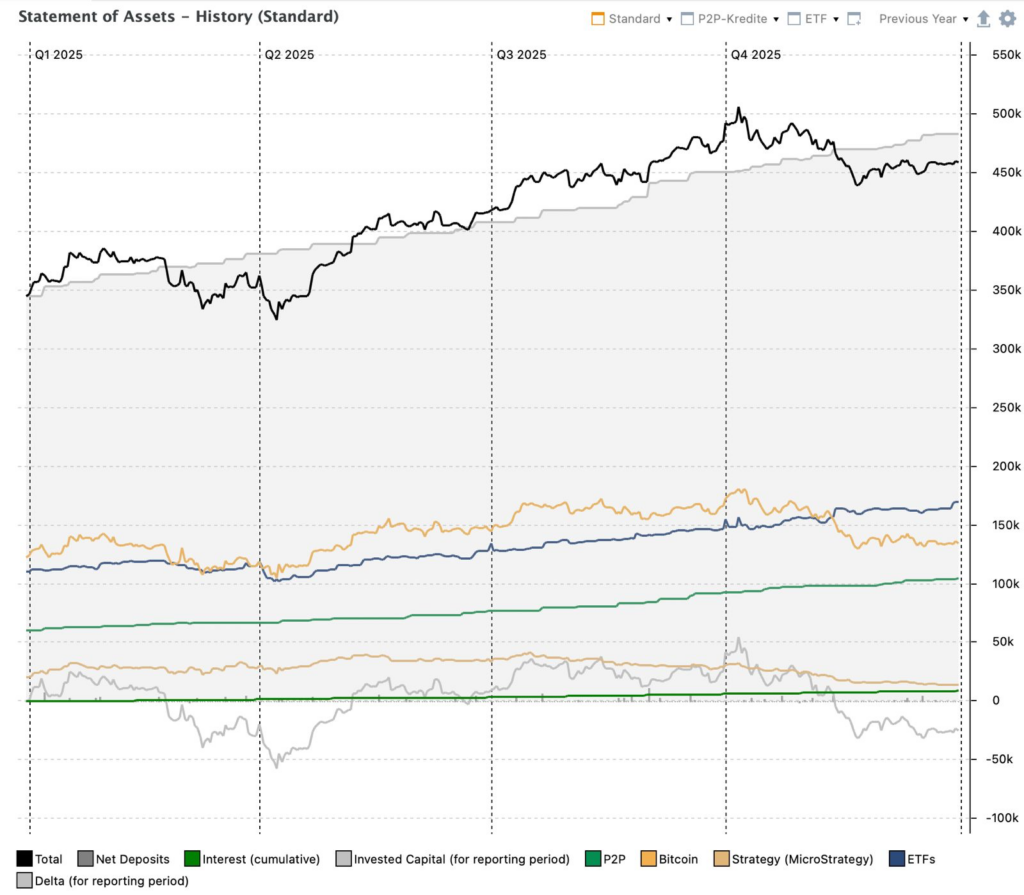
However, with my current portfolio value of just under €500,000, I have reached my interim target for the time being.

The following table provides you with an overview of my investments over the past few years, as well as the performance of my portfolio.
Overview: Monthly investments and portfolio performance 2021–2025
| Year | Monthly investment | Total assets |
| by 2021 | 1.000-2.000 € | 19.000 € |
| 2022 | 5.800 € | 70.200 € |
| 2023 | 3.400 € | 122.000 € |
| 2024 | 14.250 € | 347.000 € |
| 2025 | 11.500 € | 462.000 € |
We now offer the Northern Finance website, including videos, in Spanish and many other languages, which automatically expands my potential market.

If you’re currently unable to earn any more, it’s certainly important to start by cutting back on your spending. However, as a second step, you should definitely try to increase your income.
There are various ways to achieve this:
- thanks to a higher income from their main job
- a part-time job
- or the move towards self-employment
Being self-employed allows me to invest 60–70% of my monthly income, which currently amounts to around €10,000 a month.
What’s more, the sooner you start incorporating frugalism into your life, the quicker you’ll achieve your financial goals and financial freedom. It’s worth looking into the different ways to invest, such as the 10 best ETFs or the 10 best value investments.
Like any lifestyle, frugalism isn’t all advantages. It’s important to understand the downsides too before embarking on a frugal lifestyle. Let’s take a look at the pros and cons of frugalism to round things off.
The Pros and Cons of Frugalism: Are Frugalists Always Happier?
Frugalists not only enjoy the benefits of this lifestyle, but also frequently face some of the drawbacks that come with living very frugally. Let’s take a closer look at the three biggest pros and cons.
3 Pros and cons of frugalism at a glance:
| Advantages | Disadvantages |
| Financial independence: By living frugally and investing consistently, you can grow your wealth and reduce your reliance on your income or job. | Restrictions in everyday life: Living a very frugal life can lead to a decline in quality of life, as one consciously forgoes certain comforts, activities and experiences. |
| Reduced stress & greater security: As your wealth grows, so does your sense of security. You build up savings that reduce your financial stress. | Social pressure: A very frugal lifestyle can lead to restrictions in one’s social life or be met with a lack of understanding from friends and family. |
| A mindful lifestyle: Frugalists consume only the bare essentials. This inevitably leads to a mindful lifestyle and less excess. | Too much focus on money: Focusing too much on money and saving can mean that personal goals are no longer prioritised. |
Tips for living frugally:
- Save At the start of your frugalism journey, save as much as you can. Even if it’s only €10 a month. It’s much more important that you get into the habit of saving
- Invest in your own abilities. This is how you increase your potential to earn more money and grow your investments. And that is the real key to achieving financial freedom.
Investments always involve the risk of loss. The value of your investments
can go up or down. The forecast or past performance is no guarantee or
prediction of future results.
Do your own research or seek financial advice before making any invest-
ments. The WELCOME promotion is subject to Terms and Conditions. Gift
Shares are allocated randomly from a selection of eligible stocks, with high-
er-value shares awarded less frequently.
Conclusion: Frugal living and making sacrifices early on have paid off
My journey into frugal living began more than 10 years ago. Back then, I decided to live frugally in order to achieve my goal of financial freedom as soon as possible. To do this, I not only cut my spending to a minimum, but also increased my income.
The biggest advantage I gained from this was setting up my own company, Northern Finance. This allowed me to increase my monthly investments year after year without having to raise my standard of living at the same time. That early discipline has more than paid off for me.
After 10 years, my portfolio has now grown to almost €500,000. The time has come for me to take my foot off the gas. I’m now treating myself to more luxuries, even though this feels unusual for me as a former frugalist. Frugalism put me in the right mindset to lay the foundations for my current wealth.
FAQ: How do you get started with frugal living?

