


Do you want to save for your retirement in good time, or invest money to fulfil your dreams, such as buying your own home? There are plenty of reasons why you might want to grow your money, but what options are available, and which ones are best suited to you? In this article, we’ll show you what investment options are out there, why it’s worth investing, and what tips you should definitely bear in mind if you’re a beginner.
In brief:
- In this article, we’ll show you the reasons why you should start investing your assets
- We’ll also show you some of the best-known ways to invest and grow your wealth
- Are you a beginner who’s just starting to get to grips with finance and investing? If so, you should definitely bear these tips in mind to avoid making mistakes
Why should I invest my money?
In this section, we’ll explore why it might actually be worth your while to start growing your money and investing. After all, investing does take effort! First, you need to find out what options are available, weigh up the pros and cons, and then put your plans into action. So why is it still worth it?
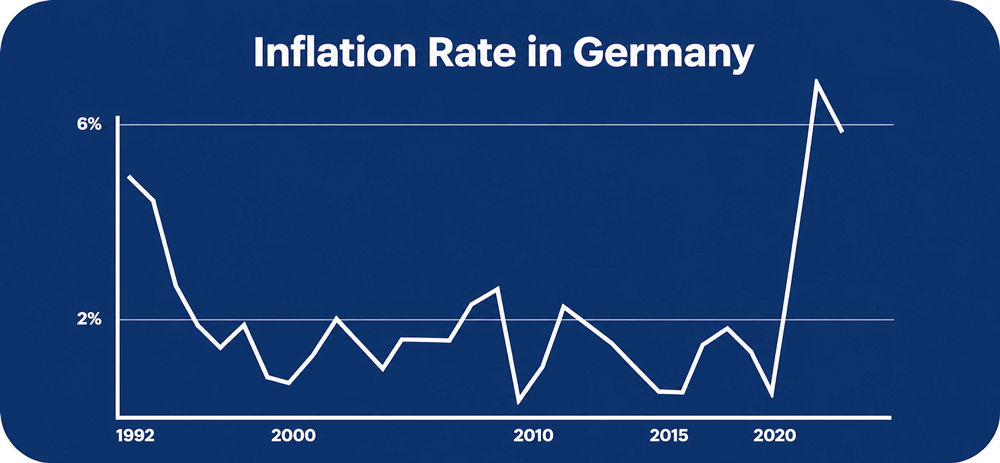
Inflation erodes the value of your money
One characteristic of a market economy is that prices for services and products fluctuate, which may be linked to various factors. When periods occur in which there is a general rise in prices, this is referred to as inflation.
The inflation rate describes the percentage change in the consumer price index compared with that of the previous year. This can be measured by using a notional basket of goods as a basis. The basket contains the goods and services that an average household purchases over the course of a year.
The role of central banks is to keep this price level stable. The aim is to achieve a consistently moderate rate of inflation of less than 2 per cent, although this cannot always be guaranteed.
The opposite of inflation is what is known as deflation, which involves a general fall in prices and can have negative consequences for a country’s economy. During a severe period of deflation, companies must respond accordingly; this may involve cutting wages, reducing production or making staff redundant.
Attention!
But what negative consequences do high inflation rates have for households, and why can investing help? Rising prices mean that people can buy fewer and fewer goods and services for the same amount of money. As a result, your wealth loses value over time.
Traditional investment products such as building society savings plans or savings accounts generate very little interest. Nor will this approach enable you to keep pace with inflation. This is where investments offering attractive potential returns come in, helping to protect your wealth against inflation.
Start early, reap the rewards – make the most of compound interest
The power of compound interest is an excellent way to grow your wealth. Put simply, it is ‘interest on interest’. In other words, it refers to interest earned on interest that has already been earned. Once you have made a profit and reinvested it, it will continue to generate further interest over the entire subsequent period.
- This leads to exponential growth – in other words, an ever-increasing rise in your wealth
- This is one of the most important investment instruments
- With many investment schemes, you have the option of withdrawing your profits or reinvesting them
- If you want to make the most of this effect, it’s a good idea to reinvest any profits you make
Other factors relate to the extent to which you can take advantage of compound interest. The rate of return on the investment also plays a role. The higher the rate of return, the greater the growth.
One factor that should not be underestimated is the investment horizon of your investment. A long investment horizon can ensure that the capital you have invested grows at a disproportionately high rate. This shows just how important it is to start growing your money as early as possible by investing it.
With some asset classes, you have the option of receiving interest either annually or more frequently during the year. Annual interest is usually paid once at the end of the year. Interest paid more frequently during the year is paid, for example, quarterly or half-yearly, i.e. several times a year. If you have the choice, you should opt for the latter, as compound interest can have a greater effect because the sum on which interest is calculated is higher.
Investing today is more flexible than ever before. Thanks to digitalisation, anyone can invest using their mobile phone or computer. With many investment products, the minimum investment amounts are very low, making it possible for anyone to start investing early on. This is often possible from as little as one euro a month, so that everyone can get involved and benefit from compound interest.

Achieving financial goals
There are numerous goals that can only be achieved if the financial circumstances are right:
- Financing a home
- Supporting the family financially
- Planning ahead to ensure a worry-free retirement
- Investing so that your own children have a financial cushion for their education, university studies or driving licence
- Build up a fortune so that you’ll have to work less later on or can retire earlier
This selection shows just how important it is to focus on your own financial goals. Investing is a very effective way of doing this. If you invest your assets and benefit from returns, you can achieve and realise these goals much more quickly and easily.
There are other aspects to consider as well. Anyone looking into financial goals and investing cannot avoid considering other financial matters. These include one’s own expenditure and one’s own salary.
As your knowledge grows, you’ll learn to take responsibility for your finances and your future. You’ll keep track of your spending, identify ways to save, reassess your priorities and, in this way, achieve your goals step by step.
In the long term, this approach will help you draw up a plan setting out how much money you need, what your specific goals are, and the possible ways to achieve them. A plan like this can give you peace of mind, allowing you to look to the future with optimism, knowing that you have everything under control.
Investing made easy
Another reason to invest is that today you have more opportunities than ever before. On the internet, you’ll find plenty of options for learning more about finance and investing. You can benefit from the experience that other people have gained over the years and are keen to share with you.
- It is important to scrutinise and verify the source
- You should be wary of providers who claim to show you how to “get rich quick”
- They often just want to persuade their customers to invest in their expensive courses
- Look out for impartial providers who inform you about the pros and cons and do not try to pressure you into buying anything
Digitalisation has further transformed the way we invest. In the past, it was much more difficult to invest one’s assets, and not everyone was able to do so. Today, anyone can invest and build up their wealth over the long term.
All you need is a securities account with a bank or a broker. You then enter your personal details. You’ll often need to verify this account using an ID card or passport – and that’s it: you’ll have access to a wide range of investment options.
The low minimum investment amounts are a particular advantage. This means you can start investing early and don’t have to worry if you don’t currently have much money to invest. If you start early, you’ll be able to benefit from the power of compound interest sooner, gain more experience and make fewer mistakes when you have more capital to invest later on.
You can use these methods to grow your money
Now that we’ve looked at the reasons why it makes sense to invest, the question arises: what can you invest in, and which asset classes offer you the best opportunities and suit your individual circumstances?
The “classics”: fixed-term savings account, instant-access savings account, current account
Fixed-term savings accounts and instant-access savings accounts are very secure investment options that are certainly suitable for certain purposes, even though they currently offer very little interest. Below, we look at the differences between these two types of investment.
A fixed-term deposit account is tied to a fixed period. You can choose this period before investing, and then your money is tied up for that duration. In return, the bank pays you a fixed rate of interest, which is paid out to you once the pre-agreed period has expired.
If it’s important to you to always have access to your money, a call money account is a better option for you, as you aren’t tied to a specific term. Here, you can invest your money at short notice and earn call money interest on the amount invested. You don’t have to adhere to any notice periods, but instead enjoy a high degree of flexibility.
Good to know:
A current account is a useful addition to these two options, as it is ideal for day-to-day banking transactions. It offers you maximum flexibility, although it pays little or no interest.
A call money account, for example, is ideal for providing a financial buffer in case you need a sum of money unexpectedly. A fixed-term deposit account, on the other hand, is suitable for capital that you do not necessarily need at the moment and wish to invest profitably for shorter periods. You cannot set up bank transfers or standing orders via these accounts.
Attractive potential returns from shares
If you decide to buy a share, you acquire a stake in the relevant company and thereby become a co-owner. The fundamental aim is to profit from the increase in the value of the share. Investors aim to buy a share and sell it again at a later date for a higher price.
- In addition, there is the opportunity to benefit from dividends
- If a company makes a profit, it may decide to pay this out to its shareholders in the form of dividends
- This is not a requirement, but there are companies that are known for paying regular dividends
The amount of these dividends and whether they will be paid will be decided at the Annual General Meeting. Some investors follow a dividend strategy and buy shares in what are known as ‘dividend kings’. These are companies known for paying out particularly high dividends. Have a read of my articles on top dividend shares for more on this
Good to know:
Unlike traditional investments, shares offer the potential for attractive returns and are an important component of a portfolio’s return strategy. These higher potential returns come with risks. You’ll find out what options you have for reducing these risks in the final section of this article.
One of these potential risks is a lack of diversification. If you invest your capital in just one share and the company goes into insolvency, you will lose your money. However, if you spread it across many different companies, you can ensure that the risk is spread appropriately – this is known as diversification. You don’t necessarily have to buy lots of individual shares to achieve this; there’s an easier way!
Higher returns and greater security? ETFs for building wealth!
If you don’t want to invest in individual shares, you can invest in equity funds. So-called ETFs, or exchange-traded funds, track an index, such as the DAX. An ETF tracking the DAX therefore invests in Germany’s 40 largest companies through a single security.
This is a passive form of investment, which means there is no fund manager. Fund managers aim to achieve the highest possible return by actively managing the fund’s composition.
- In practice, however, it is rarely possible to beat the market and achieve excess returns over long periods
- Instead, actively managed funds are often expensive, as the fund manager has to be paid
With a passive ETF, you don’t have these problems: the composition is already fixed, making it a cost-effective form of investment. Thanks to the high level of diversification, the risks are significantly lower than with shares.
Good to know:
An ETF tracking the MSCI World Index, for example, comprises 1,600 companies worldwide. With just a single security, you can invest in a large number of companies from different countries and sectors, thereby reducing your risk.
Want more planning? Invest in bonds
Bonds are fixed-income securities. They have a predetermined maturity and interest rate, and therefore allow you to plan more effectively than, for example, shares. However, they offer fewer opportunities for returns.
If you opt for German government bonds, this is a very safe investment with low potential returns. If you invest in a bond issued by another country that promises very high potential returns, the investment can be very risky. The so-called credit rating helps you to assess the risk of the bond realistically. A high credit rating indicates a safe investment; there is a high probability that the issuer will repay the principal, including interest.
Good to know:
Bonds are issued, for example, by countries, banks or companies. The risks involved can vary considerably.
Plenty of opportunities for investing in commodities
Normally, it is rare for investors to invest directly in commodities. One example of this is gold, which some investors store physically in a bank or in their own safe. It is more common to invest indirectly, for example via a commodity ETC. ETC stands for Exchange-Traded Commodities.
These track the performance of specific commodity classes. This allows you to invest in commodities easily without having to hold them yourself. You stand to benefit if the value of a commodity rises. However, investments in commodities are sometimes subject to significant price fluctuations, which can lead to losses.
Lending between private individuals – P2P lending
For traditional loans, you need a bank, and the process often involves a great deal of time and red tape. P2P lending is a relatively new asset class that enables lending between two private individuals. P2P stands for ‘peer-to-peer’.
So-called P2P platforms act as intermediaries. On these platforms, you can search for investors for a loan or become a lender yourself and earn interest.
Good to know:
One advantage for investors is that it is easy to invest in a wide range of loans and to benefit from the potential for high returns. Furthermore, investors can support private projects.
However, this does involve risks, foremost among which is the risk of default. A borrower may be unable or unwilling to make repayments. To mitigate this risk, care should be taken to ensure sufficient diversification so that the risk is spread across different loans.
Furthermore, P2P platforms provide credit ratings designed to make trading more transparent and secure for investors. These credit ratings enable investors to assess the level of risk associated with a loan.
- However, the platforms are still relatively new
- They do not yet have much experience, which is why creditworthiness may sometimes be assessed incorrectly
- It is advisable to read any information about the loan with a critical eye
- It can also help if you spread your assets across different platforms

Benefiting from property
There are many different ways in which you can make a profit from property. Of course, one option is to own your own property. A property can be used as your own home and sold at a later date once its value has increased.
It is also a good idea to let out property and benefit from the rental income. However, this also involves other costs, such as repair costs, administration and effort. Furthermore, income varies greatly depending on the region in question.
Even investors who are currently unable or unwilling to buy their own property can still benefit from the property market. Property funds offer one such option:
- Open-ended property funds: These operate on an ongoing basis, allowing you to invest in a wide range of properties
- Closed-end property funds: Investments are made in a predetermined number of specific properties. Once the required amount has been raised, the funds close.
Another option is REITs, or Real Estate Investment Trusts. These are global corporations that own or manage their own property. They distribute at least 90 per cent of their profits to investors. Find out more about property shares here.
Good to know:
Anyone can invest in the property market, even if they are currently unable to benefit from owning their own property. Property funds, REITs and property ETFs offer alternatives.
How to grow your money for beginners – these 5 tips will help you!
It can be a bit overwhelming to get to grips with finance and investing for the first time. That’s why we’ve set out some important tips below that you should bear in mind.
1. Setting goals: What do I want?
This goal may sound trivial, but it is absolutely essential. Only when you know exactly what you want will you know how much you need to achieve it. This knowledge will help you choose the right investment and strategy. Only by giving these questions careful consideration can you draw up a plan and pursue your goals consistently.
For example, ask yourself questions like these to help you define your objectives and, in turn, your strategy:
- Why do I actually need the wealth I’m working towards?
- Could other financial goals get in the way? Do I want to buy a house, have children, or save for my pension?
- How much do I need to achieve this goal?
- When will I need the funds, and how many years do I have left?
- Do I want to make a one-off investment or save a bit each month?
- Are my finances stable, or is there still some uncertainty at the moment?
- Will my monthly expenses be lower or higher in the future?
2. Savings rate and savings potential
There are various ways to invest your money: you may have inherited some money and now want to invest it. Alternatively, you may still be a student, not have much to spare, but still want to start investing. You might be wondering whether you should make a one-off investment or set up a savings plan.
If you already have a substantial amount of capital at your disposal, a single investment might be worthwhile for you. That way, the entire sum can work directly for you and generate interest.
- If, on the other hand, your aim is to save regularly – perhaps in small amounts – a savings plan is a better option
- To work out your savings rate, you should take a close look at the goals you’ve set yourself
- If you know how much you need and by when you need it, you’ll know your savings rate
You could also take a closer look at where your money is currently going and what your expenses are. This will help you identify areas where you can save money and further increase your savings rate. Examples include finding cheaper subscriptions or cancelling contracts that you no longer use enough.
3. The basics: building up a nest egg and paying off debts
Imagine you’ve spent a long time researching shares or ETFs, drawn up a detailed plan to provide for your retirement, and proudly invested your entire savings – and suddenly you need an expensive repair for your car! So what now?
To prevent this scenario from occurring and to avoid having to sell shares or fund units unexpectedly, every investor should set aside a nest egg. This serves as a financial buffer against any unexpected expenses. Nobody can protect themselves against every possible cost.
- As a general rule, single people should save up a nest egg equivalent to two to three months’ net salary before they start investing
- The situation is more complex for families, as unforeseen costs can also arise in relation to children
- It is advisable to have a nest egg equivalent to six net monthly salaries
Your emergency fund should be safe and easily accessible, so that you can get at it at any time. A call money account is therefore a good way to keep this financial cushion safe. If you haven’t built up this cushion yet, you should wait a while before investing.
The same applies to debt. If, for example, you have an expensive loan, you should pay it off first before you start investing. Interest on loans is usually quite high and stands in the way of building up your wealth.
4. What are my priorities? – The magic triangle of investing
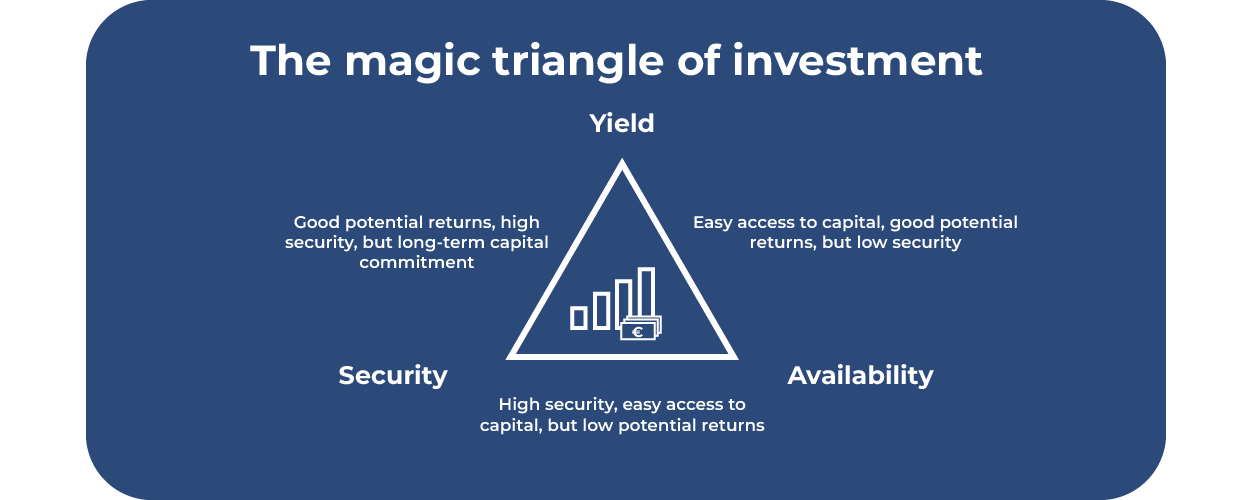
The ‘magic triangle’ of investment is a model that can be used to illustrate the advantages and disadvantages of an investment. In principle, every asset class and its characteristics can be explained in terms of three aspects: security, liquidity and return.
- These are the three fundamental objectives that an investor seeks to achieve through an investment
- However, it is never possible to cover all three characteristics with just one system
- Anyone who places great importance on high returns and liquidity will have to compromise on security
- On the other hand, those who value security and liquidity are unlikely to achieve any return
Security refers to the level of risk an investor faces of losing their capital when investing in this asset class. No investment offers complete security, but investments such as instant-access savings accounts or German government bonds are very secure.
Another consideration is the liquidity of an investment. This refers to how easily you can access the funds you have invested at short notice. With a call money account, you can access your funds very quickly; with a fixed-term deposit account, for example, you cannot, as it is tied to a specific term.
Return refers to the profits you can make from a particular type of investment. If you prioritise returns, your investment horizon usually plays an important role. Investments that offer high returns tend to come with lower liquidity or security, such as shares.
5. Risk spreading & diversification
Investing in a single stock always carries a degree of risk. That is why ensuring sufficient diversification is one of the most important aspects of investing. Consequently, you should never invest your entire portfolio in just one or a few shares.
However, diversification isn’t just about the number of securities you hold. You should also invest in different types of financial products. These carry different levels of risk. You should therefore, for example, invest part of your portfolio in shares, bonds and a fixed-term deposit account, so that the various advantages and disadvantages can balance each other out.
- It is also risky to invest your entire fortune in just one country
- When discussing ETFs, we mentioned the DAX index
- This means your wealth would be entirely dependent on developments within a single country
- However, a country may experience crises, such as political problems, an economic crisis or a natural disaster, which could affect your investment
Good to know:
If you ensure that your risks are sufficiently diversified, underperforming parts of your portfolio can offset each other. Invest in different asset classes, countries and sectors to increase the security of your portfolio.
Another aspect is sector diversification. It is impossible to predict with certainty how certain sectors will perform, which is why you should not invest your entire portfolio in a single sector. Instead, invest across a wide range of sectors to increase the security of your portfolio.

Conclusion: How to grow your money – here’s how!
To sum up, in this article we have shown you how important it is to invest. This way, you can offset inflation, achieve your financial goals efficiently and benefit from the power of compound interest.
We have also outlined a number of investment options for you. All asset classes have different advantages and disadvantages, so you should first take a close look at your goals, wishes and priorities, and then decide which investment best suits your needs.
We’ve also given you some basic tips that might help if you’re new to managing your finances. The most important thing is to build up a cash reserve, pay off your debts first and ensure your investments are sufficiently diversified to increase security. Find out more here.
FAQ – Frequently asked questions

