
Loanch reviews: Interest rates of up to 16% | €2,500 invested

Every year, new P2P platforms are launched that enable investments in the Baltic states or Eastern Europe. Loanch offers a lucrative alternative: personal loans from Asia that yield up to 16% interest!
I’ve had the chance to experience this new player in the P2P market first-hand and have already invested €2,500. In this review, I’ll show you who’s behind the new platform, what opportunities and risks are involved, and what you should bear in mind when investing.
In brief:
- Loanch is a fairly young P2P provider that allows you to invest in personal lending in Indonesia and Malaysia and earn up to 16% interest.
- The company was founded by Nik Sinikis, who has extensive experience in the world of technology and finance.
- The platform is currently experiencing strong growth, probably thanks to the attractive interest rates and good guarantees offered.
- I see excellent opportunities in the interesting Asian market. Of course, there are also some risks.
- For me personally, Loanch is currently a real “cash cow” — hence the cow in the cover picture 😜
What exactly is the P2P Loanch platform?
A look at my comparison of P2P loans shows that many platforms offer attractive interest rates for your money. In this way you finance loans to individuals or businesses. These almost always come from Baltic countries, Eastern Europe and sometimes from countries like Spain or, in the case of Maclear, even Switzerland.
A new player has recently appeared with Loanch that is opening up a hitherto often overlooked market-Southeast Asia! Loans from Indonesia and Malaysia are currently available for investment. Both nations have large populations (Indonesia is home to over 280 million people) and strong economic growth.

- Strong growth is accompanied by strong demand for quick and easy loans.
- Credit intermediaries such as Ammana and Tambadana grant precisely this type of loan.
- To enable further growth, these companies are also refinancing their loans through the Loanch platform.
- Private investors like you and me can invest there and make money available for loans.
- In return, we receive most of the interest: currently up to 16% per year!

The company was founded back in 2022, but it took some time to build the platform. In 2024, however, it was finally able to launch and welcome its first investors.
Since then, it has experienced dramatic growth: Within just 12 months, Loanch was able to scale its loan portfolio from around €6 million to just under €30 million! This now generates a profit of over €1 million per month.
Here are the most important facts about Loanch:
| Foundation | 2022 |
| Company headquarters: | Budapest, Hungary |
| Management: | CEO Nik Sinikis (founder) |
| Total investment: | 25 million euros |
| Regulated: | Unregulated platform, lenders are regulated |
| Annual report: | No annual report is available for Loanch; annual reports are available for credit intermediaries. |
| Investors: | more than14,500 users |
| Yield: | Up to 16% on P2P loans |
| Money-back guarantee: | Available, effective after 30 days |
| Minimum investment amount: | 10 EUR |
| Automatic investment: | Yes |
| The secondary market: | No |
| Tax certificate: | Yes |
| Bonus programmes: | 1% extra return by registering via my link |
Management
Loanch was conceived and founded by Nik Sinickis. The Latvian engineer holds a degree in Business Finance and has extensive experience in the economic and financial sectors. He has also been an active P2P investor himself for many years.
Until recently, Sinickis was CEO and held the majority of the company’s shares, meaning he had “skin in the game” and therefore a strong interest in Loanch’s success. The reins are now in the hands of Przemysław Paweł Januszaniec, who currently heads the company.
The managing director of Tambadana, one of the platform’s loan originators, is Harold Chen. I interviewed him and Fingular COO Alexander Naumov during my visit to the site. You can find the full interview here.
Another major investor is the Fingular Group, which recently secured €10 million in funding via the private debt platform Kilde. The interest rates paid by Fingular for this range between 14% and 15%.
Fingular’s manager, Maxim Chernushchenko, is well known in the P2P world, as his lending company “Cashwagon” suffered heavy defaults on the P2P marketplace Mintos.
Chernushchenko’s reputation has taken a serious hit, but his successes at Fingular speak for themselves – in any case, he brings extensive experience in the field of personal loans to the table.
Is it still worth using Mintos? More information in my review on Mintos!
The rest of the Loanch team consists of approximately 20 employees. The management team includes the following key members:
- Antons Lukjanenko: Human resources expert with extensive experience in the technology and finance sectors, gained through his work with large technology groups. He is responsible for investor relations.
- Jakub Černík (COO): Certified anti-money laundering specialist, she has previously worked for renowned companies such as PayPal and Western Union. Among other things, she is responsible for the Know Your Customer process, ensuring that Loanch meets all legal requirements.
Loanch business model
The business model of the P2P platform is easy to explain:
- Credit intermediaries, currently only Ammana and Tambadana, grant loans to private individuals. The latter pay very high interest rates.
- Through Loanch, we can provide the money needed for these loans, enabling Ammana and Tambadana to refinance themselves.
- The largest portion of the interest paid goes to us, the investors. Credit brokers also benefit from this arrangement.
- Loanch also receives a small percentage of this interest on each loan financed.
The fact that this concept works very well is proven by other providers who have been successfully applying it for years. In my ranking of P2P lending, for example, you will find numerous platforms that generate millions in revenue this way!
In addition, there is some news on the horizon at Loanch that is likely to further pique investors’ interest: loans are soon to be granted to Malaysian civil servants. In my view, this is certainly a positive development, as such loans are generally considered to be virtually risk-free.
This model is intended to work as follows:
- Loanch grants a loan to a civil servant
- This is then repaid directly via their salary
A Sharia-compliant loan has also been added to Loanch’s product portfolio – something that is particularly important for people in predominantly Muslim countries such as Malaysia.
Loanch has this to say on the matter: “To give you an idea of the scale: We currently process around 200 transactions a day with our Sharia-compliant product. However, we only offer it to our very best customers.
We are testing it initially to see how the market reacts. After that, we will launch a comprehensive digital marketing campaign.”
Interestingly – and presumably to the surprise of many investors – Loanch expects this new product to deliver similar profitability.
How registration with bonuses works
Would you like to try Loanch and earn up to 16% per year? Nothing could be easier! The registration process is very simple and only takes a few minutes!
To do this, you will need:
- An identity card, passport or residence permit
- A valid email address
- A mobile phone number
- A smartphone with an active Internet connection
- A bank account (not required for registration, but for depositing money at a later date)
Detailed instructions + guaranteed bonus
Start by clicking on my registration link. This will give you 1% extra interest for the first 90 days, an opportunity not to be missed!
- Then click on ‘Register’. In the next window, enter your first name and surname (please note: these must match the information on your identity document!).

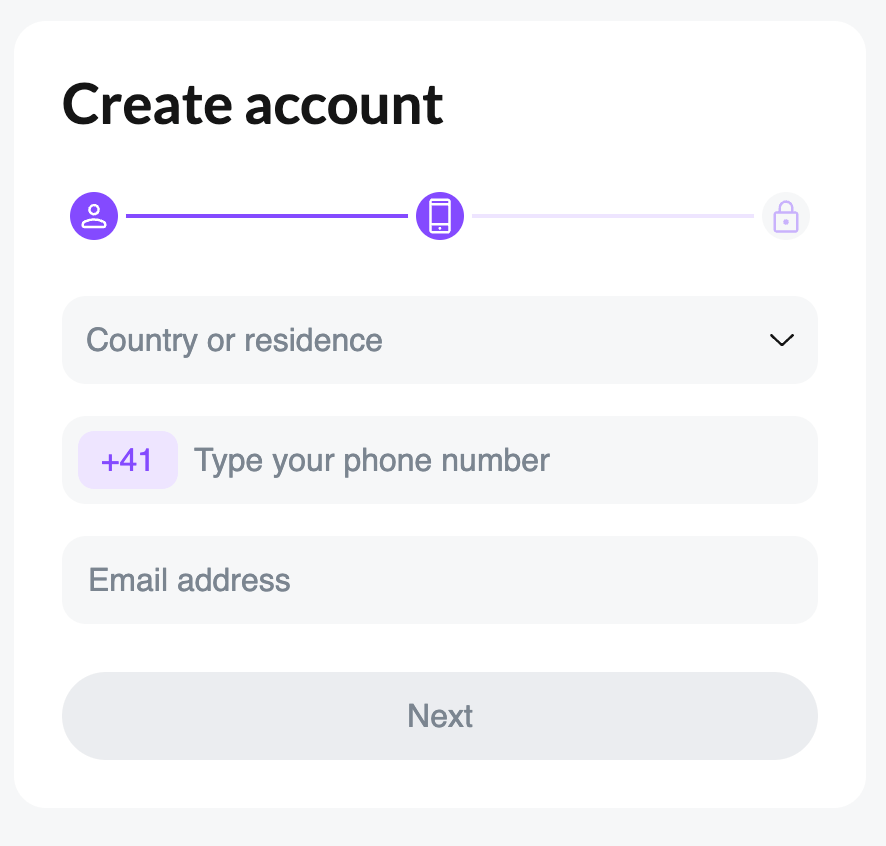
- Now enter your country, phone number and email address. You will need to confirm these later, so make sure you enter a real phone number and email address.
Good to know:
If you have selected English as your language you will be able to see the countries. You can switch to another language in another step.
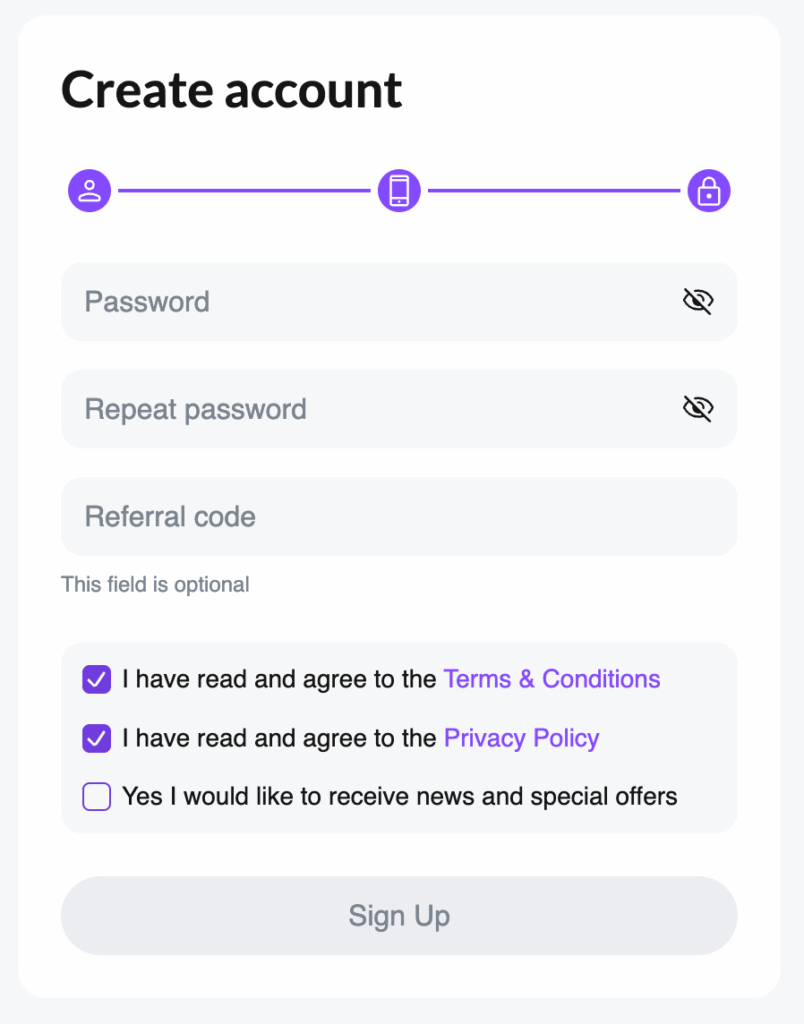
- In the third step, you still need to create a password:
- Verify your email address: You will find an email from Loanch in your inbox. Click on the confirmation link. You will be redirected to the verification page.

- Now you need to confirm your identity. If you have experience with other P2P platforms, you know how this works: for legal reasons, Loanch must ensure that you are who you say you are.
The P2P platform relies on the well-known provider Veriff. You can verify your identity using your smartphone (if you started the registration process on a computer, you will receive a QR code).
In my experience, this happens automatically, without the need to contact customer service.
After a few seconds, this process will be complete and your account will be activated. You will now be welcomed by the clear Loanch dashboard:

Deposit money, invest and withdraw profits
You can deposit money below under ‘Top up’ in the menu on the left. In my experience, a bank transfer only takes two working days. Once you have received the money, you can start investing right away.
This can be done either by manually selecting the credits or automatically using the ‘Autoinvest’ function. The minimum amount is €10 per credit in both cases.
If you wish to withdraw your money again at a later date, simply click on ‘Withdrawals’. Again, you will need to wait approximately two working days for the money to be credited to your account.
So far, my experience with Loanch has been positive: everything works perfectly and the website is clear and intuitive.
My experience with Loanch: how it works, fees and returns
I have only been active on Loanch for a few weeks, but thanks to my visit and interview with Tambadana, a credit broker, I have already been able to gain some interesting information.
Loanch does not charge any fees to investors. That’s great, but if you already have experience in the P2P sector, you know that this is the norm.
With the exception of Estateguru, none of the well-known P2P providers require anything from investors. This is one of the reasons why I reduced my capital there and invested it more in Fintown. To learn more, read my review of Fintown.
In terms of fees, Loanch is therefore able to compete with other platforms. Interest rates are also very attractive: depending on the project, they are 13.6% or 16% per annum!
In addition, sufficient credit is always available for investment, so that your money does not remain unused. These forced breaks produce what is known as ‘cash drag’:
- If sufficient loans are not available, you cannot invest all your money.
- The uninvested portion does not earn interest.
- Your overall return decreases because only part of your capital is working for you.
- You have to wait for new credits or invest larger amounts for each credit.
- However, higher sums increase the risk of aggregation and therefore your risk.
In my experience, this cash drag does not occur with Loanch. In the future, with a larger number of investors, the situation may change. At the moment, however, you do not need to worry.
My return: how I earn 16% interest
Loanch is still a relatively new platform, and I only signed up recently. To gain some initial experience, I initially invested ‘only’ €2,500. I proceeded as follows:
- I have selected only credits from user ‘Tambadana’ from Malaysia.
- All loans have a very short duration of 30 days.
- For this, I receive interest of 13.6% per year.
- Higher interest rates (up to 16%) would also have been possible, but would have required a longer term.

I chose Tambadana because I have already had the opportunity to meet this lender in person. His way of working and his professionalism convinced me, so I can invest here with complete peace of mind.
In the meantime, I have already received the first repayments and interest, and I can confirm that Loanch keeps its promises!
How does Auto-Invest work?
P2P platforms with short maturities usually have an automatic investment feature, and Loanch is no exception! It would be too laborious to manually select new loans several times a month. Furthermore, you would not reinvest your money immediately, thus losing out on returns.
Loanch’s automatic investment system is structured as follows:
- You can create a custom strategy or choose from two predefined methods.
- You can choose between ‘Long’ with loans up to 182 days in duration and an interest rate of 16%.
- The second option, ‘Short’, provides loans with a maximum duration of 32 days and an interest rate of 13.6%.
- In addition, you can also set your own parameters and independently choose the duration, interest rate and investment amount for each loan.
As soon as a loan is repaid and the interest is distributed, your money is immediately reinvested in the next loan. How to get the most out of it! This method should be the best choice for most investors:
- Short-term consumer loans do not vary greatly. Selecting them manually would make little sense. Loanch therefore only provides you with minimal information.
- This concept is very different from P2P platforms, where you invest in individual large-value loans that you should check out first. This is the case, for example, with LANDE’s agricultural loans. More information in my review of LANDE.
- If you have invested large sums in Loanch, manual selection involves a considerable amount of time and effort. In this case, the Auto-Invest feature is truly invaluable!

Good to know:
Loanch has set a maximum amount for automatic investments. You can invest a maximum of €10,000 in this way.
Loan risk: how dangerous is the P2P platform?
Sooner or later, all investors will face cases of insolvency or delays in repayments. In the case of P2P lending, these are simply part of the game, but they are easily offset by repayment guarantees and high interest rates.
Loanch is no exception! If a borrower is unable to repay the money, this does not result in any loss for you:
- The promoters Tambadana and Ammana, through whom the loans are granted, also arrange for the recovery of the funds.
- If the refund is 30 days late, Loanch’s money-back guarantee kicks in.
- The credit broker will now have to reimburse you from his own pocket.
- You will, of course, be paid any interest accrued during the period of delay.
In normal day-to-day operations, your investment is therefore secure, because in the event of default, the credit broker is obliged to refund your money. The companies will then naturally attempt to recover the money from the debtor through debt collection measures.
However, since you have already been paid, this procedure should not concern you too much. During my personal interview with Tambadana, I learned that the default rate was initially only 12% and has since fallen to 6%. It therefore appears that this is a profitable business.
Provisions for loan losses have risen from 9% in January 2025 to the current 12%. According to the company, this increase is due to the introduction of new regulatory requirements.
Due to these requirements, Loanch is no longer permitted to use certain debt collection strategies. For example, customers may only be contacted a limited number of times per day and per week. Consequently, the provisions have also been adjusted upwards.
Loanch’s experience with crises: how secure is Loanch?
Let us now turn to the significantly more serious danger: a severe crisis, a prolonged recession or similar problems. During the COVID crisis, for example, many investors had to realise that even safety mechanisms have their limits.
If too many borrowers become insolvent (for example, because they have lost their jobs due to a global pandemic), even a credit intermediary such as Tambadana or Ammana is at risk.
- In this case too, the refund guarantee applies and credit intermediaries must reimburse investors after 30 days of delay.
- Due to massive defaults and payments, the financial reserves of these credit companies are rapidly being depleted.
- In the event of a promoter’s insolvency, investors could lose part of their capital or even be left completely empty-handed.
In the past, most crises in the P2P world have been resolved acceptably. Investors generally recovered their capital, but they often had to be patient for a long time. In this case, Mintos investors faced long wait times-I still have outstanding payments too!
I assume that Loanch would also be able to overcome a crisis of this kind. Considering the attractive interest rates, I believe that this risk is acceptable. Furthermore, this risk can be minimised with one simple measure: diversification!
Spread your capital across multiple P2P platforms and you will greatly reduce the risk of incurring large losses in a crisis. In addition to Loanch, there are dozens of other P2P providers. In my ranking of P2P loans you will find the best candidates.
Loanch profit margin
The profit margin, also known as the EBIT margin, is a key indicator for assessing a company’s performance. It represents earnings before interest and taxes.
Loanch’s management report shows that this has fallen from 7% to 10% in spring 2025 to just 3% by the end of the year. Whilst this still amounts to just under €700,000 in profit per month, the margin is shrinking. Former CEO Harold Chen comments:
Quote from Chen: “I wouldn’t say that this reduces profitability. It’s more a case of the business maturing. So if we continue to grow at this pace, we will, in a sense, see a certain degree of margin compression.
The other point concerns the product structure: a large proportion of revenue is recognised right at the start. And the more customers we acquire who have a better risk profile, the more frequently they switch from lump-sum loans to instalment loans.”
The declining profit margin can therefore be explained by the fact that instalment loans generate the margin at the start of their term rather than at the end – even though the loans are repaid correctly.
The profit margin for the current year fluctuates between 4% and 7%, which corresponds to a monthly profit of around €1.1 million to €1.8 million.

I followed up with Chen and asked why costs were rising at a similar rate to turnover.
Quote from Chen: “I’d say that as we grew, we needed the resources to support that growth. A large part of this comes in the form of variable costs, as I mentioned earlier.
The other factor is staff. When we’re pressed for time, for example, we have to pay for overtime and weekend work. That all adds up.”
Chen also listed costs that have fallen over time, however. These include legal costs per contract and acquisition costs, which have fallen by as much as 30%.
Pros and cons + My opinion
My experience with Loanch is mainly based on conversations with credit brokers and an analysis of financial data. Given the company’s short history, I unfortunately cannot say much about the rest of its business. The following advantages and disadvantages have emerged so far:
| Advantages | Disadvantages |
| Very high interest rates of up to 16% | There is no experience yet with Loanch or credit intermediaries, as the companies are still relatively new. |
| Many receivables with very short maturities, less than 30 days, ensure high liquidity. | Lack of diversification: only two credit intermediaries, two countries and one type of credit (short-term consumer credit) |
| 30-day money-back guarantee | It is unclear how effective the safety mechanisms would be in a real crisis. |
| Simple and intuitive platform with automatic investment function. | There is no secondary market |
| Competent management team with experience in the P2P sector | The platform is not regulated and no annual report is available yet. |
| An interesting market (South-East Asia) ideal for diversifying existing P2P portfolios | |
| Excellent growth opportunities for Loanch and the credit companies represented therein | |
| The data available so far (growth, insolvency rate, etc.) is very positive. |
Regarding the fact that the annual financial statements for the entire group are still pending, Fingular COO Alexander Naumov told me the following:
Quote from Naumov: “We are currently moving towards a more consolidated group structure with a more institutional set-up. The audit is part of this process. I think that in future – probably later this year – consolidated and audited group reports could also be published.”
However, this is unlikely to make much difference to an investment decision. After all, if one invests directly in the Malaysian business, it is primarily the financial statements of this current company that matter – a company that is already financially self-sustaining”.
In my view, the publication of annual financial statements for the entire group is an important step towards giving investors greater certainty. I am curious to see whether the company’s forecasts will hold true.
Community experiences
Loanch is a very new platform with a track record that is still developing. For this reason, the community’s experiences have so far been limited.
There are currently only ten reviews on Trustpilot. Nevertheless, an initial sense of the platform’s reputation is already emerging within the Northern Finance community.
Some users are sceptical precisely because of Loanch’s short history. On the one hand, they highlight the platform’s dependence on the lender Tambadana; on the other, they also view the lack of a secondary market critically.

Nevertheless, some members of the community are curious to see how the platform will develop and can envisage adding Loanch to their portfolio as a diversifying investment.


For the time being, then, Loanch remains a platform that arouses both curiosity and caution among investors.
Alternative P2P platforms
Loanch offers short-term P2P lending and is therefore in the most competitive niche of the market! As a result, it faces numerous competitors:
1. Viainvest
Currently 13.3% interest on consumer loans, but with an excellent repayment track record: Viainvest has always been a rock-solid investment for investors, even during crises. This makes it easy to overlook the slightly lower interest rates and the longer loan terms.
2. Monefit Smartsaver
The provider Monefit takes the concept of highly liquid P2P lending to the extreme: there are no minimum terms or similar, and you can withdraw your money at any time! In return, you receive ‘only’ 7.25%, which is still much more than a comparable instant access savings account or similar products.

Taxation on Loanch
Profits from P2P investments are, of course, taxable. However, this often raises the question: Where do I have to pay tax? In many cases, the country in which the P2P platform is located already levies a withholding tax. You can then offset this against your flat-rate withholding tax.
With some other providers, this additional effort is not necessary and you can offset your profits directly in your country.
Fortunately, Loanch falls into the second category!
All you have to do is enter your income in your tax return.
You can see how much you have earned with Loanch in the ‘Account statement’ section on the left-hand side of your navigation bar.
If you have any questions about taxes on personal loans, please contact a specialist who is familiar with the subject of taxes.
Conclusion on my experience with Loanch: attractive interest rates and I invest
Is Loanch just another P2P platform where you can invest in short-term consumer loans? Not quite! This new platform, based in Croatia, offers microloans from South-East Asia, making it an excellent way to diversify your P2P portfolio. The interest rates, currently up to 16%, are also very attractive!
As a very new provider, it naturally lacks a track record, so there is a certain amount of risk involved. However, given the strong growth and high returns, I am willing to accept this – I have therefore already invested over €2,500 and will certainly increase this amount further.
A buy-back guarantee protects you against loan defaults, and an auto-invest feature makes investing easier. Apart from a secondary market (which is hardly necessary given the very short terms), it offers everything an investor could wish for.
My experiences with Loanch so far and my impression during the face-to-face meeting with credit broker Tambadana have been very positive. I believe that the new platform can become a benchmark in the P2P market and offer good opportunities to generate passive income with P2P!
FAQ – Frequently asked questions

