


The range of different ETFs on offer is currently wider than ever, so it’s easy to lose track of them all! That’s why we’re showing you how to identify the best ETFs and compare them effectively, so you can achieve the highest returns. With our tips, comparing ETFs won’t be such a struggle anymore.
In brief:
- On average, ETFs generate returns of between 7 and 8 per cent
- The range of ETFs is vast. There are over 10,000 ETFs worldwide (as of 2023)
- To find the ETF that’s right for you, you need to take various factors into account; some of these aren’t immediately obvious at first glance
ETF Overview: What makes this asset class so special
This post is not intended to be an article for beginners However, if you haven’t yet familiarised yourself sufficiently with this asset class, please feel free to read our blog articles on ETFs for beginners, where you’ll find all the key information on the subject.
ETFs are, in fact, among the most popular asset classes in the world. In recent years in particular, the number of ETFs under management worldwide has risen rapidly and steadily.
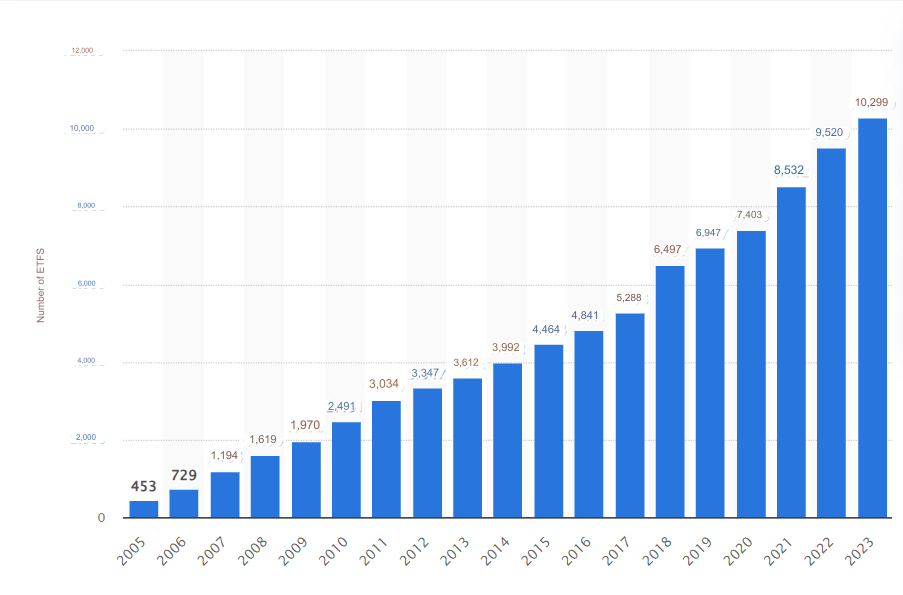
This results in a wide range of options, from which you, as an investor, now have to choose. But where does this huge popularity come from, particularly in recent years?
Low costs – higher returns
One of the most appealing advantages of ETFs is their low costs. After all, ETFs are ‘passively managed funds’. This means that no human intervention is required for the ETF to invest and trade. It automatically tracks various indices, such as the DAX or the MSCI World.
Unlike actively managed funds, there is therefore no fund manager to monitor and adjust investment decisions. As this management fee is no longer payable, there are often no significant costs left to pay. Here’s a look at the other fees you should be aware of:
| Cost type | Description | Cost centre |
| Transaction costs | Buying and selling fees / Custody account management fees | Custodian bank |
| Total Expense Ratio (TER) | These include administrative fees, the marketing budget and licence fees for the index | ETF providers |
| Spread & exchange fees | Difference between the bid and ask prices | Stock exchange |
With most providers and brokers, you can set up free ETF savings plans or pay only low transaction fees of €1–€2 per trade. However, this varies from broker to broker. Further down in this article, we’ll explain in detail what you need to look out for with the various brokers.
In addition to their low costs, ETFs generally offer high returns. On average, these stand at 7–8 per cent, far outperforming actively managed funds. This return is particularly important in times of rising inflation and the resulting loss of real purchasing power.
If high dividend yields are important to you, then I’d recommend our article on the best dividend ETFs.
Good to know:
If you’re unsure about the costs involved before buying an ETF: Before every purchase, your broker must provide you with two documents: the Key Information Document and the Cost Information Sheet. These set out all the key costs you can expect to incur (some of which are estimates based on future price trends). This way, you can check whether the costs meet your expectations before completing the purchase.
How to choose the best ETF for you
Now you know what makes ETFs such a special asset class. We’ve already covered the key features, so you should now have a good grasp of the subject. In the following section, we’ll provide you with the key figures and metrics you can use to distinguish between ‘good’ and ‘bad’ ETFs.
Please note that the figures given should not be the only factors influencing your decision. You should look into several ETFs and choose the one that best suits your personal circumstances.

Subjective criteria for comparing ETFs
We’re now going to show you exactly what matters when choosing ETFs. Depending on your investment objective or type of investment, these criteria will be of varying importance to you. We’ve also used the following points to compile our ETF rankings:
1. Whether the ETF is suitable for a savings plan
Of course, you’ll need to decide whether you want to invest your money via a savings plan or as a one-off investment. If you opt for the savings plan option, you must check with your broker to see which ETFs are eligible for a savings plan and which aren’t. This could have a significant impact on your decision.
2. Allocation of profits
As mentioned earlier, you should bear in mind whether the ETFs you are comparing are accumulation-type or distribution-type. An accumulation-type ETF makes sense particularly for long-term investments and retirement planning, whilst a distribution-type ETF is generally the better choice if your aim is to generate passive income.
3. The ETF’s focus
Every ETF is focused on a specific theme or objective. The best-known ETF is probably the MSCI World. It comprises the world’s most successful companies and is intended to be a “reflection of the global economy”. To this end, the ETF is invested across a wide variety of countries and sectors.
In addition, there are so-called “thematic ETFs”, such as hydrogen ETFs, which only include companies and assets from that particular sector or niche. This allows you to invest specifically in your preferred sectors, where you expect above-average returns.
4. Replication method
One evaluation criterion that is often overlooked is whether your ETF uses synthetic or physical replication. With synthetic replication, the index is tracked through a swap arrangement with a financial institution, which guarantees the ETF provider that it will deliver the specified return. With physical replication, on the other hand, the ETF actually invests in the securities that make up the index.
5. ETF providers
ETFs are offered by various major banks and fund management companies. When it comes to choosing one, it probably comes down to your personal preference: Which provider do you feel most comfortable with? Which one’s public image do you like best? Have you ever heard anything negative about certain companies? Here, too, you can compare ETFs and choose the one that suits you best.
Objective criteria for comparing ETFs
Objective comparison criteria are just as important. After all, you don’t want to invest in overpriced or inefficient ETFs. Here, too, we’ve summarised the key points for you:
1. Low ongoing costs (TER)
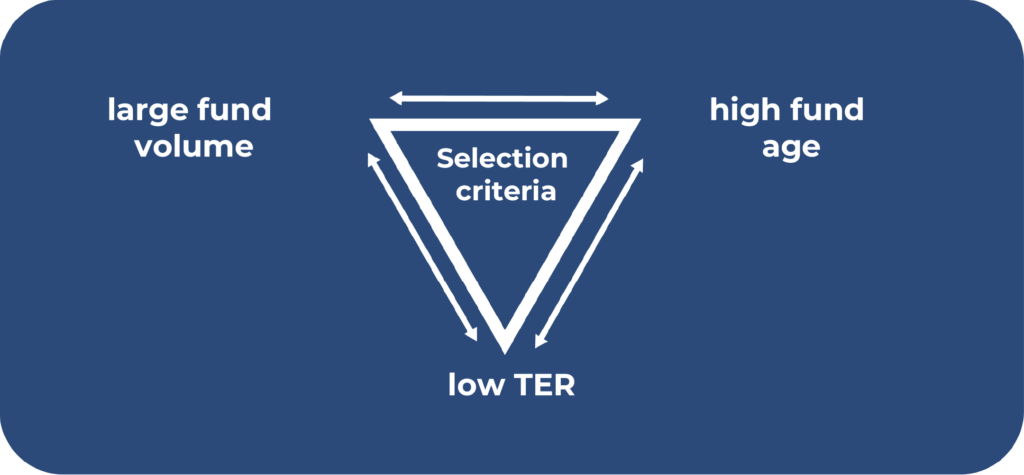
The ETF TER indicates your annual running costs as a percentage. These can vary from one ETF to another. You should always ensure that they do not exceed a reasonable limit. Typical figures range from 0.05% to 0.8%. You can find the TER in the fee schedule or via your broker.
2. Fund assets
The fund’s assets under management determine the ETF’s viability. If the assets under management remain too low over the long term, the fund management company may liquidate your chosen ETF. Make sure that your chosen fund has a minimum asset under management of 100 million euros.
3. Fund age
To make a sensible assessment, you should ensure that your ETF has been trading for more than a year – or, better still, for 3 to 5 years. This will enable you to make an informed judgement about the fund’s profitability. Some newer ETFs also run the risk of being closed down again.
A comparison of our top 5 ETFs
We’re now going to introduce you to five ETFs, all of which have been assessed and compared against the criteria listed above. Our selection is intended solely to serve as inspiration. We’ve focused on the ETFs that have delivered the best performance in recent years.
| Name | Savings plan | Allocation of profits | Replication method | providers | TER | Volume | Age | Performance over the last 5 years |
| Invesco Technology S&P US Select Sector UCITS ETF Acc | Yes | Acc | Synthetic | Invesco Investment Mangement | 0,14 % | $854.598.542 | 2009 | +143,9 % |
| iShares S&P 500 Information Technology Sector UCITS ETF USD (Acc) | Yes | Acc | Physical | BlackRock Asset Management | 0,24% | $6.792.895.935 | 2015 | +235 % |
| iShares Edge MSCI USA Multifactor UCITS ETF | Yes | Acc | Physical | BlackRock Asset Management | 0,35% | $78.517.324 | 2015 | + 74,52 % |
| Xtrackers MSCI World Momentum UE 1C | Yes | Acc | Physical | DWS Investment | 0,25 % | $1.213.513.090 | 2014 | + 88,9 % |
| iShares Edge MSCI World Momentum Factor UCITS ETF USD (Acc) | Yes | Acc | Physical | BlackRock Asset Management | 0,30% | $1.800.027.178 | 2014 | + 88,2 % |
ETF savings plan
You’re probably already aware of what an ETF savings plan is and how it works. As well as larger one-off investments, a savings plan can offer further benefits:
- You take advantage of the ETF’s price fluctuations: invest automatically, regardless of whether the price rises or falls. This way, you capitalise on both price dips and rises, thereby achieving an average return of 7–8%.
- You take your emotions out of the equation: by using an automated savings plan, you’re not trying to time the market. After all, at the end of the day, very few people manage to do that.

It all comes down to choosing the right broker
This comparison is not a substitute for our comprehensive ETF portfolio comparison. Nevertheless, we would like to compare the three cheapest neobrokers (Scalable Capital vs. Trade Republic vs. Freedom24) for you:
| Freedom 24 | Scalable Capital | Trade Republic | |
| Portfolio management | free of charge | free of charge | free of charge |
| Order charges | €2 + €0,02 (per share) | Gettext €0,99; XETRA €3,99 0,01% (min. €1,50) | LS Exchange 1€ |
| ETFs and share savings plans | not possible | free of charge | free of charge |
| Number of shares | 40.000 | 8.000 | 9.000 |
| Number of ETFs | 1.500 | 2.500 | 2.400 |
| Number of ETF savings plans | 0 | 2.500 | 1.900 |
| Starting bonus | Freedom24 Bonus Free shares worth €79 – €529 (until 30 April 2026) | No bonus available at present | No bonus available at present |
| Review | Review Fredoom 24 | Review Scalable Capital | Review Trade Republic |
Which of the three brokers you ultimately choose depends on your preferences. Personally, I prefer Freedom24 because this broker offers me the widest selection of trading venues at very low costs.

Investments always involve the risk of loss. The value of your investments
can go up or down. The forecast or past performance is no guarantee or
prediction of future results.
Do your own research or seek financial advice before making any invest-
ments. The WELCOME promotion is subject to Terms and Conditions. Gift
Shares are allocated randomly from a selection of eligible stocks, with high-
er-value shares awarded less frequently.
Conclusion: ETFs promise high returns
If your portfolio hasn’t been performing as well as you’d hoped so far, you should review your strategy or your choice of ETFs. By selecting them carefully and using the right comparison criteria, you can find out a great deal about the different ETFs, compare individual ETFs and choose the ones that best suit your investment strategy. After all, it’s this interplay that matters in the end. Your assets must be in line with your investment strategy!
Still want more? Find out all about the 10 best ETFs or get more ETF tips.
FAQ – Frequently asked questions about comparing ETFs

